Showing posts with label school. Show all posts

Tuesday, May 12, 2015

An Educational Day in Boston

A few weeks ago was my mom's annual trip to the East Coast.  This year I was able to meet her and her students for a short time--if only their trip hadn't been right before one of my final papers was due, I would have been able to stay with them for another day.  As it was, I was happy to see my mum, and I got to see some new and interesting things in Boston.

Too excited about seeing Mom to get much work done, I left on Monday afternoon, even though I knew they wouldn't be arriving at their hotel until 8 or 9 that night.  It rained the whole time I was on the turnpike, and there were plenty of people ignoring the new "wipers on, headlights on" law.  I ate pot roast in a diner somewhere around Quincy before heading on to the hotel; by that time it was getting dark, and, knowing that the destination was on a narrow peninsula, I had the distinct feeling that I was going to drive right off of the world and into the ocean.  That feeling wasn't lessened when I parked outside of the hotel, where, beyond the railing, the beach was invisible in the dark, but the white crests of the waves were moving out in the water.  It was also satisfying to think that the Bluebird had now gone almost completely from one coast to the other.

When they arrived and got settled in, Mom shared some chocolates she'd bought earlier that day at Ye Olde Pepper Candy Company in Salem.  The cordial cherry was especially delicious.

Tuesday started a bit gloomily, with somewhat foreboding weather.  That soon changed, though, and by the time we reached Boston (after a circuitous shuttle journey to the nearest T station and, for me, a big loop around Quincy attempting to find a place to park followed by a power-walk back to the station) the weather was practically perfect.  I'm sure the visitors may have thought it a little cool still, but I was comfortable walking around without a jacket for the first time in years a while.

The first stop we made was Fenway Park.  Though I'm by no means a baseball fan, I enjoyed visiting the park; it's part of American cultural life, and the tour revealed things most spectators there for a game wouldn't be able to see.  The tour took us through the stands and to the newest seats, behind the Green Monster in the outfield (from which the picture below was taken).  We were also able to go into the press box, the vantage point from which reporters watch the game.  The park as a whole struck me as fairly small for a major sports venue; unlike the one I'm most used to driving by back home, Fenway Park isn't surrounded by acres of parking lot, but by businesses.  The produce truck parked outside of a restaurant just outside of the park's gates added to the feel of the place and the sport as old-fashioned and part of the community, rather than just a commodified pastime. 

From there we made our way half a dozen subway stops and a few centuries back to the Old North Church.  On my previous visit, we'd gone into the sanctuary and heard a short presentation about the box pews, the organ, the clock, the angels, and of course the lanterns.  This time, though, we started by going into the tower.  Up the first flight of steps is a small room, all paneled in white-painted wood, lined on one wall with bookshelves and displaying a print of the church made (if I recall correctly) by Paul Revere, as well as two replica lanterns.  Then we ascended a second, even narrower and steeper staircase to the top of the brick portion of the tower; above is the wooden section that houses the bells.  The brick room is where the bell-ringers do their thing.  There, with the ropes looped overhead, safely out of reach from curious tourists, our guide told us about the bells and showed us a short video on how they're rung.  I liked the round windows, and the fact that they showed how thick the tower's walls are--they must be a good two feet of brick.  From the top of the church we descended to the bottom, to the basement crypt.  Portions of it are still used for internments today.  The first commander of the USS Constitution is buried there, as is Major John Pitcairn.  Walking through the crypt is a bit of a strange experience, as overhead you hear the creaking of floorboards from people in the church, the corridor is filled with pipes and bits of plaster are missing around some tombs, and, if you're taller than average, you have to do a lot of ducking.  We ended the tour inside the church, where I missed the opportunity to sit in the box Teddy Roosevelt sat in in 1912.


Since the marathon had been run the day before, the city was still dotted with people in brightly-colored jackets from the Athletic Association, or even with finishers' medals around their necks.  We saw the most of them between Old North Church and Quincy Market, where we ate lunch (expensive but filling calzones for Ma and me).  After our stop there we hurried to the Old South Meeting House, where the group had an appointment and where I left them.  I would rather have stayed than driven back to the west, but the only thing I dreaded more than the idea of leaving was the idea of leaving in rush hour traffic, so I said goodbye to my mother and went.  

By some fortuitous circumstance, my route from the Meeting House to the nearest T station took me by a graveyard.  It was across from a hotel and enclosed on three sides by tall buildings, some of which seemed to contain apartments--it hardly needs to be said that I would be thrilled to live somewhere overlooking a colonial cemetery--and I wasn't so pressed for time that I couldn't cruise through.  The plaque at the gates named it as the Granary Burying Ground, home to several leading personages in American history, including Benjamin Franklin's parents (theirs is the large while memorial in the center), the victims of the Boston Massacre, Samuel Adams, Mother Goose, Paul Revere, and John Hancock.  Many of the tombstones were well-carved and deeply, and are still quite legible for their age--if they're reproductions, then they're good ones.  I was glad to go, but I'll need to return to spend some more time there.

In Quincy I had a similar opportunity, since to get back to where I'd parked I had to pass Hancock Cemetery.  The Adams presidents and their wives were buried there, but have since been moved to the crypt of a nearby church.  Though smaller and less impressive than the Granary, and though nearby road construction detracted from the ambiance somewhat, Hancock was nice for a brief walk through, and, like the Granary, was graced with some strong carving.

While I wish I had been able to spend more time with Mom in Boston, I was glad to see for the little while I was there.  And we were blessed with good weather and safe travel, for which I was thankful.

In conclusion I'd just like to add that Blogspot has changed the way you can position photos in relation to text and I hate it.

Sunday, February 8, 2015

Stunning

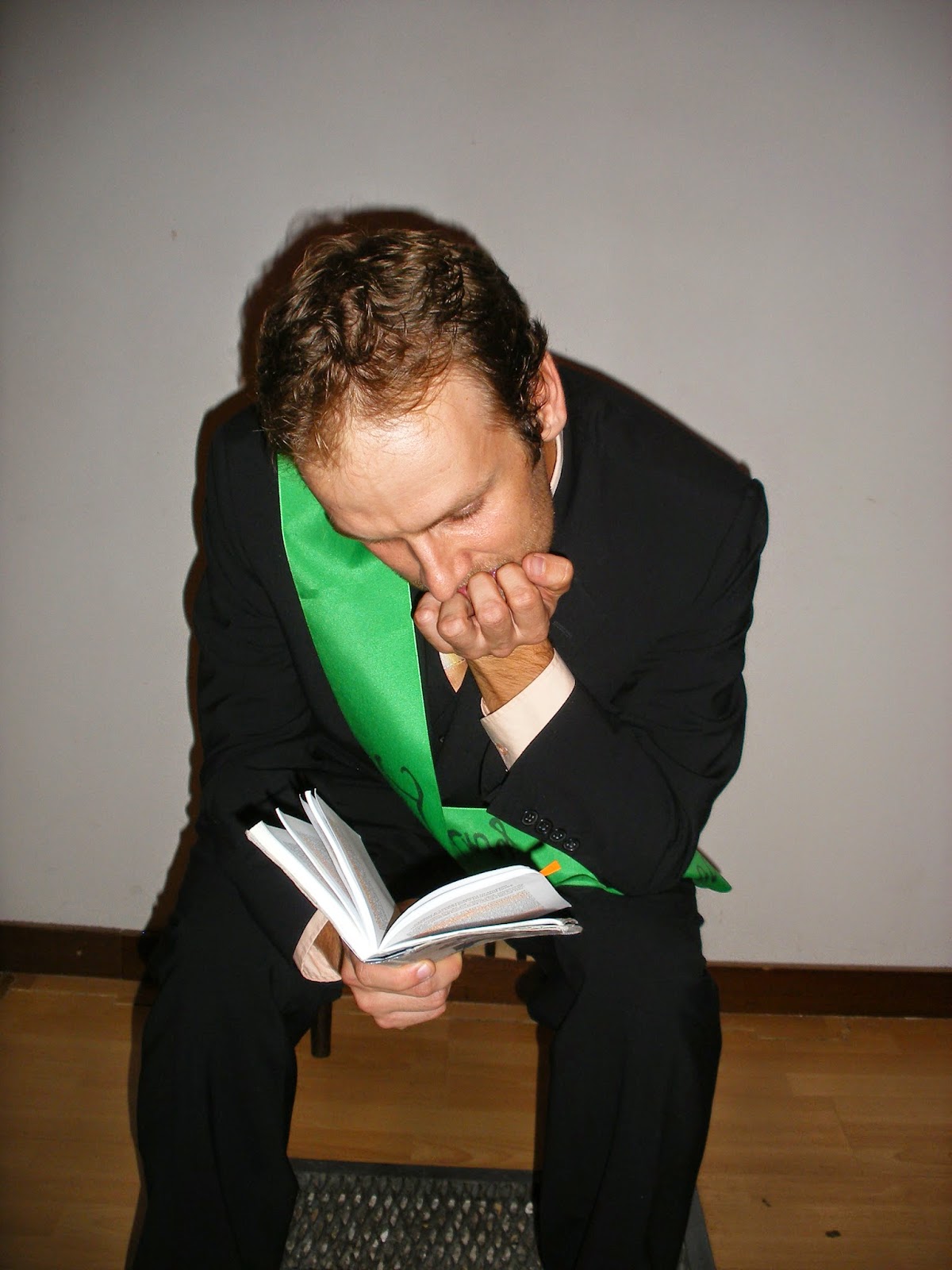
He’d probably be embarrassed to know it, but one of my favorite memories of Braňo is of him dancing at his class’ stužková.

Not dancing formally with one of the fifth-year girls while parents and coworkers and other students looked on; dancing like he meant it to “1-2-3-4” by Feist, from a CD he’d burned specially for the event.  See, during my third year Braňo somehow got roped into being the class teacher (akin to a homeroom teacher) for 5A.  Despite his reluctance, I’m sure he performed his duties to the best of his abilities.  I’m even more sure that his students, from that class and from all of the other ones he taught, held his intellect in the highest esteem. 

How could they not?  Everyone who knew him for more than a few minutes had to.  Braňo was one of the smartest people I’ve ever known, if not the smartest, period.  When I knew him he was working on his dissertation for his PhD in philosophy, focusing on Jewish philosophers; at EGT he taught philosophy and English but only to the fourth and fifth years, because none of the younger students would have much of a hope of keeping up with him.  There were times when I couldn’t keep up with him when he was speaking my own language, which he perfected while working, if I recall correctly, on a fishing boat in the Pacific Northwest.  Sometimes the American teachers would take a look at the exercises he created for his English classes, and we were often hard-pressed to come up with the correct answers.  This one has got to be my favorite, since it combines the merciless incisiveness and humor that were so integral to his nature.

Please just don’t annoy me with more of your complaints!  I wish you had been born into a happier family.  You would have been given a better education and would have more confidence in yourself.  Now it’s too late.

He loved “South Park” and lived for bicycling.  He made us laugh, sometimes when we weren’t supposed to, and he was lazy about translating for us at staff meetings.  He encouraged us to be “casual” at all times, and used “stunning,” with varying levels of irony, to describe things awful to wonderful.  He brought a book along to his own class’ stužková, and took a break late in the evening to sit and read, or at least pretended to. 

I hate that he’s dead.  I hate that the way he died makes his death all the more believable.  I hate that there are people who never got the pleasure of meeting him, and that there are students who will never have the privilege of learning from him.  I hate that, at least in my opinion, the length of his life was not proportional to the gifts he’d been given, and that all the good he had the potential to do and to share will never come to pass.

But even in his too-short time he changed people’s lives.  The day he died my Facebook feed was filled with tributes from his former students, remembering him as the best teacher they’d ever had and thanking him for what he’d taught them.  If it were any of his colleagues I might doubt their sincerity, but he challenged his students and laughed with them and laughed at them and I know they learned from him, probably even more than they realize.

Here is another of my other favorite memories.  One day the class schedule had been messed about for some very Slovak, bureaucratic reason that hadn’t been explained to us well, if at all.  In roughly equal parts frustration and actual curiosity I asked no one in particular, “Why is this happening?”  Braňo looked up across the desk in the staff room and, face entirely straight, answered, “Because of sin.”  I think I laughed then, because I wrote it down on a sticky note; and in the years since, when I’ve felt most put-upon by events and asked that same question, I’ve thought of his response and it’s made me smile.  Though it’s hard to think of that answer now, I’m sure one day in the future I’ll properly appreciate it again.

While looking for the exercise I quoted above I found an outline that Braňo had given us of the speech he had to give at stužková.  I could easily quote the whole thing, but I think this is the best possible way to end a tribute to him: in his own words, with hope.

May you be lead by something more than just cleverness or even wisdom, may you be seized by something much better than morality, may you be broken by the joy coming from the thankfulness to the one, whose arms were and are strong and wide enough to carry us all, who came to give us an actual reason to be joyful, because he not only broke the coldness and indifference of the world around you, but also the coldness in you.

Monday, May 30, 2011

The Work Outing

(In the spirit of non-plagiarism, the title is taken from the name of an episode of "The IT Crowd." It's not my favorite episode, but it was the first one I saw.)

For the past two years, the school has been involved in an ecological project with other European schools. Some of our teachers and even students have visited other schools in Portugal, Norway, and Sweden, and now it's EGT's turn to host. As hosts, they've arranged excursions for the visiting teachers; today they're in the High Tatras, and yesterday there was a trip to a cave and a manor house. It may seem like an odd combination, but the two are fairly close to each other (and less than an hour from Tisovec). The boss invited us to go along on the trips, because she likes us to see the country. H'd already been to the cave and kaštiel, so Robin and I went along with the guests. They went in a small bus, and we went in the school car, where we saw nice views like this one here. Man, Slovakia is pretty.

The Ochtinská aragonite cave is one of only like three or four aragonite caves in the world. It is, of course, out in the middle of nowhere, and like Domica, the entrance is in a bizarre spaceshipesque building. Inside the cave there is pretty marble-like rock, which I liked, and the aragonite formations, like bleached sea urchins clinging to the roof of the cave. Most of them are smallish, but there's a big one called the Hedgehog. At this particular cave, I suppose because it's uncommon, they wanted 10 bleedin' euros to take pictures. I ask you. Needless to say, I have no pictures.

Then we went along to Betliar. Some websites and guidebooks call it a "castle," probably in part because the Slovak word kaštiel sounds like castle; but it's really a mansion or manor house. Generally I'd prefer to go to the really hardcore fortressy castles, and that's one of the reasons I hadn't been to Betliar before this; but it turned out to be really cool. The house belonged for many years to Hungarian noble families.

The first few rooms are standard Here's a bit of furniture, some swords, and a family tree of the people who used to hang out here; after that it gets weird, when you go into the Grotto, a faux-cave with somewhat poorly taxidermied local animals like wolves and bears and a boar, and weirder still in the rooms where there are trophies from Africa. There were some masks and spears and shields, and a couple crocodiles, and a sea turtle, and a gigantic snakeskin, and this monstrosity:What?

After that it goes back to normal, more rooms and portraits and things. As we went through one room I saw a piece of furniture and thought, 'Where is the spinet?' and a few rooms later, there it was (I think it was really a fortepiano), with a bust of Beethoven on it and everything. One thing I thought was cool about the house was that the corners have square projections, sort of like towers or bay windows, and all the bathrooms are in those corners.

But really, the coolest room in the place is the library.
After the tour we walked around the grounds for a bit. It's got several odd little building that seem to serve no purpose, like a Masonic temple and a Chinese pagoda and Rob and I may or may not have climbed on one of them. You'll never know for sure.

Wednesday, May 18, 2011

Maturita Update

Even though having examined 44 students in the past three days (with 7 to go tomorrow) has melted my brain, there's one thing that makes it worthwhile, the most important part of maturita week...

BRYNDZA CAKES.

Sunday, May 15, 2011

Hell Maturita Week

This is the beginning of a very important week. It’s maturita time.

...There should have been more of a clamor after that dramatic statement. You don’t know what the maturita is? That’s likely because it’s very much a European rite of passage, especially here in Central and Eastern Europe.

The maturitas (maturity, if you want the proper plural) are end-of-school leaving exams. All Slovak students must take the Slovak exam, and of course at bilingual schools the students must take a foreign language exam as well, so our students all take the English maturita. After that students may choose a few subjects and they take intensive seminars on these throughout their final year to prepare them for the maturita. These subjects include geography, biology, and their second foreign language, among others. At EGT the kids take the Slovak maturita in their fourth year, and all others their fifth year. For some of the tests, including Slovak, English, and history, there is a separate written component completed earlier in the spring. The main event is the oral exam.

I can only speak about the subjects that I’ve been involved in, which are English and history, but this is the basic form. There are 30 possible tasks, and each task has three parts. The first student comes in and chooses a number from cards face-down on the table. Then he or she gets about 30 minutes to prepare. Students may write notes for themselves during this time, and some questions have specific aids, like articles, maps, or pictures. At the end of the 30 minutes the student must talk about the three questions in front of a panel of three proctors. As one student begins talking, another is preparing. The proctors ask questions to help the students. The students talk for 20 to 30 minutes or until they’ve entirely exhausted their abilities.

There are very particular rules about the proctors. Each panel must have an outside proctor who is not an EGT teacher, and for the bilingual subjects one proctor must be a native English speaker or equivalent. Obviously, the proctors are supposed to be qualified and know the answers for all the 90 possible tasks.

Scoring, like all grades, is on a scale of 1 to 5. Opposite to the Advanced Placement exams in the US, a 1 is the best score and a 5 is the worst. Each question is scored, then the proctors decide what the student’s overall score should be. Then there’s a complicated formula that’s like (a certain number of points X the score from task 1) + (another number of points X score from task 2) + (some more points X score from task 3) / 10 or 3 or something, I don’t even know, obviously I’m not in charge of anything involving math because this is serious business. About five students do their tests, then the proctors discuss, then the students come back in and the head of the panel asks if it’s alright to read all their scores aloud (no one ever says no). Then she reads their scores and all the proctors shake the kids’ hands. As you can imagine, this can be rather awkward if a kid doesn’t pass. I’m never really sure what to say, anyway.

Two years ago I was on the history panel. I learned a lot from it, because each task has at least one question about Slovak/Czechoslovak history, and though the students answer this question in Slovak, the headmistress made them summarize what they’d said in English for me. When I first got the packet of questions I felt a little like the students must feel: overwhelmed at everything they need to know. I originally had an example of a task posted, but I've decided to take it down, because the tasks sometimes don't change that much year to year and I don't want to risk doing the wrong thing.

History is a good panel to be on because usually only 20 to 30 kids take it, so it’s usually only one day. English, on the other hand, is four days this year and was five days in the past two years. Usually they try to divide the proctoring between two American teachers, but this year I am the duty native speaker, so I’ll be here all week, folks. This is because I was the only one who taught the fifth years their British and American history review course, and the English maturita for some strange reason includes a question about history/geography/social studies of English-speaking countries. So I’m the only one who knows the answers to all the history questions. The English tasks also include one conversation topic and one (British/American) literature question. The conversation topics cover everything from stereotypes of different nationalities to sport to whether it’s better to live in a village or a city.

While some people say that the maturita really has no bearing on students’ futures, it’s nonetheless an important part of their schooling and culture. And for about 11 hours a day for the next four days, it’s going to be an important part of my life, too.

Saturday, May 14, 2011

Class Trip

In my time living here I have come to internalize a bit of the rivalry between Slovakia and Hungary. I think Slovakia is better than Hungary in almost every way (except at having Cherry Coke and Dr. Pepper). I’m especially perturbed by the Hungarian language and its complete linguistic isolation from any neighboring language. And even though Slovakia lost in the hockey, at least this time they didn’t lose to Hungary.

All that said, it’s a little hard for me to get into the message behind our class trip to Hungary: that we should be proud of Hungarian history because it is our Slovak history as well. For about 900 years present-day Slovakia was part of Hungary, first in the kingdom of Veľká Morava and later in the Austro-Hungarian Empire. Most of any current antipathy between the two countries originates in the post-World War I era, when Hungary lost about two-thirds of its land under the Treaty of Trianon.

We—almost 30 third years, three history teachers, the financial secretary, and the secretary and her family, including her brother, who drove the coach—left Tisovec just after 7 on Wednesday morning and headed south and then west. On the way students gave short presentations (in English) on the history of the Hungarian kingdom. I took notes like a good student myself. We actually crossed into Hungary twice—we went in, then back into Slovakia, then back into Hungary again. I must admit I’m not sure why we did this, but it was a good illustration of how open the borders are.

Just across the Dunaj/Duna/Danube from Štúrovo (known as Párkány during the Hungarian years) is Esztergom, or Ostrihom if you’re Slovak. The basilica there is the third largest in the world. It was completed in 1856. I thought the most interesting part was the crypt, with brick arches and epic statues of Eternal Life and Eternal Perdition. It was also here that I discovered that the kids were going to take more pictures of themselves than of anything historical.

The next stop was Visegrád. There are two castles there: the reconstructed royal palace (királyi palota) near the riverbank and the citadel (fellegvár) up on a hill. The citadel is older, and the palace dates from the time of one of the greatest Hungarian kings, Matthias Corvinus. Matthias’ wife, Beatrix, was Italian and brought the Renaissance to Hungary. The royal palace has a Renaissance courtyard with the “Hercules Fountain” depicting baby Hercules strangling some snakes. The original, fragments of which are preserved inside the palace, was made of red marble, and ran with wine during banquets. The citadel of course has lovely views of the river and also wax-work dioramas of scenes of castle life that the headmistress and I agreed were full of silly inaccuracies (like lemons and oranges as garnish/decoration). The really great part was leaving the palace and getting on the coach to go up the hill to the citadel. In my non-teacher life I would’ve had to walk, and I’m grateful I didn’t have to do that with my kids.
We got a bit behind schedule somehow and arrived in the town of Szentendre around 5:30. Originally the kids were supposed to have free time and get dinner there, but we went straight to the restaurant. After we ordered I went back to the ATM we’d passed to get some forints. The ATM was only one turn away and should’ve taken about a minute and a half, tops, to get to. Even before my first lap around the block I was already thinking, “Oh, Ahab, you know better than to wander around a foreign town by yourself,* especially in your current fatigue-addled state of mind.” I managed not to get irreparably lost, though, and made it back to eat my beef stew. It was so good.

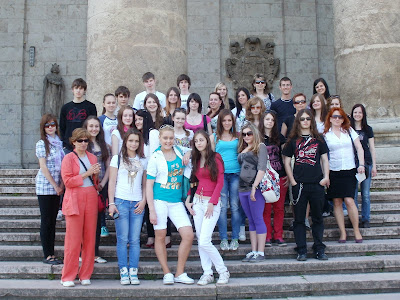
Our hostel was on the outskirts of Buda. It was a quick trip from there to the castle hill on Thursday morning. We walked around the president’s palace, Matthias Church, and the Fisherman’s Bastion. I was called upon to review the characteristics of Gothic architecture outside the church; I was hoping we’d go in, but we didn’t, alas for me. From there the bus took us to Pest and we went to the House of Terror. I think that it seemed even worse to me this time since I’ve been teaching 20th century history. Some of the kids were upset by the museum, as they should have been, so at the end of the visit the headmistress and I tried to explain why we visit museums like that, and concentration camps—lest we forget. As we left one of the girls told me that it was the first time she’d realized how bad things got during the socialist era (Hungary tried to rebel against the Soviets in 1956 and the attempt was answered with great cruelty). She said, “I thought after World War II it was better.” I told her I’d thought so, too, before I became a history teacher.

After all that, the headmistress let the kids exercise their democratic rights, and they voted not to visit the art museum. We had a brief stop at Heroes’ Square (Hősök tere, left) and then took the metro to some other square whose name is frankly unimportant. Then we all got two hours of free time.

Last time we visited Budapest we didn’t get to go in the big market hall when all the stalls were open, so I headed there. I will miss European markets when I leave. Most of the greengrocers had strawberries out, and when I walked by the first stall and smelled them I had to have some. I consulted my phrasebook and found a vendor who was not busy and looked pleasant. Standing in front of the strawberries I smiled and said hopefully, “Fél kilo?” It worked like a champ. I paid about 500 ft. for my half-kilo, rinsed them at a little sink, took them outside, and ate about half of them straightaway.

Then I succeeding in locating both Cherry Coke and Dr. Pepper, and of course got a milkshake from Mickey D’s.

When we reconvened (the kids had almost all gone to McDonald’s, too, and shopping), we took the metro back to Hősök tere and the bus met us there. You have not seen a bunch of kids more eager to go home from a pleasant two-day trip than these ones. Admittedly it was noticeably warmer in Budapest than in Tisovec (a thermometer as we were leaving said it was 32°), but when one of the girls described the weather as “tropical,” I LOL’d.

My biggest concern during the trip was whether or not these kids were actually making any connections between what we were seeing and what they’d learned in class. I’m certain a few of them were willfully ignoring any possible educational tidbit—I do teach them, after all, I know what they’re like—but I think most of them got something. And though one girl got a little sick, no one got drunk or arrested or woke me up in the middle of the night, and that’s really all I could have asked for. It was fun to laugh at them and the silly things they did and said, too; two of the girls were giggling about something as we walked to Hősök tere and I asked what they were doing. Miška said, "Majka fell in love with the construction worker" we'd just passed. Majka defended herself with "He has beautiful eyes!" and looked for him very unstealthily the next two times we passed by the same place. Teenagers.

In the end, no matter how much I complain about not understanding Slovak and Slovakia, there is no mistaking the sense of relief I feel when I get back from having left the country.


*Clearly I do not truly know better.

Saturday, April 16, 2011

The Best Homework I've Ever Assigned

Last week in 20th century history I asked the fourth and fifth years to write a short response (220-250 words) to the question "How do the events of the Cold War/Communist era affect my life today?" I wanted them to think and to connect the present to historical events. As an example, I told the kids that one of the products of this time was a drink created in Czechoslovakia to compete with sodas like Coca-Cola: my beloved Kofola.

This may have been the only time in my teaching career that I was actually excited to collect and read everybody's homework. Common themes in the responses were:
--I don't really know about the communist era because I was born after it ended (1989) but
--my grandparents think it was a positive time overall because everyone had jobs
--I actually talked to my parents about my homework
--there sure are a lot of big gray buildings built during that time
--we'd all be learning Russian right now if Communism were still here
--now it's much easier to travel to other countries and we appreciate that
--even if it had some advantages, I'm glad I don't live in a Communist country

When I was in high school, Communism was a joke, just another word to use when describing something we didn't like. Shortly after arriving in Slovakia I realized that Communism was no joke. Its remains are everywhere, and the current leaders of the country are mostly "former" Communists. Many Slovaks believe that Communism had advantages for their country, although most also acknowledge its disadvantages. For those of us who never had to experience such a system, I hope reading these excerpts will give you insight into what Communism was and is really like. Some things in the responses made me sad, like the one about the library, but some made me smile, and they also made me think. I hope they do the same for you.

"In my opinion the thing which affects my life mostly and not only my life but all of ours lifes is that regime was changed [in 1989] but thinking of people was not."

"Before communism we had a really nice and old library with huge windows [in Lučenec]. There were so many books and it had so much space. Inside of that library was an interesting spiral staircase. That time no other towns and cities in the region of Novohrad did not have library like my town. But when the communism came, they removed it and built a statue of one man there. This time we have a library which is very useless and ugly. We just can't say we are proud of our 'new' library."

"Summer camps are something, what have beginning in communism and I never regret that it incepted. And nice is that I'm not alone, who love camps and who is grateful for this. Camps have long tradition but always in one spirit, or with one motto...Live for fun, friends and love. Camps contain all of these important life values."

"Other thing is that there is one biscuit from communist era which I love - Horalky. This is the best biscuit ever. I hope you love it too. I think in this era they made better biscuits than now."

"The weapon of self-destruction of communist system is Liberta. Liberta is bicycle. But no normal bicycle. It makes you free, it has magical power. Communists wanted to create something what will calm down unsatisfied rebels in peaceful way. But when people tasted the taste of liberty by Liberta, they recognized what is true freedom and what is communism."

"I could say that there is also second thing which affected me. Fashion. Extravagant in this time was striped shirt and on graduation class-photographs, they could not have this shirt, because it was not allowed. In this time, when you want to be extravagant you would wear something like in communism was normal. Now it is called retro style and you would be really cool. So I think that fashion in communism really affected us. also it had breakthrough and I am really happy that we can wear what we want and nobody looks at you, like you are an idiot."

"I remember when we had Škoda and it was super car. In those times it was like a limousine. It is interesting that engine is in the rear side of car. You can do pretty nice drifts on it. When you sit into Škoda 105 you feel like boss. This car was awesome."

"To tell the truth I had never seen such a reliable, nice, friendly and persistant car neither before nor after it [the Škoda 120L]. This dark green car seemed to be able to do anything. We ised to ride to town, to forests, simply everywhere. And from me as a child with lack of confidence became a strong individual. I learned to trust this mechanism. I was not afraid of machines anymore. My family and I were given new possibilities. I even started to learn how to drive and I was only twelve. I also learned how to care about it. At last we gave it a name--Elza. Unfortunately, we had to sell it some time ago but I can tell that I became completely different person than I had been before. I thank socialism for Škoda 120L."

"However, I found a good thing that was invented during that time. It is Slovak famous "good night" show for children that is called Večerníček. Večerníček is a character with resemblance of an old, kind man who has the role of an usher. He ushers the show and fairy tales are broadcasted in the show. I loved it as a kid. Before I went to bed I must have always seen it and then I could go to sleep. There was also a special soundtrack that was very catchy. Always when I heard the first sounds of it I ran straight to the living room. I sat down on the floor, in front of the TV and I was watching my favorite show. It started shortly before 7 and after that I needed to go to sleep. Večerníček is shown also nowadays. It has started in 1963. Honestly, I am not that excited to see it as I was when I was a kid but I still have some good memories about it. Especially, when I hear the soundtrack it makes me smile."

"If I just imagine the situation if there had been no comunism, Slovakia would nowadays be much more developed. But--it isn't so. Therefore we--the young people--are the ones to help the state development. I think it is a big motivation for us eventhough if there had been no comunism, we would certainly be somewhere else. I would really like to take a role in helping the slowly developing system."

Thursday, April 7, 2011

Second Years' Tourism Adverts

We read about tourism last week in 2A, so I asked the kids to write a short piece to attract tourists to Slovakia. Here are some of the unedited results. In regards to the second selection, we did talk in class about how lots of (predominantly) British guys come to Bratislava for their bachelor (stag) parties.

"Small country with Big heart. Also like this is called Slovakia. It's not very rich, not very big in size, but we are still happy! Not the materialistic things makes us, like money happy. Our environment, beauty of nature; honest people, beautiful sightseeing places like Vysoke Tatry, Nizke Tatry, Poloniny, Pieniny, Slovensky raj (mountains), Spisky hrad, Krasna Horka, Cachtichy hrad (castles), many caves should attract you here. We want tourists, We love tourists from whole world. Every nation, every race are welcome in our 5* hotels. Come to Slovakia, You won't regrate!"

"Okey. When you want to go to Slovakia for bachelorette it is very good choise. However, disco clubs aren't good in Slovakia you can get drunk very cheaply, but you watch out for you to arrest by the police due your bad behavior. (:D) I can also say that we have very pretty girls, but lots of them are gold-diggers. (:D)"

"Sheep cheese is traditional delicacy too. This cheese is produce on chalets. On chalets you may ride on horses, sing old people's songs with folk dancers, eat a lot of good food like mutton, veal, bryndzove halušky...

If you want to see all of this you must come and live through everyone of these things."

"People around the world visit these places to see the way of life of native people and feel the atmosphere of the past."

"I recommend this country for trip with your family on holiday. Your children will see things that they have never seen before. I like our home because I grew up here. Don't waste your time and come to Slovakia and experience something that you will remember for rest of your life."

"My words are useless, you have to come here and see it!"


There you have it. Time to ring up the tourist board and tell them their new campaign is all sorted.

Saturday, April 2, 2011

Accordion Heaven

At the staff meeting on Monday somebody mentioned there would be a concert that some of the students would go to on Thursday, but the details were a little hazy. Things cleared up as the week progressed; the whole school would go at 10:30, meaning I'd miss a 20th century history class (aw darn), and the concert would involve...accordions.

I actually really like hearing people play the accordion. Sometimes I can hear kids practicing from the music school behind us, and it always makes me smile. I was stoked for an accordion concert. The concert involved kids from the Tisovec music school, including beginners with tiny accordions (see right), and a group of about 30 musicians from the Základná umelecká škola (basic arts school) in Lipany, near Prešov. There were a few kinds of different accordions, and different colors, and one was even plugged into an amp. It was rad.

(Not played at this concert, but related, is kind of an old-school accordion with all buttons and no keys, called a heligónka in Slovak. Isn't that the best word ever? Heligónka!)

A sextet of accordionists, accompanied by a bassist, played a song written by a man named something that sounded like Tupac, because I said to Rob, "They're going to play a Tupac song?" and that might have been about Jánošík. I was going to ask one of my students, the girl on the left, what the song was called and who wrote it, but she wasn't at school on Friday.* I really liked this piece. I don't know why I was holding the camera kind of wonky, though; sorry about that.


And then they played "Final Countdown."


It was the best day ever.


*Hello from the future. The song is called "Dupák" and was written by Ján Cikker.

Wednesday, November 24, 2010

Thanksgiving

I am thankful that it's finally snowing in Tisovec.

I am thankful for my health and safety.

I am thankful for my students (like my beloved third years), who are funny and smart and kind and frustrating and always surprising.

I am thankful for Hobbits—the kind you eat, not the kind you walk into Mordor with.

I am thankful for the Middle Ages.

I am thankful that we just celebrated 21 years of the fall of Communism in the former Czechoslovakia.

I am thankful for Johann Sebastian Bach.

I am thankful that I have eaten halušky at 10:30 PM and kapustnica at midnight.

I am thankful to be teaching history again, and I am thankful for my old Barron’s AP European History study guide.

I am thankful for bryndza cakes, and those little meringues with the chocolate cream.

I am thankful that I don’t have to use the ř.

I am thankful for my past and present friends/colleagues/traveling companions/co-conspirators.

I am thankful for my family. I am really very spoiled by them.

And I am super duper thankful for the lovely, effective new dryer in the basement.


One day my life may actually get hard, but it hasn’t yet, and I’m thankful for that.


i thank You God for most this amazing
day:for the leaping greenly spirits of trees
and a blue true dream of sky;and for everything
which is natural which is infinite which is yes

(i who have died am alive again today,
and this is the sun's birthday;this is the birth
day of life and love and wings:and of the gay
great happening illimitably earth)

how should tasting touching hearing seeing
breathing any-lifted from the no
of all nothing-human merely being
doubt unimaginable You?

(now the ears of my ears awake and
now the eyes of my eyes are opened)
--e.e. cummings

Monday, February 15, 2010

Ples

A paraphrase of part of the conversation I had with my mom yesterday:
“I thought about writing about ples, but I don’t know if I should.”
“Why wouldn’t you?” she asked.
“Well, it’d just be, like, ‘Ples: it’s like stužková, but different.’”
“You should explain how it's different from štuz--štužková.”
Therefore, I’m going to describe ples. Parts of this entry will be cribbed from the e-mail I wrote to a friend about the event. As my sagacious brother says, “Work smarter, not harder.”

We had our ples on Friday night. The complete and proper title for the event is školský ples, or school ball. A few students, attempting to use English terms, call it “prom,” but it’s quite different from American prom. At our school ples is organized by the student company, which is mostly fourth years. Some towns and villages are also having ples this weekend, so this is not something limited to the high school environment. Ours is in the cultural center next door to the school, in the same room where stužková is held. Like stužková, ples starts at 6 PM, and it is considered proper form for the teachers to leave only after the headmistress does, which is usually sometime around 1 AM.

Ples is less formal than stužková. It’s still a formal event, but it doesn’t have the sober coming-of-age aspect that stužková has; hence the program was less involved than at stužková. Ples began with a welcome and introduction, and the headmistress made a toast; after this there was a program. The entertainment consisted of three main elements: music, dance, and fire. Some of the fourth years played the piano, and there were also piano-and-saxophone duets featuring a fourth year’s younger brother on alto sax; and two younger students, a second year and a third year, sang “You Raise Me Up,” made famous by Josh Groban. Interspersed with these songs were dances performed by two ballroom-dance couples, one of whom is a third year. (His nickname is Bravík, which means something like “little pig.”) The finale was a performance of fire-twirling by two girls, neither of whom were students. It was cool and completely unexpected, so well done, student company. Around midnight there was a raffle, but that was the extent of the planned activities.

After the program there was dinner and dancing. The headmistress and her husband began the formal dancing, and then members of the company and other students joined in. Thankfully, I was not called upon to dance in this style. Style doesn’t enter into it when I’m dancing. The provision of music was split between a DJ and a band. Sadly, neither played any iteration of “Take Me Home, Country Roads” (which, if I didn’t mention this in my stužková post, was played in some form at both stužkovás and ples last year), but the DJ redeemed himself in the eyes of many by playing Donna Summer’s “Hot Stuff,” and, right before I left, my favorite ’90s Euro-dance song.


How is ples different from prom? Well, for one, this is February. No US high school would have prom in February. It’s rather slushy at the moment, and still fairly cold, though by no means as frigid as it was the week before last. For those of us who had to walk from our apartments to the cultural center and then back home, the walk was a bit of an adventure. I walked to my friends’ apartment halfway between mine and the cultural center wearing my hiking shoes and warm socks, and changed into my heels there to walk the rest of the way. By the time we left, the moisture on the road was frozen into a thin layer of ice. Imagine walking on an intermittently icy road in heels and a dress that you really don’t want to ruin at around 1:45 on a Saturday morning. It is as fun as it sounds.

Ples is also different in that attendance is not restricted to a particular class. There were first through fifth years there, as well as a handful of last year’s graduates. Dates were not required, but seemed encouraged; some students brought their non-EGT significant others. As at prom, they went all out in dressing up.


Another difference is in the way teachers and students interact at ples. At my senior prom long ago, teachers were there specifically as chaperones. We were guests, not chaperones. I guess the difference is that ples is for the whole school community, not just the students, the way prom is. On Friday night we talked and danced and took pictures with our students. It never would have crossed my mind to ask a teacher to dance with me--I think that would have been social suicide, and our teachers were probably prohibited from dancing with students. Our students happily invite their teachers to dance with them; in some cases they don’t just invite, but insist. I’m not being dismissive when I say that I believe this is a cultural difference. People still dance here.

Of course, people still get down with the get down here, too. As time passes, the DJ throws on more “disco” (that is, dance) music and less Strauss. Once again, it’s not just the kids who dance, but the teachers, too; and the students are not visibly mortified to see their teachers shake a tail feather. This is when they are most insistent that we dance. I haven’t figured out why students want me to disco. I suppose they think that if you’re sitting down, you’re not having fun. I like watching other people dance as much as or more than I like dancing myself.

This year I only made it until about 1:30 before I went home. As always, the party went on all night. One day I really am going to have to stay until morning. I had a lot of fun at ples. I think these things are easier when you’re no longer a teenager.

Thursday, February 11, 2010

My Work Here is Done

Today I'm once again stretching the idea of this blog to include something I want to share. We'll say it's about cultural differences and whatnot and call it square.

I'm a missionary, but I also have an auxiliary, personal mission. That mission is to spread my love of three things: American football, bagpipes, and country music. I just realized that as of this afternoon I've done all three things this week:

1. On Tuesday night I was able to share my enthusiasm for football with nine girls as we participated in a Bible study based on the show "Friday Night Lights." Because I missed the Super Bowl, I was way too emotionally invested in a football game that was scripted for drama. But I got the singular joy of watching one of my fellow teachers explaining to a group of rapt teenage girls the difference between the extra point and the two-point conversion after a touchdown.

2. In our first-year social studies class we talked briefly about icons of Scotland, one of which is the bagpipes. I was able to play for them a bit of "Scotland the Brave" and also of Dropkick Murphys' version of "Amazing Grace." (The firsties always think that haggis sounds disgusting, but I tell them that I've watched people make sausage here, and it's not that much different.)

3. Since Valentine's Day is on Sunday, I decided to play a "love song" for my second years. When I play a song with words in class, I provide the lyrics for students and they often have to fill in gaps. That way it's educational. The song that I chose for them to listen to is one of my personal favorites, "John Deere Green" by Joe Diffie, which is an intensely country song. I didn't realize how difficult it would be for them until we were actually in class and I watched their faces as they tried to fill in prepositions and articles.

So I've managed the trifecta this week. Even though I've achieved that, there is still more to do. There is more country music to listen to and an actual football to toss. And that's why I'm coming back to Slovakia for one more year of teaching.

Friday, December 18, 2009

Christmas Time is Here

This year I have two Christmas songs to share. First off, some of my second-year students love to sing, so I asked them to sing some Christmas songs to make a video greeting for one of their former teachers. They sang "Jingle Bells" in English and then in Czech; here's the latter, since I'm assuming that most of you know how it sounds in the former. And they're all staring off in one direction because they're reading the words from the chalkboard.


Then a few weeks ago we sang songs at Bible study, and the kids then taught us "Silent Night" in Slovak. We only got one verse, but it's more than I knew before.

Tichá noc, sväta noc,
Všetko spí, všetko sní,
Sám len svätý bdie dôverný Pán,
Stráži dietátko nebeský dar
Sladký Ježiško spí, sní
Nebesky tíško spí, sní

I must also add that like all of my students love any iteration of "Last Christmas." Any class I played that for started singing.

Sometime quite soon I will be heading off for my Christmas adventure of epic proportions. I'm not entirely prepared right this second, but I am quite excited. Of course you should all be looking forward to the next update, which will appear here early in 2010. From all of us in Tisovec, veselé vianoce a šťastný novy rok!

Wednesday, December 16, 2009

Stužková Professional Stylie

I know I complained about the omnipresent and annoying photographers at stužková, but they did have good cameras and they did get some good pictures of us and the kids. One of the girls (whom I don't even teach--you rock, Katka D!) provided me with some of those pictures; and while it might violate some copyright laws and will probably cause an international incident*, here are two photographs showing the američany and some of our students in their regional dress. I include the last one because of its sheer cuteness.


*Dear boss...
Whenever one of us does something even remotely ill-advised, we often pretend we're writing to our program supervisor informing him of what's happened. (This itself is a holdover from university, when we used to pretend our actions would make it into the campus police blotter.) The imaginary e-mails usually begin "Dear boss, we regret to inform you..." although one of my favorites was "Dear boss, the bail is two thousand euros."

Sunday, November 29, 2009

Stužková

Last year around this time I posted a video and said that I’d talk about stužková in the near future. It wasn’t near, but the future is now.

Stužková is a ceremony that has no parallel in American culture. It’s held for and by the fifth year students late in the fall. It’s not a graduation ceremony, although it’s similar in some ways, and it’s not a prom, though dancing is a big part of stužková. On our school calendars,stužková is translated as a “ribbon ceremony,” and the word for ribbon is stuha. One major part of stužková is the giving of green ribbons to all of the students. The ribbons symbolize their hopes for the future (including that they will pass all of their exams), and the students wear their ribbons until the end of the year. Anywhere you go in Slovakia you’ll now see kids with green ribbons on their jackets and bags, so you know they’re in their final year of high school. The ceremony is also a coming-of-age type ritual; they’re now adults. (Remember, fifth years are superseniors, and students start “high school” when they’re anywhere from 14 to 16; so some of my oldest students are already 19 and 20 years old.) Stužková requires several costume changes, but the students begin in formal dress, and the majority of the guests, especially parents, also dress formally.

Our stužkovás* start at 6 p.m. When guests arrive, they’re escorted to their seats at long tables. The headmistress and her husband, and the class teacher and her husband are usually at a head table. When everyone is seated, the students process in, and bow or curtsey to the headmistress and their class teacher. Then the students acting as emcees welcome everyone to the stužková. One of the students gives an address, then the headmistress does the same. The students are introduced and their class teacher pins on their ribbons. The school chaplain prays, and a parent makes a short speech and proposes a toast. The students sing “Gaudeamus Igitur.” Then there is a receiving line where all of the teachers shake their students’ hands and offer them some kind of bon mot. Mostly I just told them congratulations, and commented if they looked especially nice.

After the welcomes and speeches and formal toasts and appetizers, the dancing starts. Students first dance with a member of their family, most often their mother or father. Unlike at home, dancing is something that everyone learns here, so it’s incredible to see goofy kids dancing really well. After the family dance, there is the teacher-student dance. This is the subject of speculation among the teachers during the days leading up to stužková. Sometimes students will let slip which teachers they’re dancing with, but usually they don’t tell, so I always wonder who I’ll dance with. So far I’ve been fortunate to dance with really pleasant young men, who have excused my complete inability to dance. Once those dances have been completed, there is open dancing. The kids may dance with their parents again, or with a boyfriend or girlfriend, or a sibling, or a favorite teacher. Parents and teachers also dance.

Dinner is served next. At three of the four stužkovás I’ve attended, it’s been chicken cordon bleu, rice, fries, corn, and cabbage; at the other it was chicken topped with ham, a half a Georgia state fruit,† and cheese, then rice, fries, and some fruit. The tables also have rolls, cakes, and a selection of beverages, including wine, water, Kofola, orange juice, and fruit brandy, on them. It is acceptable for parents to BYOB.

More dancing after dinner. At this point the DJ usually throws on some waltzes, tangos, and Slovak folk music. Around 9:30ish (I never wear a watch nor have my phone at stužková) the students’ program will start. The program usually includes singing, dancing, and skits. At 5A’s stužková, one of the students did a brilliant impression of the Slovak philosophy teacher, which included calling Francis Bacon “Slaninou,” which is bacon in Slovak. Both stužkovás last year included a skit about the Slovak folk hero Jánošík.

When the program is over, there is…more dancing! Many of us use this opportunity to go outside and cool off, because it gets quite warm in the room, and to talk to former students who have come back to see their friends. This goes on until midnight. At midnight the students light candles, read short poems about each other, and get a special piece of cake. Then they often play the stužková song‡ and the kids jump around and dance to that.

This year, the 5Bs had a really cool extra part after the midnight program. They all got dressed in the folk costume from their home region and came out and danced and sang. They also had a folk band come in and play so that they could dance all the better. In the video, not only can you see the ridiculously omnipresent photographers, but hopefully you can tell that everyone around us was singing along to the song. That kind of thing always makes me want to be able to sing along, too.


After the midnight program they bring out more snacks (the infamous meat plate, potato and/or pasta salad, more rolls) and coffee. There’s more dancing, and the headmistress usually leaves around 1 a.m. The other teachers must stay until she leaves, so once she’s gone home, we’re free to either head out or get crazy on the dance floor. The DJ starts to play dance music, and the kids disco it up until morning. The latest I’ve stayed was until around 3:15 this past week, but some teachers literally stay all night. Nine hours was enough for me.

If you’re lucky, you get to sleep in the morning after stužková; but if you’re up and around, you’ll see kids heading home from the party, or getting on buses. And hopefully by Monday morning everyone is recovered enough to be back at school and functioning normally.

Stužková is one of those things that's so important that people can't explain why it's important. It just is. I hope I've been able to describe it well enough to show some of that. Despite whether or not I return to teach here next year, this won't be my last stužková; I'm already making plans to come back in 2012 for the current 2B's stužková.

*Improper Slovak alert. It’s fun putting the English plural ending on Slovak words, though, and easier than memorizing the Slovak plural endings.
†“Peach” sounds like a very vulgar word in Slovak, so we try not to go around saying it a lot.
‡I hope it gets stuck in your head as much as it's stuck in mine right now. Also, that video is quite amusing.

Thursday, November 26, 2009

Thanksgiving

This year, I am thankful for
my family;
getting to see my friends this summer, and having friends where years and miles apart make no difference, because the more things change, the more they stay the same;
the internet;
"Brownie," my Tisovec dog;
my new bathroom, even without its door;
my kids, who, against all reason, can make me smile just by saying hello in the halls;
my Slovak colleagues;
Kofola, forever and always;
learning new things, like about Britain after the Middle Ages;
having a(n American) football and getting kids to play with us;
the opportunities to travel and see and do new things;
our plans for Christmas (wait for it...it's gonna be legendary);
ruská zmrzlina;
health and safety;
this amazing, strange, beautiful country that I get to live in and love and be "from";
los otros gringos aquí, whom I adore;
knowing that no matter how long and hard the road, no matter how fun the trip, at the end of it I will walk down the middle of the street surrounded by my hills and, even if I can't see them, my sheep and my stars, and sleep well in my own bed at night.

And now I am proud to present the new T-town song. The students had a coffeehouse last night and we were asked to present something, so we created and sang this song, to the tune of "Part of Your World" from Disney's "The Little Mermaid." "Ako sa povie?" means "How do you say?" in Slovak. The more I watch the video, the more I seem to be just shouting rather than singing, but it was the most fun.

Look at this place, isn't it neat?
I get around on just my two feet!
Wouldn't you think it's the town,
The town that has everything?
Look at this view, treasures untold
How many wonders can one valley hold?
Lookin' around you'd think sure, it's got everything.
We've got Kofola and gul aplenty
We've got bryndza and haluky galore
Want potraviny? We've got twenty!
Yeah T-town! But that's not all...it's got more.

You can be where the ovce are
You can see, you can see 'em grazing
Strolling around on those--ako sa povie?--hills
Taking the bus you don't go too fast
But there's no rush and no reason to leave
Strolling along down those--ako sa povie?--streets
Down where they bike, down where they hike,
Down where they play all day on the courts
Not getting tan
But glad that I am
Part of this world

What did I give to be able to live next to this potok?
What did I pay to spend my days looking at rocks?
People might say let's get away, let's head to Praha for the weekend
See new face, go new places, ready to leave

But we want to be where the two street are
In our small town where we can't get lost
When does a town become--ako sa povie?--home
I'm here to stay, laugh, learn and play
And give my heart to friends in this place
At EGT
Glad I can be
Part of this world


Happy Thanksgiving!

Tuesday, January 13, 2009

Student Quotes

These don't really have to do with travel, but they're from Slovaks, so I'm saying they count. From class and reading students' homework today.

A third year on To Kill A Mockingbird:
"I saw how much Calpurnia helped Atticus with breeding children."

A fifth year on the teenage years:
"This period is a passage from childhood to adultery."

Another fifth year on scientific breakthroughs:
"The proof that scientist are also useful..."

And in class today, a first year, when I asked the class what happens when you're beheaded:
"You get shorter."

Friday, December 12, 2008

Christmas Song

Last night we did a little Christmas caroling with some of the students, most of whom are in the choir. They started to sing a Slovak song that was really cool and that they managed to sing in parts even while walking. I coerced them into standing still and singing it when we got back to school, and took this video. Enjoy.

Friday, December 5, 2008

St. Nicholas' Day

I feel somewhat mystified by Slovakia today, and also that I should have my camera with me at all times, even during class.

Tomorrow is St. Nicholas' Day, which in many places in Europe is a day when small gifts are given. St. Nicholas (Mikulaš here) is often accompanied by a weird goaty dude. St. Nicholas rewards the good children, and the goat-dude punishes or eats the bad children.

This morning I was having class with my 5As when someone knocked on the door. I expected it to be someone bringing the class book in, but in came four students (fourth years): one was dressed as St. Nicholas, one as the goat-dude, one as a devil, and one as an angel. They were delivering what amounted to Christmas candy-grams. It was rather unexpected, though. St. Nicholas had a big crook and everything.

Then at lunch, after the lady handed me my plate of food, she also gave me a bag with a banana, a tangerine, a juice box, and a chocolate bar in it. None of my students were in the cafeteria, else I would have asked them what that was all about. I figured it was a St. Nicholas' Day thing, but I was a bit confused, still.

Then this afternoon I went shopping at the larger store, over by the school, and when I went in there were St. Nicholas and the goat-dude. This St. Nicholas looked pretty much like Santa Claus; the goat-dude had a furry head--honestly, I didn't look that hard, because he had a broom and I wasn't sure if it was part of some tradition to whack unsuspecting people with the broom. But obviously all this means that I must carry my camera around with me more often.

Tomorrow: pig-killing! Well, the pig'll be dead by the time we get there, but there are sausages to be made.

Thursday, November 27, 2008

Thanksgiving

You have no idea how much I'm thankful for this year.

First and forever and always I am thankful for my family and my friends. I hope they already know that, but I'm just throwing it out there.

One of the things that I am most thankful for is the magic of Skype. It truly is magic, and wonderful and amazing. Without it I would be very sad/poor, because I would either not get to talk to people at home, or have to buy many, many international phone cards.

I am thankful that I have been safe and secure all this year, especially here in Slovakia. I've never felt in any danger...although I have been slightly menaced by the čuvačy.* If you see a big white dog in a field in Slovakia, DO NOT mess with it or its sheep.

I am indeed thankful for my school and my coworkers and my students. Of course, without them none of this would be possible. I feel very lucky that I teach at one of the best schools in the country, and that we have such a nice facility. The other teachers are all easy to work with, which is wonderful. And the majority of my students are lovely, amusing people.

Since I teach a class that's about life and institutions in English-speaking countries (realia), I was able to impart the time-honored tradition of the hand turkey on most of the first years. I made an example turkey and wrote on the back one thing I am thankful for, which is the school. The kids all traced and cut out their hands, some of them with a great deal of concentration, then decorated them and wrote something they were thankful for. The first class who did it had a lot of "I am thankful for my family and friends," so in the subsequent classes I said, "Mine says I am thankful for this school, but yours can say anything, like 'I am thankful for Kofola and karate and puppies,'" and I began to get more varied responses. Some of the students wrote that they were thankful for 1A or 1B, one wrote that she was thankful for 3A, and my favorite said something like "I am thankful for my family and friends and chili pizza and my home and my school and gummi bears."

Happy Thanksgiving!

*That plural form is purely conjecture. One is a čuvač, but I'm not entirely sure what more than one should be.