The other day I came across this video. Set to "Spring 0" and "Spring 1" from Recomposed by Max Richter: Vivaldi - The Four Seasons, it features footage of Málinec (southwest of Tisovec). I think it's beautiful and captures the country wonderfully.
Showing posts with label Slovakia. Show all posts
Showing posts with label Slovakia. Show all posts
Monday, April 17, 2017

Friday, March 31, 2017
Slovenská hudba
We all know that my favorite Slovak song is "Tota Heľpa," and that, at least in my opinion, there's little better than a crowd of all ages playing instruments and singing folk music. But to think that Slovak music is all fujaras and people in kroj is just foolish. As evidence, I offer a few of my favorite non-folk songs from Slovakia. I will admit that the following selections do not represent a comprehensive overview of recent popular music; they are a totally subjective and not terribly well-informed collection. Počúvajte and enjoy!
HONORABLE MENTIONS: Not in Slovak
"Crushin' My Fairytale" by Celeste Buckingham
Celeste is like part American and part Swiss and lives in Slovakia and is fluent in the language. She co-starred in my favorite Slovak movie, Láska na vlásku, and recorded a song for the end credits. She also sings in English, as in this song. You might recognize Bojnice Castle as the filming location for the video.
"Princess of the Light" by Lavagance
The video for Lavagance's song "Gabriel" seems to be set in a Baumax (a home improvement store) and downtown Bratislava. That song seems tailor-made for the final scene in an hour-long drama on an American network, and I'm surprised it hasn't been so used yet. As far as I know, they only sing in English, but I have made no investigation to prove the contrary. There are two videos for "Princess of the Light"; the one I prefer features SĽUK, the Slovak national dance troupe.
"Stužková" by Elán
Okay, the song is from 1985, and the band and lyrics are Czech, and you only really hear this during stužková season in November. But it's so iconic that I can't in good conscience omit it, and the video--made, remember, before the fall of Communism in Czechoslovakia--is amazing.
TRETIE MIESTO: "Môj život je muzika" by Kollárovci
It's either this one or "Neodchádzaj" (which I hope they play at every wedding and ples and stužková from now until the end of time). This song is folky, but not actually traditional. All of the music on this album, also titled Môj život je muzika (My Life is Music), is catchy; Dad's favorite is "Mariša," and I have to be careful about listening to or even thinking about "Sokoly" because it gets stuck in my head quite easily.
DRUHÉ MIESTO: "Horehronie" by Kristína
Slovakia's entry in the Eurovision Song Contest back in 2010. I feel like the recent trend has been for Eurovision songs to be all in English, but I wish more were in their countries' native languages. "Horehronie" is all about how beautiful the region is, a sentiment with which I agree wholeheartedly. The song didn't win, but that's Eurovision politics for you.
I also like Kristína's recent songs "Si pre mňa best," and "Na bieleho koňa" from Johankino tajomstvo, which I still have not seen, dang it.
PRVÉ MIESTO: "Ľahká" by Korben Dallas
The album is called Banská Bystrica and its cover features the SNP Museum in the city, so I don't know how much more Slovak you can get than that. I love Juraj Benetin's voice on this track; its weight and depth is a counterpoint to the addressee, who is lightweight (ľahká), like a nut on the water (ako orech na vode). For me that line fits the song much better if I don't think about its literal translation, but just picture what it means; and when I do so, the water I imagine is the stream in the hills, north of the spring and near the Jewish cemetery, peaceful and secluded and close to home.
Sunday, February 8, 2015
Stunning
He’d
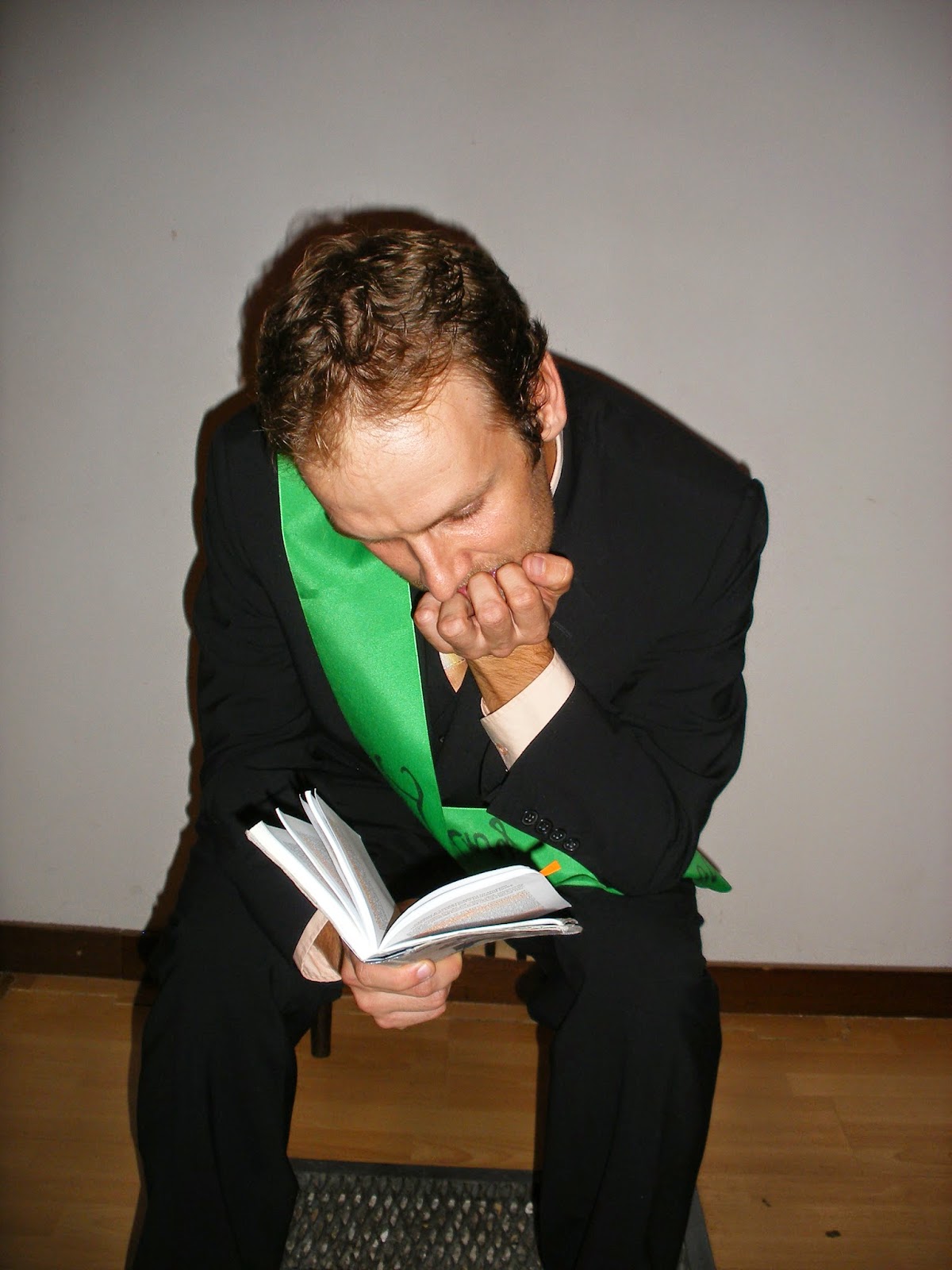
probably be embarrassed to know it, but one of my favorite memories of Braňo is of him dancing at his class’ stužková.
 He loved “South
Park” and lived for bicycling. He made
us laugh, sometimes when we weren’t supposed to, and he was lazy about
translating for us at staff meetings. He
encouraged us to be “casual” at all times, and used “stunning,” with varying
levels of irony, to describe things awful to wonderful. He brought a book along to his own class’ stužková, and took a break late
in the evening to sit and read, or at least pretended to.
He loved “South
Park” and lived for bicycling. He made
us laugh, sometimes when we weren’t supposed to, and he was lazy about
translating for us at staff meetings. He
encouraged us to be “casual” at all times, and used “stunning,” with varying
levels of irony, to describe things awful to wonderful. He brought a book along to his own class’ stužková, and took a break late
in the evening to sit and read, or at least pretended to.
Not dancing
formally with one of the fifth-year girls while parents and coworkers and other
students looked on; dancing like he meant it to “1-2-3-4” by Feist, from a CD
he’d burned specially for the event. See, during my third year Braňo somehow got roped into being the class teacher (akin
to a homeroom teacher) for 5A. Despite
his reluctance, I’m sure he performed his duties to the best of his
abilities. I’m even more sure that his
students, from that class and from all of the other ones he taught, held his
intellect in the highest esteem.
How could
they not? Everyone who knew him for more
than a few minutes had to. Braňo was one of the smartest people I’ve
ever known, if not the smartest, period.
When I knew him he was working on his dissertation for his PhD in
philosophy, focusing on Jewish philosophers; at EGT he taught philosophy and
English but only to the fourth and fifth years, because none of the younger
students would have much of a hope of keeping up with him. There were times when I couldn’t keep up with him when he was speaking my own language,
which he perfected while working, if I recall correctly, on a fishing boat in
the Pacific Northwest. Sometimes the
American teachers would take a look at the exercises he created for his English
classes, and we were often hard-pressed to come up with the correct
answers. This one has got to be my
favorite, since it combines the merciless incisiveness and humor that were so
integral to his nature.
Please just don’t annoy me with more
of your complaints! I wish you had been
born into a happier family. You would
have been given a better education and would have more confidence in
yourself. Now it’s too late.
He loved “South
Park” and lived for bicycling. He made
us laugh, sometimes when we weren’t supposed to, and he was lazy about
translating for us at staff meetings. He
encouraged us to be “casual” at all times, and used “stunning,” with varying
levels of irony, to describe things awful to wonderful. He brought a book along to his own class’ stužková, and took a break late
in the evening to sit and read, or at least pretended to.
I hate that
he’s dead. I hate that the way he died
makes his death all the more believable.
I hate that there are people who never got the pleasure of meeting him,
and that there are students who will never have the privilege of learning from
him. I hate that, at least in my
opinion, the length of his life was not proportional to the gifts he’d been
given, and that all the good he had the potential to do and to share will never
come to pass.
But even in
his too-short time he changed people’s lives.
The day he died my Facebook feed was filled with tributes from his
former students, remembering him as the best teacher they’d ever had and
thanking him for what he’d taught them. If
it were any of his colleagues I might doubt their sincerity, but he challenged his students and laughed with them and laughed at them and I know they learned from
him, probably even more than they realize.
Here is another
of my other favorite memories. One day
the class schedule had been messed about for some very Slovak, bureaucratic
reason that hadn’t been explained to us well, if at all. In roughly equal parts frustration and actual
curiosity I asked no one in particular, “Why is this happening?” Braňo looked up across the desk in the staff room and,
face entirely straight, answered, “Because of sin.” I think I laughed then, because I wrote it
down on a sticky note; and in the years since, when I’ve felt most put-upon by
events and asked that same question, I’ve thought of his response and it’s made
me smile. Though it’s hard to think of
that answer now, I’m sure one day in the future I’ll properly appreciate it
again.
While
looking for the exercise I quoted above I found an outline that Braňo had given us of the speech he had
to give at stužková. I could easily quote the whole thing, but I
think this is the best possible way to end a tribute to him: in his own words,
with hope.
May
you be lead by something more than just cleverness or even wisdom, may you be
seized by something much better than morality, may you be broken by the joy
coming from the thankfulness to the one, whose arms were and are strong and
wide enough to carry us all, who came to give us an actual reason to be joyful,
because he not only broke the coldness and indifference of the world around
you, but also the coldness in you.
Friday, November 14, 2014
Castle Run
A few weeks ago one of my former students shared a video on Facebook of a bunch of guys freerunning and parkouring around Spiš Castle. This was done with the castle's permission, because it was a professional video with sponsors and everything. The group, Born To Trick, has made a series of these videos called "Castle Run"; there are eight of them, each filmed in a different Slovak castle. This morning the poor soul who has the dubious distinction of being my best Slovak friend sent me a link to this video, done at Orava Castle. I can't imagine leaping about in that castle, where I felt so dizzy even when I looked at the pictures of it when I got home. Though I've not seen all of the videos yet, this one might end up being my favorite; besides the parkour it also features folk dancers, and that's what Slovakia is. It's people who are proud of their country, its culture and its natural beauty, and that celebrate that while embracing modern life.
Wednesday, October 5, 2011
Saturday, July 2, 2011
Leaving Home, Coming Home
I'm leaving Tisovec tonight; I'm leaving Slovakia tomorrow morning. Right now I have no words of my own to tell you what this means to me. I can't believe this day has come. I don't yet entirely believe that I won't be back in six weeks. I'm ready to see the people I love in the States, but I'm not ready to not see the people I love here.
As always, in the absence of my own words, I turn to someone else's. From The Prophet, here is Kahlil Gibran's "The Coming of the Ship" from Juan Cole's website.
Almustafa, the chosen and the beloved, who was a dawn unto his own day, had waited twelve years in the city of Orphalese for his ship that was to return and bear him back to the isle of his birth.
And in the twelfth year, on the seventh day of Ielool, the month of reaping, he climbed the hill without the city walls and looked seaward; and he beheld the ship coming with the mist.
Then the gates of his heart were flung open, and his joy flew far over the sea. And he closed his eyes and prayed in the silences of his soul.
But he descended the hill, a sadness came upon him, and he thought in his heart: How shall I go in peace and without sorrow? Nay, not without a wound in the spirit shall I leave this city.
Long were the days of pain I have spent within its walls, and long were the nights of aloneness; and who can depart from his pain and his aloneness without regret?
Too many fragments of the spirit have I scattered in these streets, and too many are the children of my longing that walk naked among these hills, and I cannot withdraw from them without a burden and an ache.
It is not a garment I cast off this day, but a skin that I tear with my own hands. Nor is it a thought I leave behind me, but a heart made sweet with hunger and with thirst.
Yet I cannot tarry longer. The sea that calls all things unto her calls me, and I must embark. For to stay, though the hours burn in the night, is to freeze and crystallize and be bound in a mould.
Fain would I take with me all that is here. But how shall I?
A voice cannot carry the tongue and the lips that give it wings. Alone must it seek the ether.
And alone and without his nest shall the eagle fly across the sun.
Now when he reached the foot of the hill, he turned again towards the sea, and he saw his ship approaching the harbour, and upon her prow the mariners, the men of his own land.
And his soul cried out to them, and he said:
Sons of my ancient mother, you riders of the tides,
How often have you sailed in my dreams. And now you come in my awakening, which is my deeper dream.
Ready am I to go, and my eagerness with sails full set awaits the wind.
Only another breath will I breathe in this still air, only another loving look cast backward,
Then I shall stand among you, a seafarer among seafarers.
And you, vast sea, sleepless mother, Who alone are peace and freedom to the river and the stream,
Only another winding will this stream make, only another murmur in this glade, And then shall I come to you, a boundless drop to a boundless ocean.
And as he walked he saw from afar men and women leaving their fields and their vineyards and hastening towards the city gates.
And he heard their voices calling his name, and shouting from the field to field telling one another of the coming of the ship.
And he said to himself:
Shall the day of parting be the day of gathering?
And shall it be said that my eve was in truth my dawn?
And what shall I give unto him who has left his plough in midfurrow, or to him who has stopped the wheel of his winepress?
Shall my heart become a tree heavy-laden with fruit that I may gather and give unto them?
And shall my desires flow like a fountain that I may fill their cups?
Am I a harp that the hand of the mighty may touch me, or a flute that his breath may pass through me?
A seeker of silences am I, and what treasure have I found in silences that I may dispense with confidence?
If this is my day of harvest, in what fields have I sowed the seed, and in what unrembered seasons?
If this indeed be the our in which I lift up my lantern, it is not my flame that shall burn therein.
Empty and dark shall I raise my lantern,
And the guardian of the night shall fill it with oil and he shall light it also.
These things he said in words. But much in his heart remained unsaid. For he himself could not speak his deeper secret.
And when he entered into the city all the people came to meet him, and they were crying out to him as with one voice.
And the elders of the city stood forth and said:
Go not yet away from us.
A noontide have you been in our twilight, and your youth has given us dreams to dream.
No stranger are you among us, nor a guest, but our son and our dearly beloved. Suffer not yet our eyes to hunger for your face.
And the priests and the priestesses said unto him:
Let not the waves of the sea separate us now, and the years you have spent in our midst become a memory.
You have walked among us a spirit, and your shadow has been a light upon our faces.
Much have we loved you. But speechless was our love, and with veils has it been veiled. Yet now it cries aloud unto you, and would stand revealed before you.
And ever has it been that love knows not its own depth until the hour of separation.
And others came also and entreated him.
But he answered them not. He only bent his head; and those who stood near saw his tears falling upon his breast.
And he and the people proceeded towards the great square before the temple. And there came out of the sanctuary a woman whose name was Almitra. And she was a seeress.
And he looked upon her with exceeding tenderness, for it was she who had first sought and believed in him when he had been but a day in their city.
And she hailed him, saying: Prophet of God, in quest for the uttermost, long have you searched the distances for your ship.
And now your ship has come, and you must needs go.
Deep is your longing for the land of your memories and the dwelling place of your greater desires; and our love would not bind you nor our needs hold you.
Yet this we ask ere you leave us, that you speak to us and give us of your truth. And we will give it unto our children, and they unto their children, and it shall not perish.
In your aloneness you have watched with our days, and in your wakefulness you have listened to the weeping and the laughter of our sleep.
Now therefore disclose us to ourselves, and tell us all that has been shown you of that which is between birth and death.
And he answered,
People of Orphalese, of what can I speak save of that which is even now moving your souls?
As always, in the absence of my own words, I turn to someone else's. From The Prophet, here is Kahlil Gibran's "The Coming of the Ship" from Juan Cole's website.
Almustafa, the chosen and the beloved, who was a dawn unto his own day, had waited twelve years in the city of Orphalese for his ship that was to return and bear him back to the isle of his birth.
And in the twelfth year, on the seventh day of Ielool, the month of reaping, he climbed the hill without the city walls and looked seaward; and he beheld the ship coming with the mist.
Then the gates of his heart were flung open, and his joy flew far over the sea. And he closed his eyes and prayed in the silences of his soul.
But he descended the hill, a sadness came upon him, and he thought in his heart: How shall I go in peace and without sorrow? Nay, not without a wound in the spirit shall I leave this city.
Long were the days of pain I have spent within its walls, and long were the nights of aloneness; and who can depart from his pain and his aloneness without regret?
Too many fragments of the spirit have I scattered in these streets, and too many are the children of my longing that walk naked among these hills, and I cannot withdraw from them without a burden and an ache.
It is not a garment I cast off this day, but a skin that I tear with my own hands. Nor is it a thought I leave behind me, but a heart made sweet with hunger and with thirst.
Yet I cannot tarry longer. The sea that calls all things unto her calls me, and I must embark. For to stay, though the hours burn in the night, is to freeze and crystallize and be bound in a mould.
Fain would I take with me all that is here. But how shall I?
A voice cannot carry the tongue and the lips that give it wings. Alone must it seek the ether.
And alone and without his nest shall the eagle fly across the sun.
Now when he reached the foot of the hill, he turned again towards the sea, and he saw his ship approaching the harbour, and upon her prow the mariners, the men of his own land.
And his soul cried out to them, and he said:
Sons of my ancient mother, you riders of the tides,
How often have you sailed in my dreams. And now you come in my awakening, which is my deeper dream.
Ready am I to go, and my eagerness with sails full set awaits the wind.
Only another breath will I breathe in this still air, only another loving look cast backward,
Then I shall stand among you, a seafarer among seafarers.
And you, vast sea, sleepless mother, Who alone are peace and freedom to the river and the stream,
Only another winding will this stream make, only another murmur in this glade, And then shall I come to you, a boundless drop to a boundless ocean.
And as he walked he saw from afar men and women leaving their fields and their vineyards and hastening towards the city gates.
And he heard their voices calling his name, and shouting from the field to field telling one another of the coming of the ship.
And he said to himself:
Shall the day of parting be the day of gathering?
And shall it be said that my eve was in truth my dawn?
And what shall I give unto him who has left his plough in midfurrow, or to him who has stopped the wheel of his winepress?
Shall my heart become a tree heavy-laden with fruit that I may gather and give unto them?
And shall my desires flow like a fountain that I may fill their cups?
Am I a harp that the hand of the mighty may touch me, or a flute that his breath may pass through me?
A seeker of silences am I, and what treasure have I found in silences that I may dispense with confidence?
If this is my day of harvest, in what fields have I sowed the seed, and in what unrembered seasons?
If this indeed be the our in which I lift up my lantern, it is not my flame that shall burn therein.
Empty and dark shall I raise my lantern,
And the guardian of the night shall fill it with oil and he shall light it also.
These things he said in words. But much in his heart remained unsaid. For he himself could not speak his deeper secret.
And when he entered into the city all the people came to meet him, and they were crying out to him as with one voice.
And the elders of the city stood forth and said:
Go not yet away from us.
A noontide have you been in our twilight, and your youth has given us dreams to dream.
No stranger are you among us, nor a guest, but our son and our dearly beloved. Suffer not yet our eyes to hunger for your face.
And the priests and the priestesses said unto him:
Let not the waves of the sea separate us now, and the years you have spent in our midst become a memory.
You have walked among us a spirit, and your shadow has been a light upon our faces.
Much have we loved you. But speechless was our love, and with veils has it been veiled. Yet now it cries aloud unto you, and would stand revealed before you.
And ever has it been that love knows not its own depth until the hour of separation.
And others came also and entreated him.
But he answered them not. He only bent his head; and those who stood near saw his tears falling upon his breast.
And he and the people proceeded towards the great square before the temple. And there came out of the sanctuary a woman whose name was Almitra. And she was a seeress.
And he looked upon her with exceeding tenderness, for it was she who had first sought and believed in him when he had been but a day in their city.
And she hailed him, saying: Prophet of God, in quest for the uttermost, long have you searched the distances for your ship.
And now your ship has come, and you must needs go.
Deep is your longing for the land of your memories and the dwelling place of your greater desires; and our love would not bind you nor our needs hold you.
Yet this we ask ere you leave us, that you speak to us and give us of your truth. And we will give it unto our children, and they unto their children, and it shall not perish.
In your aloneness you have watched with our days, and in your wakefulness you have listened to the weeping and the laughter of our sleep.
Now therefore disclose us to ourselves, and tell us all that has been shown you of that which is between birth and death.
And he answered,
People of Orphalese, of what can I speak save of that which is even now moving your souls?
Monday, May 30, 2011
The Work Outing
(In the spirit of non-plagiarism, the title is taken from the name of an episode of "The IT Crowd." It's not my favorite episode, but it was the first one I saw.)
F or the past two years, the school has been involved in an ecological project with other European schools. Some of our teachers and even students have visited other schools in Portugal, Norway, and Sweden, and now it's EGT's turn to host. As hosts, they've arranged excursions for the visiting teachers; today they're in the High Tatras, and yesterday there was a trip to a cave and a manor house. It may seem like an odd combination, but the two are fairly close to each other (and less than an hour from Tisovec). The boss invited us to go along on the trips, because she likes us to see the country. H'd already been to the cave and kaštiel, so Robin and I went along with the guests. They went in a small bus, and we went in the school car, where we saw nice views like this one here. Man, Slovakia is pretty.
The Ochtinská aragonite cave is one of only like three or four aragonite caves in the world. It is, of course, out in the middle of nowhere, and like Domica, the entrance is in a bizarre spaceshipesque building. Inside the cave there is pretty marble-like rock, which I liked, and the aragonite formations, like bleached sea urchins clinging to the roof of the cave. Most of them are smallish, but there's a big one called the Hedgehog. At this particular cave, I suppose because it's uncommon, they wanted 10 bleedin' euros to take pictures. I ask you. Needless to say, I have no pictures.

Then we went along to Betliar. Some websites and guidebooks call it a "castle," probably in part because the Slovak word kaštiel sounds like castle; but it's really a mansion or manor house. Generally I'd prefer to go to the really hardcore fortressy castles, and that's one of the reasons I hadn't been to Betliar before this; but it turned out to be really cool. The house belonged for many years to Hungarian noble families.
The first few rooms are standard Here's a bit of furniture, some swords, and a family tree of the people who used to hang out here; after that it gets weird, when you go into the Grotto, a faux-cave with somewhat poorly taxidermied local animals like wolves and bears and a boar, and weirder still in the rooms where there are trophies from Africa. There were some masks and spears and shields, and a couple crocodiles, and a sea turtle, and a gigantic snakeskin, and this monstrosity: What?
What?
After that it goes back to normal, more rooms and portraits and things. As we went through one room I saw a piece of furniture and thought, 'Where is the spinet?' and a few rooms later, there it was (I think it was really a fortepiano), with a bust of Beethoven on it and everything. One thing I thought was cool about the house was that the corners have square projections, sort of like towers or bay windows, and all the bathrooms are in those corners.
But really, the coolest room in the place is the library.

After the tour we walked around the grounds for a bit. It's got several odd little building that seem to serve no purpose, like a Masonic temple and a Chinese pagoda and Rob and I may or may not have climbed on one of them. You'll never know for sure.
 or the past two years, the school has been involved in an ecological project with other European schools. Some of our teachers and even students have visited other schools in Portugal, Norway, and Sweden, and now it's EGT's turn to host. As hosts, they've arranged excursions for the visiting teachers; today they're in the High Tatras, and yesterday there was a trip to a cave and a manor house. It may seem like an odd combination, but the two are fairly close to each other (and less than an hour from Tisovec). The boss invited us to go along on the trips, because she likes us to see the country. H'd already been to the cave and kaštiel, so Robin and I went along with the guests. They went in a small bus, and we went in the school car, where we saw nice views like this one here. Man, Slovakia is pretty.
The Ochtinská aragonite cave is one of only like three or four aragonite caves in the world. It is, of course, out in the middle of nowhere, and like Domica, the entrance is in a bizarre spaceshipesque building. Inside the cave there is pretty marble-like rock, which I liked, and the aragonite formations, like bleached sea urchins clinging to the roof of the cave. Most of them are smallish, but there's a big one called the Hedgehog. At this particular cave, I suppose because it's uncommon, they wanted 10 bleedin' euros to take pictures. I ask you. Needless to say, I have no pictures.

Then we went along to Betliar. Some websites and guidebooks call it a "castle," probably in part because the Slovak word kaštiel sounds like castle; but it's really a mansion or manor house. Generally I'd prefer to go to the really hardcore fortressy castles, and that's one of the reasons I hadn't been to Betliar before this; but it turned out to be really cool. The house belonged for many years to Hungarian noble families.
The first few rooms are standard Here's a bit of furniture, some swords, and a family tree of the people who used to hang out here; after that it gets weird, when you go into the Grotto, a faux-cave with somewhat poorly taxidermied local animals like wolves and bears and a boar, and weirder still in the rooms where there are trophies from Africa. There were some masks and spears and shields, and a couple crocodiles, and a sea turtle, and a gigantic snakeskin, and this monstrosity:
 What?
What?After that it goes back to normal, more rooms and portraits and things. As we went through one room I saw a piece of furniture and thought, 'Where is the spinet?' and a few rooms later, there it was (I think it was really a fortepiano), with a bust of Beethoven on it and everything. One thing I thought was cool about the house was that the corners have square projections, sort of like towers or bay windows, and all the bathrooms are in those corners.
But really, the coolest room in the place is the library.


After the tour we walked around the grounds for a bit. It's got several odd little building that seem to serve no purpose, like a Masonic temple and a Chinese pagoda and Rob and I may or may not have climbed on one of them. You'll never know for sure.
Sunday, May 29, 2011
Facts About Kežmarok
1. Kežmarok is in the Spiš region. Like all Spiš towns, it has a lot of evidence of the German settlers who lived there. One of the biggest clues is the German name for the town, Käsmark ("cheese market"). The town got its market privilege in the 13th century.
2. There are some pretty good views of the Tatras there.

3. The town castle is at the end of the old square. It's got some exhibits in the different towers, like one about a doctor from the town who was the first in Slovakia to take x-rays, and of course arms and armor. At the end of the tour are some rooms with displays on life in the town in the 19th and 20th centuries, including census information that said that the highest number of Jews in the town, before the war, was over a thousand, but that in the 2001 census there was only one Jew. There was also an old wartime street sign for Ulica Adolfa Hitlera/Adolf Hitler Strasse. It was somewhat comforting that the sign had bullet holes in it.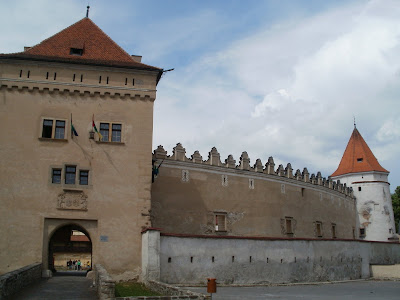 4. The castle's oldest tower has been significantly reconstructed and therefore has the safest stairs in all of Slovakia.
5. The town's lyceum has a library that is supposed to be pretty impressive, but is closed on Saturdays.
6. Here is a tank called Jánošík, across the street from the back of the castle.

7. The Basilica of the Holy Cross, also reputed to be impressive inside, also seemed to be closed (maybe for a wedding).
8. I thought maybe visitors could go up in the Renaissance belltower next to the basilica, but it, too, was apparently closed. Or maybe I just wasn't looking in the right places to go in these sites.
9. I did peek inside the Greek Orthodox church, but it was modern and had no cool icons or anything.
10. The exterior of the New Evangelic Church is light red and green, for some reason. The inside is light, with a very high ceiling and a set of steps leading up to the altar. On the right hand side about halfway down the nave is the mausoleum of Imre Thököly, a Hungarian nobleman who was a native of the town and supported Protestantism.

11. The best reason to go to Kežmarok is to see the UNESCO-listed articulated wooden church. It's right next to the new Lutheran church, and despite the name, the outer walls are plastered, so I wandered most of the way around it going, "What is this strange building?" before seeing the sign that said it was in fact the wooden church.
During the 17th and 18th century Slovakia (among other parts of Europe) had some of those laws that said that Protestants could build churches as long as they didn't use any nails. They also had to build on specific sites outside towns, they couldn't have towers or bells, and parishes had to pay for construction themselves. In the case of this particular church, there are two small stone rooms at the back (actually to the right of the altar, but on the side opposite the entrance) that were given to the church by the town.
The church was built in 1717 on a Greek cross plan. It measures 35 meters long, 31 meters wide, and 20 meters high (115'x102'x66'). The walls are made of red fir, the supporting columns of yew, the hardest wood found in Slovakia, and the altar and pulpit of lime. With the ground floor and six balconies, there is room for 1500 people. In this picture, taken stealthily from behind the pulpit, you can see that the church looks like the prettiest barn you've ever been in. The ceiling is painted like a partly cloudy blue sky, with saints around the edges. The altar looks like it's marble because it's painted so nicely. Everything is beautifully carved and painted, and most of the writing, like the saints' names and inscriptions near the altar, is in German. There aren't that many pictures of the interior online, which is disappointing, because it is very nice; but on the other hand, pictures aren't as cool as actually walking in and seeing it yourself.
2. There are some pretty good views of the Tatras there.
3. The town castle is at the end of the old square. It's got some exhibits in the different towers, like one about a doctor from the town who was the first in Slovakia to take x-rays, and of course arms and armor. At the end of the tour are some rooms with displays on life in the town in the 19th and 20th centuries, including census information that said that the highest number of Jews in the town, before the war, was over a thousand, but that in the 2001 census there was only one Jew. There was also an old wartime street sign for Ulica Adolfa Hitlera/Adolf Hitler Strasse. It was somewhat comforting that the sign had bullet holes in it.
4. The castle's oldest tower has been significantly reconstructed and therefore has the safest stairs in all of Slovakia.5. The town's lyceum has a library that is supposed to be pretty impressive, but is closed on Saturdays.
6. Here is a tank called Jánošík, across the street from the back of the castle.
7. The Basilica of the Holy Cross, also reputed to be impressive inside, also seemed to be closed (maybe for a wedding).
8. I thought maybe visitors could go up in the Renaissance belltower next to the basilica, but it, too, was apparently closed. Or maybe I just wasn't looking in the right places to go in these sites.
9. I did peek inside the Greek Orthodox church, but it was modern and had no cool icons or anything.
10. The exterior of the New Evangelic Church is light red and green, for some reason. The inside is light, with a very high ceiling and a set of steps leading up to the altar. On the right hand side about halfway down the nave is the mausoleum of Imre Thököly, a Hungarian nobleman who was a native of the town and supported Protestantism.
11. The best reason to go to Kežmarok is to see the UNESCO-listed articulated wooden church. It's right next to the new Lutheran church, and despite the name, the outer walls are plastered, so I wandered most of the way around it going, "What is this strange building?" before seeing the sign that said it was in fact the wooden church.
During the 17th and 18th century Slovakia (among other parts of Europe) had some of those laws that said that Protestants could build churches as long as they didn't use any nails. They also had to build on specific sites outside towns, they couldn't have towers or bells, and parishes had to pay for construction themselves. In the case of this particular church, there are two small stone rooms at the back (actually to the right of the altar, but on the side opposite the entrance) that were given to the church by the town.
The church was built in 1717 on a Greek cross plan. It measures 35 meters long, 31 meters wide, and 20 meters high (115'x102'x66'). The walls are made of red fir, the supporting columns of yew, the hardest wood found in Slovakia, and the altar and pulpit of lime. With the ground floor and six balconies, there is room for 1500 people.
In this picture, taken stealthily from behind the pulpit, you can see that the church looks like the prettiest barn you've ever been in. The ceiling is painted like a partly cloudy blue sky, with saints around the edges. The altar looks like it's marble because it's painted so nicely. Everything is beautifully carved and painted, and most of the writing, like the saints' names and inscriptions near the altar, is in German. There aren't that many pictures of the interior online, which is disappointing, because it is very nice; but on the other hand, pictures aren't as cool as actually walking in and seeing it yourself.
Saturday, May 28, 2011
Stormy Weather
First, a quick announcement: Happy fourth birthday yesterday, blog!
It took about an hour to upload this to YouTube, so the storm has stopped for now. Chances are good that it'll start up again, but I'm prepared with lots of candles for the anticipated power outage and various accoutrements for when I have to go outside.
Ah, there it goes again. Rain boots, engage!
*For some reason we teachers here always talk about when we woke up on weekends/holidays. Sleeping past 8 is quite an accomplishment.
Also, please note that footnotes are now clickable. Progress!
As you no doubt remember, last spring was exceptionally rainy. In comparison, this one has been quite dry. Until today (dun dun dun). The rain woke me up at 2 this morning, and had stopped by the second time I woke up at 7,* although there were some clouds lurking in the sky. I'd planned to go to a castle ruin, Pustý hrad, near Zvolen, but I didn't feel sanguine about my chances of not getting rained on as I walked around, so I decided to stay home. I feel this was a good choice.
We've had strong rain, thunder and lightning, and hail. The thunder was more impressive in real life than it sounds here, but you can see the lightning pretty well.
It took about an hour to upload this to YouTube, so the storm has stopped for now. Chances are good that it'll start up again, but I'm prepared with lots of candles for the anticipated power outage and various accoutrements for when I have to go outside.
Ah, there it goes again. Rain boots, engage!
*For some reason we teachers here always talk about when we woke up on weekends/holidays. Sleeping past 8 is quite an accomplishment.
Also, please note that footnotes are now clickable. Progress!
Wednesday, May 18, 2011
Maturita Update
Even though having examined 44 students in the past three days (with 7 to go tomorrow) has melted my brain, there's one thing that makes it worthwhile, the most important part of maturita week... 

BRYNDZA CAKES.
Monday, May 16, 2011
Practicalities #4B: The Train
The other public-transportation option for getting out of Tisovec is the train. The same website gives train information, including international trains. (It does used to lie about one particular train, though; there really isn't one that leaves Brezno and goes south at 16:29 on Saturdays.)
Trains are rad. I prefer taking the train to taking the bus. It's a bit more expensive (€1.38 for the train between Tisovec and Hnúšťa and about €.80 for the bus), but worth it: There are usually fewer people on the train, and it's more fun to look out the window, and you can ride backwards. The train from Tisovec to Brezno goes through one tunnel, where if the lights don't come on you can harass your friends in the dark; and over a few bridges that pass over the road, which is fun until your train unexpectedly stops in the middle of one and hangs out there for a few minutes.
In Tisovec there are two stops, Mesto and the main station. Mesto is the closer to us; the main one is about 15 minutes' walk to the north. Neither Tisovec stop has any kind of ticket office, nor do many small-town stations. You buy your ticket onboard from the conductor. From bigger towns and cities you buy your ticket at the station. There was no graffiti on the station when I first got here. :(
Also, at small stations (even Brezno, pictured below) you might have to walk over one set of tracks to get to your platform. This is considered acceptable and safe. Why wouldn't it be?
The trains that go through Tisovec are two cars at most. Usually there's only one. For this reason I call it the "tiny train."


Here's a tiny train passing by my apartment yesterday evening on its way south to Jesenské. The drivers always blow their horns around this point—that's the only way I knew when to start recording.
Slovak trains also encourage you to throw things out the window and jump out.
Most of the trains that pass through Bystrica are full-sized ones, with more amenities. They have compartments, just like in "Harry Potter" (but without the Dementors), although whenever I'm sitting in a compartment I get nervous about when my stop is and how much time it'll take me to gather my things and disembark. Of course there are overnight compartments, too. When you get up in the Tatras and other more-touristed areas, the station announcements are in Slovak, German, and English, but 'round here they're only in Slovak.
Trains are rad. I prefer taking the train to taking the bus. It's a bit more expensive (€1.38 for the train between Tisovec and Hnúšťa and about €.80 for the bus), but worth it: There are usually fewer people on the train, and it's more fun to look out the window, and you can ride backwards. The train from Tisovec to Brezno goes through one tunnel, where if the lights don't come on you can harass your friends in the dark; and over a few bridges that pass over the road, which is fun until your train unexpectedly stops in the middle of one and hangs out there for a few minutes.
In Tisovec there are two stops, Mesto and the main station. Mesto is the closer to us; the main one is about 15 minutes' walk to the north. Neither Tisovec stop has any kind of ticket office, nor do many small-town stations. You buy your ticket onboard from the conductor. From bigger towns and cities you buy your ticket at the station.
There was no graffiti on the station when I first got here. :(Also, at small stations (even Brezno, pictured below) you might have to walk over one set of tracks to get to your platform. This is considered acceptable and safe. Why wouldn't it be?
The trains that go through Tisovec are two cars at most. Usually there's only one. For this reason I call it the "tiny train."
Here's a tiny train passing by my apartment yesterday evening on its way south to Jesenské. The drivers always blow their horns around this point—that's the only way I knew when to start recording.
Slovak trains also encourage you to throw things out the window and jump out.
Most of the trains that pass through Bystrica are full-sized ones, with more amenities. They have compartments, just like in "Harry Potter" (but without the Dementors), although whenever I'm sitting in a compartment I get nervous about when my stop is and how much time it'll take me to gather my things and disembark. Of course there are overnight compartments, too. When you get up in the Tatras and other more-touristed areas, the station announcements are in Slovak, German, and English, but 'round here they're only in Slovak.
Riding the train here is nothing like riding Amtrak at home. It's far, far cheaper, for one, but Europe just has a completely different idea of what train travel is than North America does. I'll really miss taking the trains here, and I hope train travel becomes more inexpensive and efficient at home, so I can enjoy it there, too.
Practicalities #4A: The Bus
 I'm always saying how I took the bus or the train from here to there, so I thought I'd elaborate on what "the bus" and "the train" mean.
When you want to leave Tisovec, you must first figure out how you're going to go. This involves going to http://www.cp.sk/, where you fill in when and from where you're leaving and where you want to go, and it tells you what buses, trains, or combination thereof you can take. (If you're leaving Slovakia, you usually also check a private company like Eurolines.) Then—and this is VERY IMPORTANT—you write down not only the times that you want, but all of the other times in the general vicinity of the ones you want. This is so that when you miss a bus or one just doesn't show, you have a backup plan. You also write down the route the bus is taking and where you have to make connections. I usually have pieces of paper in my bag that say things like
6:08-8:39 Z
9:10-9:50 pl 3
(bus leaving Tisovec at 6:08 and arriving at Zvolen in 8:39, then subsequent bus leaving Zvolen from platform 3 at 9:10 and arriving in Banská Štiavnica at 9:50)
or
13:35-15:05 BB
15:50-16:40 B pl 21
16:49-17:54 t
(bus to Banská Bystrica, bus from platform 21 there to Brezno, train from Brezno to Tisovec).
If you don't have these things, then you must have a cell phone and a friend with an internet connection to check cp.sk for you, or a place to stay the night, or all of the above. This is the Voice of Experience talking.
The main bus stop in Tisovec is in front of the church, but there's one to the north on the way to Brezno and two to the south on the way to Hnúšťa. Here's the catch (one of many): it has to be a local intercity bus to stop at one of those stops, or you have to be able to explain in Slovak where you want to get off and hope that the driver is obliging.
Speaking of obliging, sometimes the bus will stop and instead of actually getting on, someone will talk to the driver and give him a bag or a box and then get off. Then at another stop someone will collect the parcel from the driver. I seem to remember once the thing that was being delivered was eggs.
On long trips there's often a stop, usually in a town. These stops, which are not marked on the schedule, can range from 10 to 45 minutes. Big bus stations like Bystrica, which is probably the most frequent stopping-point, have restrooms and food stands, with "burgers" and langoš (Slovak frybread; sources report that the best langoš is at the Bratislava bus station). If it's a long break, the driver may kick people off the coach.

 The long-haul buses, like those going from Košice to Bratislava, for example, are usually nice big coaches, Volvos or Scanias or the like. The two pictures above are the Scania coach we took to Hungary. The shorter-range buses can be nice, but they can also be pretty cruddy. Both the very first picture and the one below are shorter-range buses. It's really a crapshoot what kind of bus is going to show up.
It seems like the drivers own their own buses, because some of them have done a lot of interior personalization in the front windows. There's often Slovakia memorabilia, sometimes garlands of fake flowers, saints or crucifixes, and small stuffed animals (keep in mind the great majority of drivers are men). The best decoration was probably one on a bus that Bear often rode last year: a tiny novelty t-shirt that said "Sexy Boy."
The worst things about the bus are that it's easy to feel motion sick, especially going to Brezno or Muráň, and there's often not much legroom, and sometimes you get the smelly drunk dude sitting next to you, and on occasion the bus you're waiting for just doesn't show up, and every once in a while it's really crowded and you have to stand up for a bit. The good things are that the buses are pretty frequent, especially between Tisovec and Brezno, so there's always a good chance of getting home as long as you can at least get to Brezno, and they're mostly cheap, and pretty safe, even if the driver seems a little reckless. Riding the bus: all part of the adventure.
Sunday, May 15, 2011
Hell Maturita Week
This is the beginning of a very important week. It’s maturita time.
...There should have been more of a clamor after that dramatic statement. You don’t know what the maturita is? That’s likely because it’s very much a European rite of passage, especially here in Central and Eastern Europe.
The maturitas (maturity, if you want the proper plural) are end-of-school leaving exams. All Slovak students must take the Slovak exam, and of course at bilingual schools the students must take a foreign language exam as well, so our students all take the English maturita. After that students may choose a few subjects and they take intensive seminars on these throughout their final year to prepare them for the maturita. These subjects include geography, biology, and their second foreign language, among others. At EGT the kids take the Slovak maturita in their fourth year, and all others their fifth year. For some of the tests, including Slovak, English, and history, there is a separate written component completed earlier in the spring. The main event is the oral exam.
I can only speak about the subjects that I’ve been involved in, which are English and history, but this is the basic form. There are 30 possible tasks, and each task has three parts. The first student comes in and chooses a number from cards face-down on the table. Then he or she gets about 30 minutes to prepare. Students may write notes for themselves during this time, and some questions have specific aids, like articles, maps, or pictures. At the end of the 30 minutes the student must talk about the three questions in front of a panel of three proctors. As one student begins talking, another is preparing. The proctors ask questions to help the students. The students talk for 20 to 30 minutes or until they’ve entirely exhausted their abilities.
There are very particular rules about the proctors. Each panel must have an outside proctor who is not an EGT teacher, and for the bilingual subjects one proctor must be a native English speaker or equivalent. Obviously, the proctors are supposed to be qualified and know the answers for all the 90 possible tasks.
Scoring, like all grades, is on a scale of 1 to 5. Opposite to the Advanced Placement exams in the US, a 1 is the best score and a 5 is the worst. Each question is scored, then the proctors decide what the student’s overall score should be. Then there’s a complicated formula that’s like (a certain number of points X the score from task 1) + (another number of points X score from task 2) + (some more points X score from task 3) / 10 or 3 or something, I don’t even know, obviously I’m not in charge of anything involving math because this is serious business. About five students do their tests, then the proctors discuss, then the students come back in and the head of the panel asks if it’s alright to read all their scores aloud (no one ever says no). Then she reads their scores and all the proctors shake the kids’ hands. As you can imagine, this can be rather awkward if a kid doesn’t pass. I’m never really sure what to say, anyway.
Two years ago I was on the history panel. I learned a lot from it, because each task has at least one question about Slovak/Czechoslovak history, and though the students answer this question in Slovak, the headmistress made them summarize what they’d said in English for me. When I first got the packet of questions I felt a little like the students must feel: overwhelmed at everything they need to know. I originally had an example of a task posted, but I've decided to take it down, because the tasks sometimes don't change that much year to year and I don't want to risk doing the wrong thing.
History is a good panel to be on because usually only 20 to 30 kids take it, so it’s usually only one day. English, on the other hand, is four days this year and was five days in the past two years. Usually they try to divide the proctoring between two American teachers, but this year I am the duty native speaker, so I’ll be here all week, folks. This is because I was the only one who taught the fifth years their British and American history review course, and the English maturita for some strange reason includes a question about history/geography/social studies of English-speaking countries. So I’m the only one who knows the answers to all the history questions. The English tasks also include one conversation topic and one (British/American) literature question. The conversation topics cover everything from stereotypes of different nationalities to sport to whether it’s better to live in a village or a city.
While some people say that the maturita really has no bearing on students’ futures, it’s nonetheless an important part of their schooling and culture. And for about 11 hours a day for the next four days, it’s going to be an important part of my life, too.
...There should have been more of a clamor after that dramatic statement. You don’t know what the maturita is? That’s likely because it’s very much a European rite of passage, especially here in Central and Eastern Europe.
The maturitas (maturity, if you want the proper plural) are end-of-school leaving exams. All Slovak students must take the Slovak exam, and of course at bilingual schools the students must take a foreign language exam as well, so our students all take the English maturita. After that students may choose a few subjects and they take intensive seminars on these throughout their final year to prepare them for the maturita. These subjects include geography, biology, and their second foreign language, among others. At EGT the kids take the Slovak maturita in their fourth year, and all others their fifth year. For some of the tests, including Slovak, English, and history, there is a separate written component completed earlier in the spring. The main event is the oral exam.
I can only speak about the subjects that I’ve been involved in, which are English and history, but this is the basic form. There are 30 possible tasks, and each task has three parts. The first student comes in and chooses a number from cards face-down on the table. Then he or she gets about 30 minutes to prepare. Students may write notes for themselves during this time, and some questions have specific aids, like articles, maps, or pictures. At the end of the 30 minutes the student must talk about the three questions in front of a panel of three proctors. As one student begins talking, another is preparing. The proctors ask questions to help the students. The students talk for 20 to 30 minutes or until they’ve entirely exhausted their abilities.
There are very particular rules about the proctors. Each panel must have an outside proctor who is not an EGT teacher, and for the bilingual subjects one proctor must be a native English speaker or equivalent. Obviously, the proctors are supposed to be qualified and know the answers for all the 90 possible tasks.
Scoring, like all grades, is on a scale of 1 to 5. Opposite to the Advanced Placement exams in the US, a 1 is the best score and a 5 is the worst. Each question is scored, then the proctors decide what the student’s overall score should be. Then there’s a complicated formula that’s like (a certain number of points X the score from task 1) + (another number of points X score from task 2) + (some more points X score from task 3) / 10 or 3 or something, I don’t even know, obviously I’m not in charge of anything involving math because this is serious business. About five students do their tests, then the proctors discuss, then the students come back in and the head of the panel asks if it’s alright to read all their scores aloud (no one ever says no). Then she reads their scores and all the proctors shake the kids’ hands. As you can imagine, this can be rather awkward if a kid doesn’t pass. I’m never really sure what to say, anyway.
Two years ago I was on the history panel. I learned a lot from it, because each task has at least one question about Slovak/Czechoslovak history, and though the students answer this question in Slovak, the headmistress made them summarize what they’d said in English for me. When I first got the packet of questions I felt a little like the students must feel: overwhelmed at everything they need to know. I originally had an example of a task posted, but I've decided to take it down, because the tasks sometimes don't change that much year to year and I don't want to risk doing the wrong thing.
History is a good panel to be on because usually only 20 to 30 kids take it, so it’s usually only one day. English, on the other hand, is four days this year and was five days in the past two years. Usually they try to divide the proctoring between two American teachers, but this year I am the duty native speaker, so I’ll be here all week, folks. This is because I was the only one who taught the fifth years their British and American history review course, and the English maturita for some strange reason includes a question about history/geography/social studies of English-speaking countries. So I’m the only one who knows the answers to all the history questions. The English tasks also include one conversation topic and one (British/American) literature question. The conversation topics cover everything from stereotypes of different nationalities to sport to whether it’s better to live in a village or a city.
While some people say that the maturita really has no bearing on students’ futures, it’s nonetheless an important part of their schooling and culture. And for about 11 hours a day for the next four days, it’s going to be an important part of my life, too.
Saturday, May 7, 2011
Trenčín
Slovakia, as we have no doubt previously discussed, is not a big country. It is about twice the size of Wales, or four times the size of Jamaica, or, like, a twentieth the size of Canada (thank you, Across Cultures). It should take about 10 hours to drive clear across the country east-west, or about five north-south. But as I didn't have the foresight two years ago to buy a used car and learn to drive stick, I still have to rely on public transportation, and so it took Robin and me six hours and three buses to get to Trenčín on Friday afternoon.
We liked the city immediately. The center is a short walk from the bus and train stations, passing the rock outcrop the castle's built on. Trenčín has many lodging options, but we stayed in the Hotel Grand. It is by far the swankiest place I've stayed in Slovakia. Accordingly it was a bit spendy. I regret nothing.
 A stage with a big screen and a sound system were set up in Mierové namestie, the main square, and a crowd had gathered to watch Slovakia play (and, unfortunately, lose to) the Czech Republic in the hockey championships. We watched most of the game in a restaurant called Mexiko. Their interpretation of enchiladas was pretty wide of the mark, but the mojitos were good.
On Saturday morning we got to see the town without a lot of people around before heading up to the castle. There's a covered stairway that goes partway up the hill and leads to Marianské namestie, a little square consisting of a church and a smaller chapel. There was a mass in progress, but even if the church had been open, it was too full of scaffolding to see anything interesting.
At the castle gate we bought our tickets for the tour starting at 9:45. (The photo fee was a very reasonable .70€.) Tours start at the gate to an inner courtyard, so we looked around some before and saw a baby trebuchet and a new phenomenon, castle goats. At t he outset our guide told us she didn't speak much English and then proceeded to give us the most salient points in perfectly serviceable English.
Trenčín's recorded history dates back to the Roman Empire, when Roman soldiers defeated a local Germanic tribe and then wrote about it on the cliff that the castle would later occupy.* The oldest part of the castle is a rotunda built in the 9th or 10th century of which now only ruins remain. Much of the castle was destroyed by fire in the late 18th century and thus there's been a lot of reconstruction, but whatever. I'm giving this one a pass. The most famous master of the castle was Matúš Čak (Csak in Hungarian), who held the cool title "Lord of the Váh and the Tatras." The tallest tower is named for Matúš and dates from the 14th century.
Tower-climbing story of the day: This one is unique because there isn't one continuous staircase all the way up. You go up a floor, walk through a room to a different corner, and take a different staircase. They're all pretty narrow and have very short doorways. Only the last one is a spiral, too.
Our tour over, we went back down to the lower area and saw that t here was a mini historical reenactment camp set up, including an old-school wooden merry-go-round. Then Rob spotted a guy shooting arrows, and asked him if she could try. It was a euro for four arrows and we both had a go. I SHOT ARROWS IN A CASTLE. Just clarifying that for the record. For another euro, the blacksmith at the forge let visitors strike their own commemorative coins by whacking a simple die with a hammer. Trenčianský hrad wins for activities.
Then, as so many of these stories go, we ate some ice cream and departed the town.
Trenčín is a good place. You don't really need to be there more than a day; it would be a good excursion from Bratislava.
The next post will be about a special mid-week adventure happening this Wednesday and Thursday. For the sake of my third-year history class, I'm going back...to Hungary.
*Guidebooks will tell you the inscription can be seen through a window at the back of the Hotel Tatra, which is built right up against the cliff. Said hotel is currently under massive interior reconstruction and is closed for a bit, so don't plan on being able to see the writing anytime soon. There's a replica on display at the castle.
We liked the city immediately. The center is a short walk from the bus and train stations, passing the rock outcrop the castle's built on. Trenčín has many lodging options, but we stayed in the Hotel Grand. It is by far the swankiest place I've stayed in Slovakia. Accordingly it was a bit spendy. I regret nothing.
 A stage with a big screen and a sound system were set up in Mierové namestie, the main square, and a crowd had gathered to watch Slovakia play (and, unfortunately, lose to) the Czech Republic in the hockey championships. We watched most of the game in a restaurant called Mexiko. Their interpretation of enchiladas was pretty wide of the mark, but the mojitos were good.
On Saturday morning we got to see the town without a lot of people around before heading up to the castle. There's a covered stairway that goes partway up the hill and leads to Marianské namestie, a little square consisting of a church and a smaller chapel. There was a mass in progress, but even if the church had been open, it was too full of scaffolding to see anything interesting.
At the castle gate we bought our tickets for the tour starting at 9:45. (The photo fee was a very reasonable .70€.) Tours start at the gate to an inner courtyard, so we looked around some before and saw a baby trebuchet and a new phenomenon, castle goats. At t
 he outset our guide told us she didn't speak much English and then proceeded to give us the most salient points in perfectly serviceable English.
Trenčín's recorded history dates back to the Roman Empire, when Roman soldiers defeated a local Germanic tribe and then wrote about it on the cliff that the castle would later occupy.* The oldest part of the castle is a rotunda built in the 9th or 10th century of which now only ruins remain. Much of the castle was destroyed by fire in the late 18th century and thus there's been a lot of reconstruction, but whatever. I'm giving this one a pass. The most famous master of the castle was Matúš Čak (Csak in Hungarian), who held the cool title "Lord of the Váh and the Tatras." The tallest tower is named for Matúš and dates from the 14th century.
Tower-climbing story of the day: This one is unique because there isn't one continuous staircase all the way up. You go up a floor, walk through a room to a different corner, and take a different staircase. They're all pretty narrow and have very short doorways. Only the last one is a spiral, too.
Our tour over, we went back down to the lower area and saw that t

 here was a mini historical reenactment camp set up, including an old-school wooden merry-go-round. Then Rob spotted a guy shooting arrows, and asked him if she could try. It was a euro for four arrows and we both had a go. I SHOT ARROWS IN A CASTLE. Just clarifying that for the record. For another euro, the blacksmith at the forge let visitors strike their own commemorative coins by whacking a simple die with a hammer. Trenčianský hrad wins for activities.
Then, as so many of these stories go, we ate some ice cream and departed the town.
Trenčín is a good place. You don't really need to be there more than a day; it would be a good excursion from Bratislava.
The next post will be about a special mid-week adventure happening this Wednesday and Thursday. For the sake of my third-year history class, I'm going back...to Hungary.
*Guidebooks will tell you the inscription can be seen through a window at the back of the Hotel Tatra, which is built right up against the cliff. Said hotel is currently under massive interior reconstruction and is closed for a bit, so don't plan on being able to see the writing anytime soon. There's a replica on display at the castle.
Friday, April 29, 2011
Slovensko Do Toho
Forget the royal wedding; Slovakia's got other things on its mind today, the beginning of the 2011 International Ice Hockey Federation World Championships. This would be a big deal in any hockey-crazy country, but it's an even bigger deal here because this year Slovakia's the host. From now until May 15, games will be played in Bratislava and Košice, with 16 teams competing. Fan gear is all over the place here, and lots of businesses are using hockey in their advertising.
Wednesday, April 27, 2011
Banská Štiavnica
 Before we returned to school today I managed to squeeze in one more day trip. Tuesday was a working day, though not a school day, so the buses were running normally, and I found that it was easier to get to Banská Štiavnica on a weekday than on a weekend.
Banská Štiavnica is a former mining town. Back in the olden days, there was gold in them thar hills, and silver, too. The town became the site of a mining academy, and one of the most prosperous areas in Slovakia. It has not one but two castles, many churches, and a lot of handsome buildings.
If you're planning on visiting Banská Štiavnica, the first thing you need to know is that it's in a hilly area, so there's lots of going up. The second is that if you're going by bus, you should get off at the Križovatka stop, which is the one right in front of the Billa. Then, facing Billa, turn left and walk up the street until it becomes Dolna, which takes you right up to the historic center. Ahab: Getting off at the wrong bus stop so you don't have to.
I was in the town for a good four hours, but I don't feel like I did four hours worth of anything. What I did do was visit one of the many museums, the Kammerhof, which had exhibits about mining and the life of the miners. It made me realize that mining would be a horrible job for me personally, and that it couldn't have been fun for anyone. Of the objects on display I especially liked the models of mines built in bottles.
As previously mentioned, the town has two castles, although in Slovak these are zámky, not
 hrady. The newer, Nový Zámok, has an exhibit on the defence of the town from the Turks, and I walked up the hill to see the castle itself, but didn't go in. Instead I visited Starý Zámok. When I first was reading the various sites' opening hours, one listed the Old Castle as being closed on Mondays AND Tuesdays in April, and for a while I was pretty miffed about it. There was a small door open at the castle itself, though, and there were listed special Easter hours, saying that it was indeed open. Huzzah!
As in Kremnica, this Old Castle is a walled enclosure around a central building. I liked the one in Banská Štiavnica better than Kremnica, for a few reasons. One: there were no workers digging things up and looking somewhat reproachful at visitors. Two: the Old Castle is smaller and cozier. Three: there's a walkway around the inside of the wall. Four: I saw a squirrel there. It used the stairs and ran up and down the walkway and then sat on the roof and ate a nut.
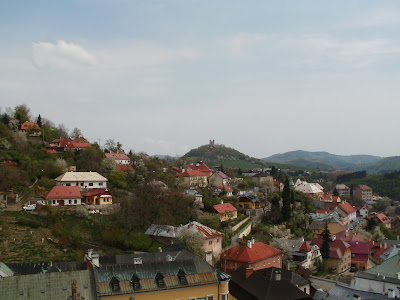
In the towers on the wall there are different displays. One, called Himmelreich, was the prison tower, and still has old manacles and plank beds with iron restraints. Another has various pieces of decorative ironwork, and another has keys and locks and tools all made of iron. I liked going in the bell tower the best. It had big doors that opened up with views of the town (as below), and descriptions of the three bells, the oldest of which is from the 16th century.
I'm not entirely sure what the building in the middle of the
 complex originally was. In its courtyard and the rooms off it there are displayed a number of sculptures and monumental carvings. On the second and third floors there appear to be offices or something. On one corner there is the most pointless spiral staircase, as it literally just leads into a wooden roof. The cool thing about it is that instead of a plain, solid circular central post, the staircase has a three-part, open Gothic column.
There are lots of things I didn't get to do in town. There are two different parts of old mines that you can tour, other museums and galleries, and a very famous Calvary on the hill opposite the Old Castle. As I got ready to leave, I felt like I hadn't gotten everything I could have out of Banská Štiavnica. Maybe if I had had more time, or gone earlier, or had been with someone who could communicate more clearly than I can? I'm not sure. While it is certainly a nice place to visit, and probably worthy of its UNESCO listing, I was merely whelmed by the town. I did have some delicious mandarinky zmrzlina on the way to the bus stop, though.
Friday, April 22, 2011
A Brief Tour of Lučenec
When you come into Lučenec from the east, the first thing you see is a ginormous silver double cross.
At the bus station, you'll find very nice, new facilities. The bathrooms are especially noteworthy. You don't have to pay to use them, and they have Dyson Airblade hand dryers.
In the historic center, there's this church
and this one,
and this knight who's half wood and half metal. The descriptions are in Slovak and Latin, so I should understand what it's all about between the two languages, but I don't. Something about defending the town in 1551.
Then you walk down the street to find the old synagogue.
Finally you go to the town park, which is rather big and really quite nice. 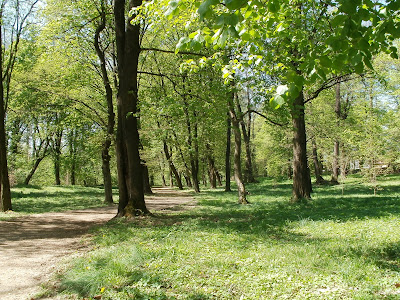
Then you go home and cross another one off your list.
Thursday, April 21, 2011
Kremnica
 We in Slovakia are on Easter break starting today. As you can tell by the fact that I'm writing a blog, I've not gone abroad anywhere. This is because I procrastinatoriously failed to buy plane tickets somewhere before they got too expensive. So while I'm not in France, as I'd hoped to be, I do have the opportunity to chip away at my list of places I still have to see before I leave.
Today I went to Kremnica. This town is most famous for having something like the oldest continuously-operated mint in the world. The town itself was granted a charter in 1328. The old part has double fortifications: one wall around the square and the mint, and another around the castle complex on a hill.
As I said before, it's a castle complex, not one castle building. To be honest, it's not all that castley. The most important part of the complex is the cathedral...which is closed for renovation. It's supposed to be really impressive inside. In the complex you can also go in (from left to right below) the bell tower, the cathedral tower, the north tower with an exhibit on archaelogical finds and the defense of the castle, and the pink tower, which incorporates the oldest building there, a Romanesque chapel and ossuary.
When the guide was telling me about the cathedral tower, she said it was a strenuous climb of 127 steps, at which I thought that 127 wasn't too bad. The sign outside the tower itself says, among other things, "Going up the 127 winding stairs is pretentious." I laughed, and then started up, and then agreed, as long as your definition of pretentious is "terrifying as hell." Why do I keep going up these towers with the really steep, really narrow steps? I don't like being afraid; but I always go. When I was almost at the top, I heard people coming down, so I pulled over into a little alcove to let them go by, and these two workers literally ran down the stairs, as if to mock me.
The town museum is quite good. It includes exhibits on the history and guilds of the city, the mining process, medals and medallions, and, my favorite part, money in the area and Slovakia in general, from the earliest Celtic coins to the euro. I recommend visiting this museum. You might have to hang out for a while to get in, though, depending on whether the one guide is giving a tour or is available to sell you a ticket.
It was a good one-day trip (I left just after 6 this morning and got back just after 6 this evening, for the record). Maybe if I'd gone earlier in my Slovakia time I would've been more wowed by Kremnica, or maybe if I'd been able to go in the cathedral, but it was still a pleasant day and I enjoyed it.
Sunday, April 17, 2011
In Living Color
For about a year, Blogger hasn't let me post videos directly to my blog. I investigated moving to a different service, but the one I was interested in charged for video uploading, and that was not going to happen, so I stayed put and just didn't post videos. But after the accordion madness, something had to be done. I needed you to be able to see the accordion videos! To that end, I broke down and signed up with YouTube.
If I've marked everything correctly, you won't be able to comment on the videos on YouTube, nor will they come up in a search. People are rude and ignorant when commenting on that site, and I don't want to have to deal with that; the videos are only going on there since Google Video is kaput. So I know the videos are poor quality, often shaky, blah blah blah. Most of them were taken on a digital camera (although a few were done with my mom's camcorder), and I have problems holding still. It's not necessary for you to tell me these things.
Now I'm going to post some of the videos that I would have done in the past had I had the ability. First up is the bus tour of Kraków from last July, at a dizzying quadruple speed.
Next, what Tisovec looks like from the fourth floor of the hotel.
Here are the bells from York Minster.
And finally some head-butting sheeps.Saturday, April 16, 2011
The Best Homework I've Ever Assigned
Last week in 20th century history I asked the fourth and fifth years to write a short response (220-250 words) to the question "How do the events of the Cold War/Communist era affect my life today?" I wanted them to think and to connect the present to historical events. As an example, I told the kids that one of the products of this time was a drink created in Czechoslovakia to compete with sodas like Coca-Cola: my beloved Kofola.
This may have been the only time in my teaching career that I was actually excited to collect and read everybody's homework. Common themes in the responses were:
--I don't really know about the communist era because I was born after it ended (1989) but
--my grandparents think it was a positive time overall because everyone had jobs
--I actually talked to my parents about my homework
--there sure are a lot of big gray buildings built during that time
--we'd all be learning Russian right now if Communism were still here
--now it's much easier to travel to other countries and we appreciate that
--even if it had some advantages, I'm glad I don't live in a Communist country
When I was in high school, Communism was a joke, just another word to use when describing something we didn't like. Shortly after arriving in Slovakia I realized that Communism was no joke. Its remains are everywhere, and the current leaders of the country are mostly "former" Communists. Many Slovaks believe that Communism had advantages for their country, although most also acknowledge its disadvantages. For those of us who never had to experience such a system, I hope reading these excerpts will give you insight into what Communism was and is really like. Some things in the responses made me sad, like the one about the library, but some made me smile, and they also made me think. I hope they do the same for you.
"In my opinion the thing which affects my life mostly and not only my life but all of ours lifes is that regime was changed [in 1989] but thinking of people was not."
"Before communism we had a really nice and old library with huge windows [in Lučenec]. There were so many books and it had so much space. Inside of that library was an interesting spiral staircase. That time no other towns and cities in the region of Novohrad did not have library like my town. But when the communism came, they removed it and built a statue of one man there. This time we have a library which is very useless and ugly. We just can't say we are proud of our 'new' library."
"Summer camps are something, what have beginning in communism and I never regret that it incepted. And nice is that I'm not alone, who love camps and who is grateful for this. Camps have long tradition but always in one spirit, or with one motto...Live for fun, friends and love. Camps contain all of these important life values." 
"Other thing is that there is one biscuit from communist era which I love - Horalky. This is the best biscuit ever. I hope you love it too. I think in this era they made better biscuits than now."
"The weapon of self-destruction of communist system is Liberta. Liberta is bicycle. But no normal bicycle. It makes you free, it has magical power. Communists wanted to create something what will calm down unsatisfied rebels in peaceful way. But when people tasted the taste of liberty by Liberta, they recognized what is true freedom and what is communism."

"I could say that there is also second thing which affected me. Fashion. Extravagant in this time was striped shirt and on graduation class-photographs, they could not have this shirt, because it was not allowed. In this time, when you want to be extravagant you would wear something like in communism was normal. Now it is called retro style and you would be really cool. So I think that fashion in communism really affected us. also it had breakthrough and I am really happy that we can wear what we want and nobody looks at you, like you are an idiot."
"I remember when we had Škoda and it was super car. In those times it was like a limousine. It is interesting that engine is in the rear side of car. You can do pretty nice drifts on it. When you sit into Škoda 105 you feel like boss. This car was  awesome."
"To tell the truth I had never seen such a reliable, nice, friendly and persistant car neither before nor after it [the Škoda 120L]. This dark green car seemed to be able to do anything. We ised to ride to town, to forests, simply everywhere. And from me as a child with lack of confidence became a strong individual. I learned to trust this mechanism. I was not afraid of machines anymore. My family and I were given new possibilities. I even started to learn how to drive and I was only twelve. I also learned how to care about it. At last we gave it a name--Elza. Unfortunately, we had to sell it some time ago but I can tell that I became completely different person than I had been before. I thank socialism for Škoda 120L."
"However, I found a good thing that was invented during that time. It is Slovak famous "good night" show for children that is called Večerníček. Večerníček is a character with resemblance of an old, kind man who has the role of an usher. He ushers the show and fairy tales are broadcasted in the show. I loved it as a kid. Before I went to bed I must have always seen it and then I could go to sleep. There was also a special soundtrack that was very catchy. Always when I heard the first sounds of it I ran straight to the living room. I sat down on the floor, in front of the TV and I was watching my favorite show. It started shortly before 7 and after that I needed to go to sleep. Večerníček is shown also nowadays. It has started in 1963. Honestly, I am not that excited to see it as I was when I was a kid but I still have some good memories about it. Especially, when I hear the soundtrack it makes me smile."

"If I just imagine the situation if there had been no comunism, Slovakia would nowadays be much more developed. But--it isn't so. Therefore we--the young people--are the ones to help the state development. I think it is a big motivation for us eventhough if there had been no comunism, we would certainly be somewhere else. I would really like to take a role in helping the slowly developing system."
Subscribe to:
Posts (Atom)