Showing posts with label cemeteries. Show all posts

Sunday, March 11, 2018

Flashback: DC

Back in August we took a quick trip up to Washington, D.C. (and Virginia, and Maryland for crab-eating purposes) this week.  Though there wasn't much time for sightseeing, we did take a few hours on Thursday morning to visit Arlington National Cemetery and Washington National Cathedral.

If you visit Arlington in August, I would certainly recommend taking the trolley tour.  It loops around the over 600 acre cemetery, and passengers can disembark at a number of stops to visit popular locations, like the Kennedy family plot, Arlington House, and the Tomb of the Unknown Soldier.  We were able to see a guard change at the Tomb, which happens every half hour in the summer, as well as a group presenting a wreath there.  There is a small museum between the Tomb and the amphitheater behind it that documents the history of the Tomb, and displays some gifts left by foreign dignitaries.


Then we went to the National Cathedral, over near Georgetown.  The cathedral, an Episcopal church, was designed in imitation of Europe's great Gothic cathedrals.  Make sure not to miss the observation gallery on the seventh floor, accessible by elevators from the entrance.  When we visited there was a small juried exhibit of modern stained glass on display, and photos by the windows showing landmarks in the capital and Virginia.  The gallery also gives information on the 2011 earthquake that damaged the cathedral's towers.


Tuesday, May 16, 2017

Animals Roaming Cemeteries Update, and Some Famous Friends

Rome: cats
Amherst: skunk
Green-Wood: groundhogs (?)
Woodlawn: Bronx Ninja Squirrels™ and wild turkeys

Woodlawn is only 25 miles from my aunt's house in Connecticut!  That's astonishing (just ask my mom).  It also made the wild turkeys less of an inexplicable sight, since they hang out along the Merritt Parkway all the time.

Last time I went there I missed seeing many famous people; and Woodlawn has a lot of famous people.  And not-so-famous people—it's a flippin' big cemetery.  This time I actually went by the office and filled in the paperwork to take pictures, which was worth it for the chance to talk to a security guard, who was nice in the way particular to New Yorkers.

As it was April, we did get rained on a bit as we drove through the grounds.  The sun came out eventually, though, and the weather didn't ruin the experience at all. 

Famous People I Visited
David Glasgow Farragut
The first admiral of the US Navy; our school in Spain was named for him.

Elizabeth Cady Stanton
Suffragette.

Fiorello LaGuardia
Annie's "mayor five foot two," for whom the airport was named (as well as P.S. 205, the elementary school next to my building in the Bronx).  I quite enjoy the little flower, in tribute to his name and nickname.

Joseph Pulitzer
Influential newspaper owner.  I am grateful to Pulitzer because in 1885 he, via the New York World, helped raise funds to complete the pedestal of the Statue of Liberty. 

George M. Cohan
Born on Independence Day and composer of "I'm a Yankee Doodle Dandy," "You're a Grand Old Flag," and "Over There," among many more.  His mausoleum is appropriately adorned with flags, and we sang him one of his songs.

Ida and Isidor Straus
Among those who lost their lives when the Titanic went down were the co-owners of Macy's.  Their plot features an ark, with their surname on the outside; within the gates are the rest of their personal information, along with the words "Many waters cannot quench love—neither can the floods drown it."  That made me the most emotional of anything there.

Duke Ellington
The bandleader born Edward Kennedy Ellington, famous for such tunes as "Take the A Train," "Caravan," "Sophisticated Lady," and, oh yeah, "It Don't Mean a Thing (If It Ain't Got that Swing)."

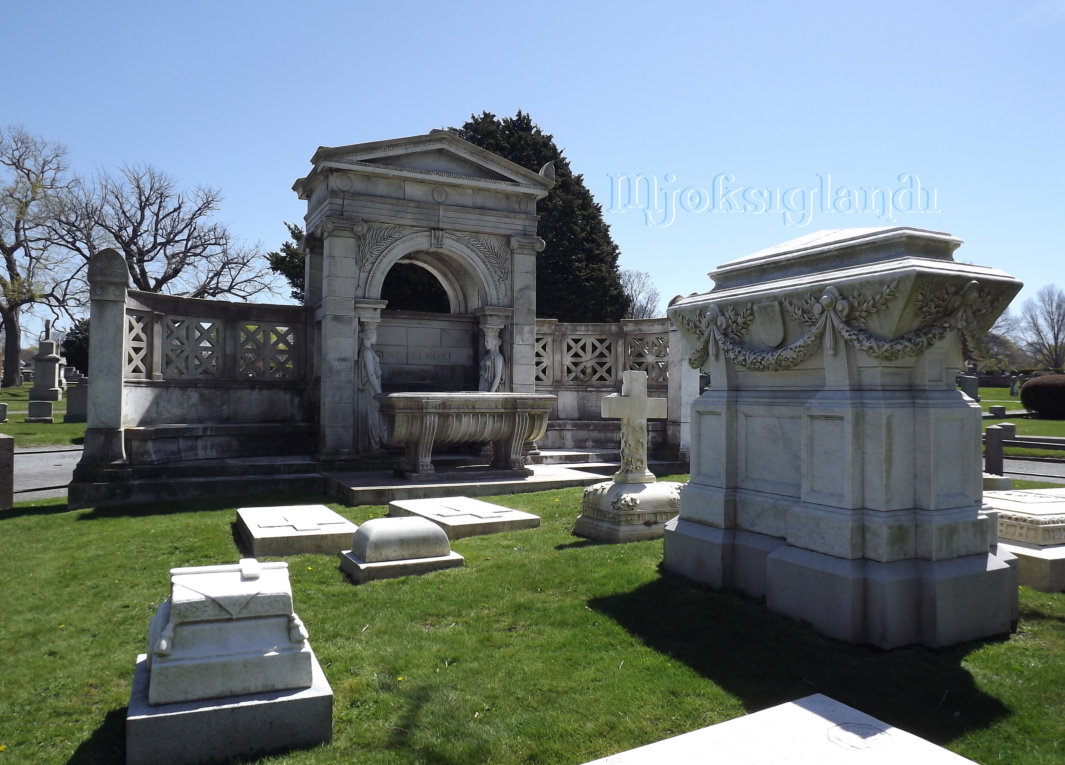
The mausoleum below is the size of our house a small chapel, and sports some insanely intricate carvings that would fit in on a French cathedral.  As always, I'm glad that people of the past had enough money to leave behind extravagant tombs for me to marvel at.


Tuesday, April 4, 2017

I'll always love you, New York

An entertainment event earlier this year* had me thinking about New York.  I assumed, because of my longstanding love for the city, that I had plenty of posts about it on this blog; you may imagine my surprise when I found that the posts tagged New York number only six—and that includes places in the state, not just the metropolis.  (I think this particular entry conveys my feelings fairly accurately, though.)  All the same, I reckon I ought to rectify this general oversight and produce some more content about the greatest city in the world.  Thus, please enjoy various and sundry comments about Nueva York.

While there are lots of songs about New York, from the previous to “NYC” from Annie to Ryan Adams’ “New York, New York” (whence this post’s title), the following is probably the song I most associate with the city.  If you’re familiar with Working Girl, you’ll probably understand why; if not, a quick viewing of the opening credits should provide illumination.  The lyrics never name any particular place, but the connection between song and location has clearly stuck with me over the years.


On the other hand, the October before last I rolled into the city on an Amtrak train, eating an apple and listening to Glenn Miller tunes, including “Pennsylvania 6-5000” (and “Chattanooga Choo-Choo,” which, while not a New York song, is a railway song).  Unlike Metro-North trains, which stop in the Bronx and descend after 125th Street to run south underground until Grand Central, the Acela from Boston and New Haven leaves the mainland to pass through Queens, below, before arriving at Penn Station.  I've flown into JFK, LaGuardia, and Islip, and arrived on buses, and even been a passenger in cars (though you could not pay me enough to drive my own self into the city), but mostly I get on the New Haven Line and in less than an hour I'm there.  And once I'm there, if I can't walk, I'd rather take the subway than the bus—I think that's because I feel less likely to end up going the wrong direction on the subway.  In all, despite the fancy, high-speed trains I've been on, rail travel still strikes me as somewhat old-fashioned, and that fits a timeless city.

In the process of working on this post I discovered that I don’t have as many pictures as I thought I must; I believe many of them are on discs that are still in California, and it rankles me not to have them all.  The best way to rectify this would probably be for me to win the lottery, make a first stop at B&H, and then spend some serious time visiting and revisiting sites around town.

Boogie Down
Of all the boroughs I’ve spent the most time in the Bronx.  Sure, most people think of Manhattan as New York City, but that’s unfair to the other boroughs, which have so much to offer.  I can’t say I’ve ever been to Queens, apart from passing through JFK, nor Staten Island, that I remember—though there are pictures of my family on the Staten Island Ferry sometime in the late ’80s, so I’ve at least been to the ferry terminal there.  Up in the Bronx are the Zoo and the New York Botanical Garden, which are definitely worth visiting.  I’d also recommend Woodlawn Cemetery, whose over 400 acres are home to influential people from Rowland H. Macy and James Cash Penney to Celia Cruz and Edward Kennedy “Duke” Ellington.

Most likely the eeriest thing I ever experienced in New York was in March 2006.  Spring break was just about to start and I took the day off of work to cross the country for a friend’s wedding.  My flight left Islip mid-morning, but I had to take a bus and a subway train and the Long Island Rail Road and a taxi to reach the airport, and in order to get there in enough time—my parents will tell you that I prefer a generous cushion before takeoff—I had to leave my apartment around three in the morning.  I walked to the closest bus stop and waited in silence so nearly complete that I was startled by the appearance of someone just walking four lanes opposite me.  The quiet was strange, disconcerting in its unfamiliarity.  When the bus came, there was only one other passenger on it.  Of course, by the time I reached Midtown and had to walk a few blocks to Penn Station, more people were out and getting ready for the day, but still far fewer than the daytime city streets.

This picture was taken from one of my roommates' rooms.  I got first dibs on rooms, so I picked one of the ones that looked out over Southern Boulevard and the zoo, and I swear sometimes I could hear the lions roaring at night.  But this view of the Bronx is not at all shabby.

And then this one time I was on my way to campus while wearing the Rangers t-shirt I’d gotten at the Goodwill in Manhattan.  A police car was nearby, and as I jaywalked I heard the PA crackle on; for a moment I was sure that I was going to be admonished for crossing Fordham Road illegally.  So you can imagine my relief when what I heard instead was one of the officers complimenting my “great” shirt.

While you’re in the 718, stop by Ivana’s on Arthur Avenue, the Bronx’s Little Italy, and have a pepper and egg wedge for me.  No one else makes them quite as good.

BKLYN
The Bronx may be known as the roughest borough, but Brooklyn’s got the reputation as the coolest.  I, however, can suck the cool out of anything, even Spot Conlon’s territory.  And so the last time I went to New York I made a point of visiting two sites in Kings County: Central Library and Green-Wood Cemetery.  The former is a formidable building with a curved façade opposite Grand Army Plaza.  The grate at the entrance features figures from literature; this chart identifies all of them, though I was fairly certain that the man second from the bottom in the center column was Walt Whitman.  The interior isn’t as impressive as the exterior, given more to function than form and seemingly last redecorated in the 1970s, but above the entrance inside is a carved eagle that once adorned the offices of the aquiline-named daily newspaper.  

I found visiting Green-Wood Cemetery a far more satisfying experience.  Journalist Horace “Go West Young Man” Greeley, Governor DeWitt Clinton, Leonard Bernstein, Samuel Morse, and Louis Comfort Tiffany are buried there, the last under a disappointingly unadorned stone; Green-Wood in June is full of blooming dogwoods and groundhogs.  The cemetery is also home to the borough’s highest point.  From there, near a spot where a Revolutionary War battle was fought, you can see Manhattan’s skyscrapers, and, by shifting a bit to the your left, the Statue of Liberty.  At the Altar of Liberty a statue of Minerva raises her arm in salute to the lady in the harbor.  If you’re there around noon on an early summer day, you might catch the scent of the freshest pizza you've ever smelled in the air.  So please bury me there, because I can’t imagine a better place to be planted than that, with that view and that history and that pie, forever.

Or maybe just cremate me and toss me into the East River* from the walkway of my favorite bridge.  The next best thing to a Gothic arch is a neo-Gothic arch, and there’s nothing more strong and graceful than the stone and wire of the Roeblings’ bridge.  For a New World city, it’s easy enough to find the medieval in New York: there are relocated buildings up at the Cloisters, arms and armor at the Met, and a Gutenberg Bible at the Public Library; St. Patrick’s is even more exuberantly neo-Gothic than the bridge.  But even if the bridge isn't real Gothic, it’s real New York.  I’ve crossed it on a bright late-September day, and on an overcast April with one of my oldest friends, and after watching Nathan’s hot dog-eating contest on Independence Day, and every time was a dream come true.

Who was to know what should come home to me?
Who knows but I am enjoying this?
Who knows but I am as good as looking at you now, for all you cannot see me?
     from “Crossing Brooklyn Ferry” by Walt Whitman

I know I have nothing groundbreaking to say about New York—why do you think I’m linking to songs and quoting Whitman?  The things I want to say have mostly already been said, and more eloquently.  The place is expensive, dirty, and aromatic; it’s uncomfortable in both winter and summer.  But every time a train or bus or plane takes me back I end up in Grand Central, head thrown back to see the ceiling, and I hear Carly Simon sing the sky is a color of blue you’ve never even seen in the eyes of your lover and I wouldn’t trade a minute there for anything.

*It was the movie of the Broadway version of "Newsies," obviously, but I like to pretend to have some dignity. ↩
*Leaving aside a portion to be tossed into the Rimava into Tisovec, too. ↩

Wednesday, March 29, 2017

Flashback: Locus Maleficarum

The town of Salem has given more power to witchcraft than those accused of and executed for it ever did.

Without its one claim to fame, Salem would just be another New England colonial town.  One could argue that it would be even less well-preserved, were there not such a strong reason to keep its old buildings in good shape.  And yes, Salem does benefit from its sea-going heritage, and Nathaniel Hawthorne and the House of the Seven Gables, and its proximity to Boston and Plymouth.  But the majority of the tourists and their dollars come for the witches.

Had they the chance to offer opinions, neither the accused nor the accusers would likely be able to believe what Salem has become.  Whereas the 17th-century citizenry lived in fear of witches, those who readily confess to using magic now flock there.  As there is nothing to suggest that the area has any innate supernatural vibes, the influx of modern witches to the scene of the crime, so to speak, can be seen as defiant at best--as they claim a space from which their alleged forebears were violently excluded--and crassly capitalist at worst.

I didn't quite realize this on my previous visit, with the seventh grade, but it was patently clear this time.  Still, it is an interesting city, and I'd go back again, if only to visit the Peabody Essex Museum, which is closed on Mondays.  (Also to visit the Olde Pepper Candy Companie, which makes really good cherry cordials.)

On our visit in May two friends and I went first to the Witch Museum, housed in a former church.  The statue out front is of Roger Conant, one of the city's founders, but his billowing cloak and Salem's prevailing preoccupation make it easy to mistake him for a witch.  Inside is a strange display.  Groups of visitors enter what must have been the sanctuary and sit on benches, either in the middle or on the sides.  Around the room, well above head height, are dioramas depicting scenes in the trials.  These dioramas are not particularly state-of-the-art, and are illuminated one at a time as a recording tells the story.  The narration sounds like something out of a B horror film, the dioramas are quaint, and the overall effect verges on cheesiness.  And yet it is not laughable.  I've known about the trials since at least sixth grade, and have read The Crucible, and consider myself generally pretty familiar with the event; but I had a visceral reaction to the dioramas, particularly the ones showing (entirely bloodless) executions.  It's one thing to know the fact that people died, and another altogether to see a representation of that.

After the show, visitors walk through a weak exhibit that gives a very vague history of witchcraft throughout the years.  It includes mannequins of a pair of modern-day witches, whose ceremonial robes are made of panne velvet, the likes of which few real witches would likely be caught dead in.

We also visited the poorly-named Witch House.  The house is the only one left in Salem that has a direct connection to the trials; Jonathan Corwin, a judge, lived there.  It's a nice two-story colonial house, set up as it may have been for its inhabitants, with herbs hanging near the hearth and one of the upstairs rooms dedicated to explaining the experience of childbirth in the colonial era.  Despite the name, the house gives no information specifically about the trials.  It was, however, easily one of the most historically edifying things we saw.

Of course the highlight of the trip was visiting the Burying Point.  Compared to others I have visited it was somewhat sparse, but residents include Justice Hathorne, Nathaniel Hawthorne's forebear and trial judge, and a Mayflower passenger.  We also enjoyed the tombstone of Nathanael Ward, a young man who had been a librarian at Harvard and who died at only age 23.  Adjacent to the Burying Point is the Witch Trials Memorial.  Executed as they were, the accused were buried in unmarked graves; the memorial names them all and records their date and manner of death. 

Many of the shops in town cater to an occult audience, and offer psychic readings.  And, of course, there's a store where you can buy all kinds of Harry Potter merchandise (with some Game of Thrones and Doctor Who goods thrown in as well).  I'll admit that I was tempted by the Salem Quidditch t-shirt, but was deterred by the school group crowding the store.  The adjacent shop claimed to sell wands, though every time we tried the door it was locked; just when we were about to give up someone noticed us at the door and let us in.  The interior was somewhat modeled after Ollivander's, though was much less precariously stocked, and there were a variety of hand-turned wands in different woods.  The shop also offered things like wax seal kits and quill pens.  I'd rather have something or be somewhere that looks like it's from the world of a story than something officially branded and cheaply produced, so I much preferred the wand shop to its neighbor, whose products you could find in any mall.

Salem is an odd place.  My previous visit presented a more well-rounded overview of the area's history, including its seafaring and literary ties.  That Salem seems almost like a different town than the witchcraft-obsessed Salem.  It is worth a visit, and also contemplation: not only of one of our worst episodes, but of why we--as individuals and as a society--revere and visit the places we do.

Wednesday, February 8, 2017

Old St David's Church and Cemetery

We begin with a brief programming note: I'm back in South Carolina for the time being, so expect to see more posts on the Southeast.

Somebody actually gave me the keys to a historic church.

Said key is kept at the Chamber of Commerce in Cheraw, South Carolina, a few blocks away from Old St David’s Church.  This information was posted online, as were the Chamber’s opening hours; though I arrived pretty much smack dab in the middle of those hours, no one was at the Chamber and the door was locked.  As I’ve had problems with doors in the past, I did put some effort into trying to open it several ways before realizing that it wasn’t just me.  I was about to call the office’s number to see if someone was hiding in the back when a woman appeared from the adjoining insurance office and let me in.  She was able to let me in and told me the staff had a meeting and would probably be back in an hour—this after I’d driven half an hour specifically to visit this church and cemetery.  If the entire staff leaves during your scheduled opening hours, maybe put a sign on the door.

Fortunately, the kind non-Chamber-employee was also able to give me the key.  Now, when I’d read online that you could pick up the key, I expected to have to sign for it, at least, and probably to have to produce my driver’s license and have them make a copy until I brought the key back.  Given those expectations, I was a little surprised to be handed the key, no further questions asked, and told that if no one was in the office when I came to return it that I should just slip it in the mail slot.  Obviously I of all people would never purposefully do anything to damage a place of worship, but they didn’t know that.  Apparently I look trustworthy and benign (though in reality I am more the former than the latter).  Anyway, the greater danger was that I would decide to live there and never return the key.

(Spoiler alert: I did not.  And there wasn’t that much that looked valuable that could be easily stolen, so I suppose that curtailed many concerns.  Still.  One hopes that normal operating procedure entails a bit more circumspection.)

Old St David's predates the Revolution, and was the last Anglican church built in the state while it was still under George III's rule.  As is common with churches of the time, it features box pews.  The interior is whitewashed, with wood accents; there isn't a painting or lick of gold to be seen.  Keyholders enter through the door on the east side.  Once inside, the raised pulpit is directly opposite the door.  The entry at the front of the church is only used when ceremonies take place there, but the stairs to the small balcony are found there.  At the other end of the church, past the altar, is the vestry, with shelves full of hymnals and information on the area during the war.  The interior door in the vestry does not lead to a bathroom; if there is one in the church, it's well hidden.  There is, however, a quality Union Jack near the back door.


Though I'm not much interested in the Civil War, I neither can nor will ignore the fact that it happened.  The monument to Confederate soldiers in Old St David’s is interesting in that it was erected in 1867, quite soon after the war ended, and while the area was still occupied by Union troops.

Despite its long history, the cemetery does not have an overabundance of Revolutionary era graves.  Of those that do exist, the most notable are not of patriots.  In June 1780 the 71st Highlanders arrived in Cheraw.  Against advice from local Loyalists, they camped near the Pee Dee River, itself not far from the church.  According to the regimental surgeon some two-thirds of the 300 soldiers suffered from fever, and several died, though their names were never recorded, even by their own officers.  In fact, a large plaque in the churchyard says that “The official Muster Rolls for this Regiment are some of the most incomplete of all the Public Records of the British Military in the 18th Century.”  There are three sites at Old St David’s where Highlanders were buried: one near the entrance, one near the vestry door, and one on the west side of the churchyard.  This last has the biggest marker, and the aforementioned plaque is nearby.  I can't help but feel a little sorry for the soldiers who died so far away from their homes and families, even if those soldiers were enemies.

Other interments of note include that of the first Bishop of Texas (who was born in Society Hill, South Carolina, not far from Cheraw), and one-half of Laurence Lempriere Prince.  Perhaps this is not as unusual a situation as it seems at first glance; one assumes that the halves are in the form of cremains, and families often split up their loved ones.  And there are bits of saints divided up all over Europe, and Shelley's heart is buried in his plot in the English Cemetery in Rome.  Still, this was unexpected, to say the least, and a bit puzzling.  An Internet search revealed no obituary that might help explain Mr. Prince's motivations, but it did return a picture of the other half.  I must say, I was somewhat let down that it was so similar to the one in Cheraw.  I was hoping that it would be different, at least, or that there would be some further scavenger-hunt aspect to it.  Which gives me ideas...

Sunday, May 22, 2016

Newport

A few Saturdays ago I drove down to Newport, Rhode Island.  It's hard to believe it's been eight years since I was last there, on the 7th grade trip.

Two bits of important practical info that I didn't know before I left: 
  1. To drive to Newport you have to cross the Claiborne Pell Bridge, which costs $4 for passenger cars (or $2 per axle for larger vehicles).
  2. There is public parking at the transportation/visitors' center, not far from the historic sites; parking is free from November 1 through April 30 (happily, the day I went).
Even though it was April and still a bit chilly, there were many more tourists than I'd expected to see.  I was both glad and disappointed that most of them were not interested in anything historical, leaving those sites for me to enjoy.  There were also at least two dudes wearing Nantucket red shorts.

There may be the most colonial houses in Newport of any place I've been so far.  This one belonged to John Stevens, a stone carver; he and his family members carved many of the stones in the Common Burying Ground, and his shop across the street has operated since 1705.  Three hundred eleven years in operation is pretty impressive for an American business.  You can sign me up for a tombstone from them, because they do nice work (including on the World War II Memorial in Washington, D.C.).

About four cemeteries are grouped together when you enter the city.  These include Historic Cemetery Number 6--if it has another name I didn't see it--home to many Irish immigrants, overgrown, with bees from a stack of hives nearby buzzing through the clover; Braman Cemetery, into which I did not venture; and Island Cemetery and the Common Burying Ground, which border each other but cannot be entered one from the other.

Both cemeteries had people with their dogs off-leash in them, and some owners failed to clean up after their pets.  Two young men rode a motorbike through Island Cemetery and later sat on graves to have a chat; in the Common Burying Ground I saw a man whom I thought at first was doing some kind of clean-up work, because he had so much stuff spread out from his car, but later it seemed like he, too, was just using a grave as a table and was kind of hanging out.  It was disconcerting, to say the least.

Island Cemetery has many interesting gravesites, some of which have been defaced by graffiti or are used as places to sleep by the homeless.  Newport cemeteries in general are a great place to find buried captains, but Island has two famous ones: Oliver Hazard Perry and Commodore Matthew Perry.  The former won the Battle of Lake Erie in the War of 1812, and is also honored with a statue in Washington Square.  From his grave the masts of ships in the harbor can be seen not far away, which I thought fitting.  Oliver's younger brother Matthew was instrumental in the opening of Japan.  He is buried in the Belmont family plot (pictured at left, with Perry's monument at right),* and a statue of him stands in Touro Park.

The Common Burying Ground is in sad shape.  Some of it cannot be attributed to malfeasance; lots of the carvings are illegible because of lichen, likely due to the damp sea air, and some slate stones had holes right through them.  At first I thought they might be bullet holes, as someone in this article also believes, but upon closer inspection I changed my mind and reckoned there must have been some inherent flaw in the stone.  However, much of the destruction must have been the result of neglect at best and malice at worst.

This is especially awful since the Common Burying Ground is home to the highest number of colonial African-American graves in the country.  I expected there to be some kind of sign noting this and giving some information, but there was nothing.  It was also curious that most of the burying ground was crowded, with little concern for space or chronology, but the section where the servants are buried has plenty of room.  I would have liked to have seen the official explanation for this.  The photos below illustrate the difference in population density in the two sections.

On a more positive note, my favorite epitaph described the ingenious Captain Pollipus Hammond and his charitable, prudent, virtuous wife Sarah.  Would that I could be all of those things.

After I failed in my quest to find affordable fish and chips, I wandered past a few mansions and Salva Regina University to the Cliff Walk.  I walked the half-mile from Forty Steps to Memorial Boulevard.  The blues in the water were beautiful, and the air was cool and fresh. 

I also found made my way to Touro Park.  Just as last time, there is no sign by the stone tower, though at the museum at Washington Square they now claim the stone tower was part of a mill built by Benedict Arnold, ancestor of the famous one.  I'd rather believe it was built by Vikings.

I just wanted to include a picture of this house because it is HUGE for a colonial home.  Obviously the section at the back was an addition, but still: it makes sense that John Banister, for whom it was built in 1751, was a merchant but also a privateer and smuggler.


*I thought it odd that someone so famous was buried in a plot that prominently featured another family's name.  It turns out that Perry was originally buried in New York and was later moved to Newport.  One of his sons-in-law, August Belmont, was fairly rich and could afford a big monument.  He's also the namesake of the Belmont Stakes. ↩

Tuesday, May 3, 2016

The Most Ancient Towne

Kit's heart sank.  This was Wethersfield!  Just a narrow sandy stretch of shoreline, a few piles sunk in the river with rough planking for a platform.  Out of the mist jutted a row of cavernous wooden structures that must be warehouses, and beyond that the dense, dripping green of fields and woods. 
 
 Thank you, public television!

When I traced how I found out about a recent destination, the source was a program aired on Connecticut Public Television sometime late last year.  I somewhat flippantly thought to myself, 'Thanks, PBS!' but then I considered that "Rick Steves Europe," not to mention "Doc Martin" and all of the thousand British crime shows we watch, air only on PBS stations.  So, in all sincerity, thank you, public television.  And if you're in a position to do so, please support your local station(s) so they can keep providing educational, informational, entertaining content.

I heard about Wethersfield, Connecticut, because of its cemetery.  My aunts saw a program about it in the fall or winter and visited in December, sending me a few photos of graves there.  With the weather finally nice, I decided to drive down on a Sunday afternoon.  I invited the aunts to meet me there, and they agreed, though I showed up earlier for two reasons: it's a shorter drive for me, since the town is not far at all from Hartford, and I wanted ample time to explore the cemetery without having to worry about them waiting for me.

At least it looked solid and respectable, compared to the cabins they had passed.  Two and a half stories it stood, gracefully proportioned, with leaded glass windows and clapboards weathered to a silvery gray.

I didn't do much reading-up before I went, but I'm glad I at least looked at the Historic Wethersfield website, because it clued me in to an important thing.  On Broad Street, near the cemetery and a block or two from Main Street, there is a house called the Buttolph-Williams House.  It looks fairly unremarkable, just three stories of dark-weathered wood and a few windows, but it was the inspiration for the family home in Elizabeth George Speare's The Witch of Blackbird Pond.  It's been so long since I read it that I hadn't realized that the book was set in colonial Wethersfield, so it was fun to go see the town and those buildings and homes that likely would have been around at the time Kit lived there.  (This write-up was delayed by the fact that it was harder than it ought to have been to procure a copy of the book to see how Kit described the town.)

The long rows of onions looked endless, their sharp green shoots already half hidden by encroaching weeds.

Considered one of Connecticut's very first towns, Wethersfield was also the home to Silas Deane, a diplomat during the Revolution, and Washington and Rochambeau met up there to plan the battle of Yorktown (which did not happen at the Yorktown in New York, as we thought, but at the one in Virginia).  With all of this history and culture, it's no surprise that the town's emblem is a red onion.  Apparently the Wethersfield red was for many years an integral part of the local economy.

The town also has the Grand High DMV of Connecticut (a.k.a. the department's state headquarters).  It is very much the most stately DMV building I've ever seen.

As promised, the cemetery had a bunch of colonial graves.  It was also interesting to see the newer markers near some graves noting in which wars the deceased had fought, because they were not limited to the Revolution; they included the War of 1812, the Civil War, and such lesser-known conflicts as Queen Anne's War and King George War, parts of larger European conflicts carried out in their colonies.  Other somewhat unusual bits of note: the grave of a Mr. Boyssou de Monplaisir of Guadaloupe, the names Salmon North and Zechariah Bunce, and the number of skulls that look like concerned lightbulbs.

It's fun to drive or walk around the historic neighborhoods and admire the 18th- and 19th-century houses.  Though this bed and breakfast isn't that historic, it is really beautiful.  Wethersfield was quaint and perfect for a pleasant Sunday afternoon out.


Saturday, April 23, 2016

Gravestone Onomastics

Recently I decided that a fun project would be to create a list of all of the legible names from tombstones that I've photographed around here.  I actually made a spreadsheet listing surname, maiden name, given name(s), honorific or rank, spouse's name, parents' names, year of death, age at death, and the cemetery and state; the dates were to note when the name would have been given.  Then I didn't know what to do with my spreadsheet, and while it may not be completely on-topic here, it's the best place I have to put it.

There are 466 individuals from graves in 11 cemeteries: Wethersfield (Connecticut; to be written up in the near future), South Hadley, Old Hadley, Amherst, Maplewood in Springfield, Calvary in Holyoke, East Parish Burying Ground in Newton, and Copp's Hill, King's Chapel, Granary and Central Burying Grounds in Boston.

This list is not at all comprehensive; it's only based on what I could decipher while embiggening on my photos (though I was kind of shocked at how detailed some of them were, even when zoomed in). I did not set any strict cut-off dates, so these date from about 1630 to about 1920--all 11 of the Winthrops, spanning almost three centuries, are on the same stone--though the majority are from the 18th century. I also listed every spelling variant separately. Of course "Abigail" and "Abigaile" are basically the same, as are "Lowel" and "Lowell," but if the point is to make an amateur study of the names, those variants can be noteworthy. The names are given in descending order of frequency.

Female Given Names Male Given Names Surnames
Mary (34) John (30) Smith (13)
Elizabeth (19) Samuel (25) Warner (12)
Sarah (18) William (17) Winthrop (11)
Abigail (12) Thomas (13) Griswold (10)
Hannah (7) Joseph (12) Buck (8)
Rebecca (7) Jonathan (9) Cook (8)
Anne (6) James (8) Montague (8)
Ann (5) David (6) Day (7)
Lydia (5) Benjamin (5) Stillman (7)
Ruth (5) Edward (5) Wolcott (7)
Eunice (4) Isaac (5) Dickinson (6)
Rebekah (4) Ebenezer (4) Fuller (6)
Anna (3) George (4) Green (6)
Elisabeth (3) Josiah (4) Beadle (5)
Huldah (3) Moses (4) Deming (5)
Jerusha (3) Stephen (4) Hanmer (5)
Martha (3) Elisha (3) May (5)
Mehetable (3) Enos (3) Parker (5)
Deliverance (2) Henry (3) Ward (5)
Eliza (2) Timothy (3) Williams (5)
Harriet (2) Adam (2) Bernard (4)
Lucy (2) Daniel (2) Blin (4)
Miriam (2) Eleazer (2) Goodman (4)
Polly (2) Elias (2) Goodrich (4)
Prudence (2) Francis (2) Moody (4)
Sally (2) Joshua (2) Nash (4)
Susannah (2) Michael (2) Porter (4)
Abiah Nathan (2) Robbins (4)
Abigaile Peter (2) Wells (4)
Annah Robert (2) Woodhouse (4)
Azubah Seth (2) Wright (4)
Barbara Aaron Chapin (3)
Betsy Abraham Crane (3)
Beulah Alvin Dix (3)
Billisent Ansell Hale (3)
Bridget Ashbel Hall (3)
Caroline Boyssou Hammond (3)
Catherine Caleb Hide (3)
Charlotte Charles Judd (3)
Chloe Chow Skinner (3)
Deborah Christopher Stoddard (3)
Desire Crafts Treat (3)
Dorcas Crispus Welles (3)
Editha Elihu White (3)
Elizebeth Elijah Woodbridge (3)
Emily Eliphas Alvord (2)
Esther Ephraim Ayres (2)
Experience Ephriam Ballard (2)
Grace Fitz John Belding (2)
Hopestill Hezekiah Bingham (2)
Jean Hiram Bordman (2)
Jemima Humphrey Bryant (2)
Johana Jabez Butler (2)
Johanah Jacob Chester (2)
Julia Jahleel Clap (2)
Katherine Joel Copp (2)
Kezia Jotham Drew (2)
Lucretia Lemuel Fox (2)
Mabel Leonard Francis (2)
Marcy Levi Franklin (2)
Margaret Loomis Harkness (2)
Maria Lorenze Harrison (2)
Meriam Lowell Holland (2)
Naomi Luke Hopkins (2)
Olive Martin Lewis (2)
Patience Mathew Lowell (2)
Phebey Matthew Merritt (2)
Rachel Nathanael Mitchell (2)
Roxa Parsons Moodey (2)
Sabra Patrick Mountague (2)
Seferanna Paul Murdock (2)
Susanna Philip Parkman (2)
Tamesin Prince Peirce (2)
Thankful Robart Pitman (2)
Thankfull Roger Preston (2)
Ruggles Russell (2)
Salmon Sampson (2)
Solomon Scoot (2)
Sylvanus Standish (2)
Thadeus Trowbridge (2)
Wait Still Varney (2)
Walter Willes (2)
Zechariah Winsor (2)
Woodward (2)
Worthylake (2)
Adams
Archer
Armstrong
Arnold
Attucks
Balston
Barns
Blake
Boltwood
Boyes
Brewster
Brown
Bulkley
Bunce
Burrough
Bush
Buttolph
Byles
Caldwell
Carr
Cheevers
Cheney
Church
Clark
Cogswell
Crouch
Cutler
Davis
Dawes
Demery
de Monplaisir
Dolbeare
Doubelde
Downe
Dwyt
Dyar
Dyke
Eastbrook
Eaton
Ellis
Elliott
Eustis
Fosdick
Foster
Frances
Gardner
Garrett
Gibbs
Giles
Gillburt
Gladding
Gleason
Goodwin
Gray
Greenough
Greenwood
Griswould
Hammatt
Hancock
Harris
Harvey
Hedge
Hollowell
Holmes
Holms
Hubbard
Hunt
Hurd
Hurlbut
Indicott
Jackson
Johnson
Kellogg
Kilborn
Kingsbury
Knock
Knowles
Labbe
Lamson
Lancelott
Latimer
Lee
Leonard
Long
Loring
Loud
Lowed
Lowel
MacCarty
Malcom
Man
Manderien
Marion
Marsh
Mather
Maverick
Maxwell
McKean
Newman
Nickols
North
Otis
Page
Pain
Park
Parsons
Pearce
Phillips
Pigeon
Raynolds
Revere
Rice
Richardson
Ridgaway
Ridgway
Riley
Rogers
Rowlandson
Sanborn
Sanders
Scollay
Seymour
Shannon
Shaw
Simpson
Snider
Sprague
Spring
Staples
Sterling
Swan
Tapping
Truesdell
Tryon
Tyler
Viburt
Voeax
Wakefield
Waterman
Waters
Watts
Webb
Wheat
Whitney
Wickam
Will
Winchester
Wiswall
Wiswel
Wollcott
Woster
Young

Friday, November 27, 2015

Flashback: Black Friday 2014

One of the reasons this post has languished unpublished for so long is because I honestly thought I'd already posted it, and was surprised, while working on something else, to see it in my Drafts folder.  AND THEN I told it to post on Black Friday this year and it failed to do so, which I only just noticed.  Better late than never, I suppose.

I spent a few days in Connecticut the week of Thanksgiving.  A day or two before the holiday itself one of the aunts mentioned Sleepy Hollow Cemetery in the town of the same name (possibly while discussing the TV show purportedly set there), and on Friday we made the short drive to New York to see some graves at Sleepy Hollow Cemetery and Kensico Cemetery in Valhalla, New York.

There are actually two cemeteries adjacent to each other in Sleepy Hollow.  One is the graveyard of the Dutch Reformed Church, with 18th- and 19th-century interments, and the other is the cemetery that shares the town's name.  The church itself was closed when we arrived.  We bypassed the Old Dutch Church's graveyard to drive through the other cemetery, stopping the car to jump in and out as necessary.  This was a welcome way to visit, because the cemetery is large and hilly, and because, being the end of November, it was fairly cold out.

Located in the Hudson Valley with views of the river, Sleepy Hollow has its fair share of famous residents.  There are Rockefellers, Astors, Chryslers, and Helmsleys, as well as several people involved in newspaper publishing in the city.  The Helmsley mausoleum features a stained glass window of the New York skyline, centered on the family's building.  I was disappointed by the entirely unremarkable Chrysler mausoleum; I'd expected something more akin to the Chrysler Building--not the chrome, really, but the Art Deco style of it--but it was plain, with a set of columns at the front and no windows whatsoever.  And not a fin in sight.  What a missed opportunity.

Where the Chryslers disappointed, though, other less well-known but still wealthy people had better taste.  The two mausoleums (mausolea?) I liked best were the Archbolds' and the Lewis'.  The latter, pictured at right, was a stone chapel with chunky architectural elements; something about it seems very Scottish, though I'm not sure why.  It also has a lovely stained glass roundel.  With its round shape, smooth dome, and mosaics, the Archbold tomb seemed to be modeled after Italian Byzantine churches.  That style, to me, makes more sense for Christian(ish) American cemeteries than does Egyptian Revival.

I was surprised to find on the map that Andrew Carnegie was buried in Sleepy Hollow.  The Scottish-born businessman was probably the greatest patron of libraries and education in the modern age.  His site is fairly simple; there's a plaque with information about his philanthropy nearby, and stones inscribed with his name and his wife's in front of a Celtic cross.  At the base of the cross were an American flag and a Scottish saltire.  Perhaps in appreciation for his exceptional generosity, people had left coins on the stone bearing Carnegie's name; since both Carnegie's name day and St Andrew's Day were coming up, I added the shiniest penny I had as my present.

In the context of the cemetery, the most famous grave is that of Washington Irving.  The author's tomb is among several of his relatives', and the plot, along with Irving's home and the Old Dutch Church, is a national historic landmark.  Irving's grave is slightly larger than the surrounding ones, and is set off by a pair of American flags.  Someone had also decorated it for the season with pumpkins and yellow flowers. 

We also saw, among the graves of the common folk, a stone with our name on it.  It wasn't anyone we knew, but it's somewhat unusual to come across people with our surname who aren't related to us.

Kensico Cemetery in Valhalla is huge.  The office has multiple brochures, including general maps and tours focusing on trees or architecture.  One large section, Sharon Gardens, is all Jewish graves; we drove through but didn't spend much time there.  In Kensico proper there's a big section full of tombstones inscribed with Chinese characters, and some really nice Art Nouveau monuments.

There are fewer industrialists and old-money type people here than in Sleepy Hollow, but more people from the entertainment world.  Sergei Rachmaninoff and his wife Natalie have a nice little plot surrounding by bushes, though the large Orthodox cross that is the center of the plot only features the composer's name.  A popular grave for visitors is Lou Gehrig's, if the baseballs and glove left there are any indication.  I think what looks like the headstone is actually a mini-columbarium; a pair of bronze doors with a keyhole are set into the stone.  I liked seeing Tommy Dorsey's grave, decorated with a trombone and the opening bars of "I'm Getting Sentimental Over You."  But by far the one I was most pleased to see was the grave of Danny Kaye and his wife Sylvia Fine Kaye.  Their monument is a stone bench; a bronze plaque with symbols of their work and interests, including a grand piano and UNICEF's logo, is set into the back.  Danny's name is on the band of a chef's hat on the left side of the plaque, and Sylvia's is on the bottom of a sheet of music on the right.  Much like Katharine Hepburn's at Cedar Hill, the Dorseys', the Gehrigs', and the Kayes' memorials are all fairly understated for people as famous as they were; that kind of humility seems to have fallen by the wayside.

As our time at Kensico was coming to an end we saw a group of graves most intriguingly carved.  The Kirby family included a naval engineer (Frank), a Phi Bete (Russell), and a PhD/author/scholar/musicologist/magician (Frank II).  All of them have stylish and possibly arcane decorations on their headstones.  While I wish Mary's had listed her accomplishments as her husband's and sons' stones had, I did appreciate the squirrel and flowers on hers.

Though I was happy to see Danny Kaye and Tommy Dorsey, on the whole I liked visiting Sleepy Hollow more than Kensico.  The former felt much cozier, and I think on the whole the graves were more interesting there, in part because they were older.  That age also meant that the graveyard felt more organic and less planned.

Sunday, November 22, 2015

Boston Burying Grounds

Some of Massachusetts' most famous burying grounds prove once again that there's a good reason stereotypical old graveyards in films look the way they do (though I can't for the life of me find a picture of one of said films that illustrates my point).

Until last week the weather had been pleasant, with temperatures into the 70s at the end of last week and bright, clear skies.  Acutely aware that this trend would not last--and indeed it has not--I wanted to take advantage of it, and of the driving that I'd be doing anyway.  So I did some plotting and made a plan to visit three of Boston's burying grounds two Mondays ago, a number that increased by one in the course of the day.

Transportation tip: If you're taking the T, aboveground stops may not have machines where you can buy tickets.  You can buy them on the train, but the machine can't give change, so don't use too big a bill, or you may end up with unused fares.

Below is a general map of my route, starting from the North T station and ending at the Boylston Street station (both on the green line).  I mapped it out because I really just wanted to see how far I'd walked; it felt like more than two and a quarter miles, but the number of lunges I did while taking pictures certainly contributed to that feeling.  By vaguely following the Freedom Trail and my recollections of last spring's visit with Mom's class, it was easy enough to find the way from the North End to the more central sites.

Copp's Hill
For some reason I seem to refuse to believe that any East Coast city has hills.  I'm not entirely sure why this is, particularly when the word itself is in the names of places; but I did indeed have to charge up a bit of a steep one to reach the first stop.  Despite Mom saying something about their proximity, I was also surprised to see that Copp's Hill is about a block from Old North Church, with the entrance to the church visible from the cemetery gate on Hull Street.  In fact, a school group came through while I was there.

Copp's Hill is the largest of the cemeteries I visited.  The half of the burying ground furthest from the gate is hilly, revealing a view of the bay.  There is also a square section along Hull Street that is set a few steps down from the rest of the cemetery; it seems to have later burials than the rest, and certainly fewer.  Of the four described here, Copp's Hill and Central burying grounds are the two that allow you to walk among the stones--Copp's Hill does have paved paths, but no barriers or markers asking you to keep to the walkways.  I appreciated this, but unfortunately, so did the family that let their children sit on the (restored) tomb of the Mather family.

King's Chapel
King's Chapel is the oldest burying ground in the city.  It's adjacent to the church of the same name, and on the small side.  Like the Granary, King's Chapel is bordered on three sides by buildings that keep most of it in shadow.  Some of the stones are nearly entirely sunk into the ground.  Several members of the Winthrop family are buried there, including the first governor of the colony.  There is also a grave dedicated to William Dawes, Paul Revere's less well known partner in midnight riding, though whether or not he's actually there is uncertain.

Granary
Interment place of Crispus Attucks and the other Boston Massacre victims, Benjamin Franklin's parents, Samuel Adams, Paul Revere, John Otis, and John Hancock, the Granary is arguably the most significant of the city's burying grounds.  I felt satisfied by being able to answer a man when he asked if I knew where Crispus Attucks was buried, though I certainly didn't explain the location very eloquently.

When I arrived, there were dozens of bags of leaves arrayed near the entrance, and before I left more were added by a team of hardworking groundskeepers.  I suppose it's necessary to remove the leaves, since the burying ground is such a prominent tourist destination, and since it would be a hazard if they were to spill out into the busy city street outside; but I missed the autumnal scenery.  And, while I appreciate the work that the crew was doing to clear up, I also wondered what they thought of the tourists wandering around while they were working.

Central
Unsurprisingly, the batteries in my camera died shortly after I arrived.  Central is on the edge of Boston Common, just near the Boylston T station, and is squirrel paradise.  I don't know if I've ever seen so many squirrels in one place.  Now the question is would I rather be a cat in an Italian cemetery, or a squirrel in a Massachusetts one?

Between my camera being kaput and the approach of the time I'd appointed for my return to campus, I didn't spend much time at Central.  It has quite an odd feature, though.  Part of the cemetery is as you see in the picture, but off to the right there is a large ditch that surrounds what I assume must be mausoleums, though they're covered with grass.  That area is where Washington portraitist Gilbert Stuart is buried; I didn't get to see him on this trip, but I did get a glimpse during the infamous Forced March through Boston Common of 2008.