Showing posts with label world heritage. Show all posts

Wednesday, March 27, 2024

As Seen On TV

Two drifters, off to see the world

Back in November Pal and I met up at JFK to board a Turkish Airways flight to İstanbul.  It was her first time crossing the Atlantic, and the first visit to Türkiye for both of us.

(Part of the reason this wasn't posted sooner is because I've been trying to post pictures as a rotating gallery on here.  I sort of figured out how to do it, but there were issues with the image sizes and it was a whole thing.  As you can see, I've stuck with the tried and true format for now.) 

I'd wanted to go to İstanbul since at least 2011, if not earlier.  I think one of the particular features that led me to add it to my wish list was the Norse runes in Ayasofya/Hagia Sophia (at left), as well as the general historic character of the city.  You know me: I'm happy to go look at old stuff and not engage as much with contemporary culture.  While Pal is also interested in history, she, being younger than me, is more engaged with modern life.  That led us to some different destinations than I would have chosen on my own, ones that I really enjoyed seeing.

This was the first trip I'd taken to an entirely new country since about 2010.  Every other foreign country in the past decade-plus has been a repeat visit.  That was the source of some trepidation beforehand.  I wasn't much worried about my lack of Turkish language skills; I knew some polite phrases, and figured in tourist destinations people would speak enough English that I'd be okay.  The world political situation being what it is, we discussed whether or not we should actually travel to the area; the State Department's advisory was (and still is) at Level 2: Exercise Increased Caution.  (For reference, the other levels on their scale are 1: Exercise Normal Precautions; 3: Reconsider Travel; and 4: Do Not Travel.  Currently Denmark is at Level 2 and Jamaica is at Level 3.)  To be on the safe side we registered online with the Smart Traveler Enrollment Program, and, as the State Department advises, tried to exercise situational awareness and avoid crowds.  We actually arrived on a national holiday commemorating Atatürk, so saw the town festooned with many a flag, banner, and bunting; on top of that, the hundredth anniversary of the republic had been at the end of October, so there was still much decoration up for that.  The holiday didn't affect our arrival at all, at least as far as I could tell.

(Though I think about the Armenian Genocide a normal amount and rarely have cause to discuss it, part of me was certain that I'd get to Türkiye and be unable to stop myself from talking about it, which I feel would not have gone over well.  Türkiye still doesn't acknowledge that the event was a genocide.)

Some things I read online and others that Pal tipped me off to made me a bit anxious.  One was that tap water from the city's pipes is not potable--and not even just unsafe for drinking, but for brushing one's teeth or washing fruit with.  The idea of having to put so much effort into something I usually do without much thought was almost tiring, even before we left.  Also tiring was the idea of the 11-hour flight from New York, particularly since I'd just been to Slovakia in September and therefore hadn't had time to forget the rigors of that journey.  On top of that, Turkish Airlines' website lists different restrictions for carryons on different pages of its site, which caused me some confusion and angst.  They do, however, have a generous checked baggage policy, even for economy.  I also really liked the amenity kits we got on the way over; the fabric was a colorful Türkiye-themed print, and while I can't wear the little slippers or socks in there, I've put the included eye mask to good use.

(I promise I didn't compare Türkiye to Slovakia the whole time.  If anything, I more often compared it in my mind to Spain.  It's the Islamic arches and tiles among palm trees.)

(BUT I was intrigued to learn that the Turkish word for sour cherry is vişne, not unlike the Slovak višňa.  What is their common root??  Something Proto-Indo-European, no doubt.

Sour cherry juice was one of the options on the flights and not only did I have that with my meals, but I also bought a carton of cherry juice at the mini-mart we frequented and enjoyed that at the hotel for several days.)

Before this trip I did the usual looking up of sites to visit, but when it came to modern Turkish culture I'd gotten most of my information from Turkish media.  I've seen a couple of dizi (TV series)--all of "Maral: En Güzel Hikayem," "Yüksek Sosyete," and "The Protector" and "50m²," the latter two both on Netflix, and some of "İçerde" and "Sen Çal Kapimi"--and movies, like "Paper Lives," "Delibal," "Miracle in Cell No. 7," and the Turkish Top Gun.  (Did you know there was a Turkish version of "The O.C."?  It truly was an iconic show.)  (Also, given the aforementioned holidays, we saw many advertisements for a movie or possibly miniseries about Atatürk, starring an actor we enjoy, as well as a Netflix movie starring one of the country's biggest stars.)  Upon reflection it turns out I've seen more Turkish media than I thought.  Anyway, it was where I learned a few phrases and got a basic feel for the city, where most of the dizi are set.  Of course TV could not completely prepare me for everything we saw and did, but if it could, there would be no point in traveling.

That I'd learned so much from watching media seemed somewhat lowbrow to me at first.  The more I thought about it, though, the more I realized that that was silly at best.  There's a lot of ambient knowledge around about places like Italy, and some of that comes from TV and films, whether they're factual or fictional.  Why should it make a difference how you're first introduced to something if it leads you to seek more knowledge and a greater understanding of it?

in the harem at Topkapı Palace

Pal, who's watched even more dizi than me, did a lot of research to find filming locations.  Some of them were obvious, like Sultanahmet Square, while others were further afield.  One of my favorites was a café that was featured in "İçerde."  It's a small place, apparently popular with university students, as it's in the area of Kadir Has University; the menu is limited to a few dishes each day, and the food is inexpensive, plentiful, and extremely tasty.  We had a chicken stew served with pilav, and while the chicken was good, I don't know if I've ever had rice as delicious as that pilav.  Plus, there were a few photos of the scenes that were filmed in the restaurant, and it was exciting to realize that we were sitting in nearly the exact same spot as some of our favorites.

(I've thought often about the İskender kebap I had for dinner one night.  A CNN Travel article describes the dish thusly: "Thin slices of doner meat are reverently laid over pieces of plump pide bread, smothered in freshly made tomato sauce, baptized with a dash of sizzling melted butter and served with a portion of tangy yoghurt, grilled tomato and green peppers.")

Things we saw that I recognized from the shows (apart from sites/locations):

  • çaycılar delivering hot tea
        (I've seen çaycı (singular) variously translated as tea server, waiter, or porter.  If you use my foolproof method of consulting Google Images to literally see what words mean, though, you'll notice that a çaycı, besides being a person, also seems to be a teapot.)
  • men counting on prayer beads
  • toplayıcılar (collectors) hauling giant bins for collecting recyclable waste
  • young women who looked vaguely familiar
  • cats and dogs roaming free
  • simit, a common and inexpensive snack sold from carts

Things the shows neglect to depict:

  • traffic: cars at a standstill on city streets, with pedestrians weaving through them to cross; and a total disregard for things like turn signals and lane markings that somehow does not lead to mass carnage
  • the hills...  It's not like I didn't see any pictures of the city before I left, but I severely underestimated the hills.  Some of them are STEEP.  Even though there are public transportation options to help avoid having to trudge under one's own power, there are times when the hills simply must be ascended.
  • trams at rush hour, which apparently starts at around 3:30 PM
  • the general mass of humanity that fills a metropolis
  • the call to prayer from several mosques overlapping 

One evening I was sitting on the roof terrace of the hotel when the evening adhan began.  I heard it from Sultanahmet, the closest mosque, and Ayasofya, as well as at least one other mosque nearby.  In the short space of time that we were visiting I got so used to hearing the call to prayer multiple times a day that I expected to hear it when I got home, and assumed that noises I heard in the distance were the adhan.

It should have come as little surprise that Türkiye is full of mosques, and yet I was still amazed at how many there were in the city.  They range from magnificent grand edifices surrounded by towering minarets to humble neighborhood temples whose minarets barely rise higher than the buildings around them, though the former are more visible. 

Despite the number of opportunities, we only visited three mosques: Süleymaniye (pictured here), Sultanahmet, and Ayasofya, in that order.  Just as some cathedrals enforce modest dress codes for their visitors, the mosques require modesty of dress and head coverings for women.  The modesty did not seem to be a problem for anyone as it was, as previously noted, November, and not particularly balmy; I can imagine summer visitors having to be asked to cover up.  In terms of head coverings, there are plenty of vendors around Sultanahmet Square selling scarves, for those who want a souvenir with immediate practical use.  The mosques and the Relic Room at Topkapı Palace will also loan visitors scarves, if necessary.  Pal and I both brought scarves with us, just in case we needed them before we were able to purchase some.  This worked out well.  I enjoy putting things on my head (and yet am somehow not a hat person), so I appreciated being in a place where it was socially acceptable and not unusual to do so.  In addition to the modest dress, worshipers and tourists alike must also remove their shoes before entering the mosques.  You can carry them with you if you have a bag big enough, or stow them in cubbies near the entrance.

All three of the mosques that we visited are very large, to say the least, and very beautiful, yet Ayasofya is the most popular with tourists; it's the only one we had to wait in line to enter, and the only one with any kind of security screening.  We managed not to have to wait very long, though.  Ayasofya seems the most well-known of the city's mosques, and one of the best-known of the world.  It, like many in İstanbul, was originally built as a church and was converted to a mosque during Ottoman rule; in fact, the massive Hagia Irene on Topkapı Palace's grounds is the only Byzantine church not to have been converted, though it was used as an arsenal. 

I found this article a cut above the usual encyclopedic information, as it also discusses the decision to convert Ayasofya from a museum to an active mosque again.  Since our visit it's changed further still; now visitors can only access the second story mezzanine and not the mosque floor, whereas for us it was the opposite (meaning I didn't get to see the runic inscription).  It now costs 25 euros for visitors to enter, too.

I'm used to reading reviews of Christian places of worship that say things like "I'm not Christian/religious, but [place of worship in question] is really beautiful/inspiring/whatever."  To be honest, I've often rolled my eyes at this.  But my uppance has come, because I experienced the same reaction in the three mosques.  I'm not Muslim, but seeing the detail and enormity in the architecture and decoration--the very small and very large manifestations of believers' devotion--was awe-inspiring.


Recommendations:

Hotel Sarı Konak: A relative actually recommended this hotel and because of that I thought we might not be able to afford it.  But we could!  True, the Sultanahmet area does seem to cater to tourists, so you have to run the gauntlet of restaurant hosts and shopkeepers trying to entice you into their places whenever you step out of the hotel, but despite that, it was a fairly quiet neighborhood (in November; your mileage may vary in peaker seasons).  The breakfast was abundant and tasty, and the views from the rooftop terrace, including of Sultanahmet, at left, were better than I ever could have imagined. 

Albura Kathisma: We ate here twice and the ball mahmudiye was so delicious that Pal ordered it both times (I got köfte the second time and it was very good, too, but I need to find a recipe for ball mahmudiye).  Ball mahmudiye is an Ottoman dish of chicken with apricots and almonds over rice, all drizzled with a honey glaze.  The restaurant touts itself as a "hassle-free zone," meaning that the hosts don't harangue passers-by to get them to come in; once you've decided to join them, you're in the company of attentive waitstaff and Madams Sylvester and Gold, as well as other cats.

Dubb Ethnic Restaurant: We also ate here twice!  Several restaurants we went to offer a dish that's cooked over a fire in a tall clay pot with a lid; at some places, the waiters make a show of the cooking by raining what I assume are coals over the pot while encouraging diners to clap along.  The show at Dubb Ethnic Restaurant was by far the most impressive, as you can see if the video below works.

I think both restaurants asked us to review them online, on places like Yelp and TripAdvisor.  While I look at the latter quite often, I don't have accounts on either site; so here I am, reviewing them on my blog.

Welcome Pickups: While the Internet assured me that it would be manageable to get a bus from the airport to somewhere near our hotel, I was not keen on trying navigate a new big city after a long overnight flight.  Instead, we opted to book a driver with Welcome Pickups.  He contacted us over WhatsApp, and when we landed he sent us photos of where he was waiting and of himself.  I greatly appreciated having someone take us directly to our hotel and not having to lug my suitcase over uneven streets.

eSIMs: Speaking of WhatsApp, after my last two trips I am fully converted to using eSIMs for international travel.  No more paying the phone company a daily fee for international roaming!  The eSIM I bought to use in Slovakia included a phone number, while the one I got for Türkiye was just data.  But that allowed me to use WhatsApp to call home, and to look up directions and times while we were on the go.

the hop on-hop off bus: Recommended if only for the cleverness of the company's name, Bus for Us, being a play on Bosphorus.  It's the only hop on-hop off I've ridden that drives between two continents, and allowed me to snap a photo of the sign that says "Welcome to Europe."

Piyerloti/Eyüpsultan: When we were first thinking of going to İstanbul I of course searched the Internet for historic cemeteries to visit.  One of them, unfortunately, had been the site of a murder and a few robberies; though those were years ago, it did give me pause.  We decided that if we didn't linger in the cemetery, and went during the daytime, it would probably be safe enough, and it was.  Eyüpsultan Cemetery covers one of the city's steep hills.  Luckily, a cable car makes a short ascent to the top of Pierre Loti Hill.

There seems to be no shortage of places in the city where you can get a wonderful view, and the plaza there showcases the Golden Horn all the way to the Bosphorus.  Get a table at one of the cafés and have a tea before you walk down the hill through the cemetery, admiring the Ottoman-style gravestones.

public transportation: Get yourself an Istanbulkart and get riding.  The reloadable cards are easy to buy at stations, from machines with several foreign language options.  Most rides we took cost 15 lira, or about half an American dollar, and you can add money to your card whenever you need.  I occasionally had difficulties getting the tram station entrance gate to read my card, but I think that was user error.  We mainly took the tram, but also the metro, two funicular lines, two cable cars, and the ferry, with fares on all of those various methods of transportation paid by Istanbulkart.

so much history they just leave it lying around (outside the archaeology museum, at least)


on the ferry on a bright, beautiful day

Sultanahmet/the Blue Mosque at sunset

On top of all of the things we saw and did and ate, I got to wake up in a room whose window opened onto cool air, seagulls calling, and the smell of salt water.  That small thing always fills me with contentment and gratitude. 


Footnote: I thought of "Moon River," probably because of the line quoted above, while on the trip, and listened to it several times there.  Here are three versions I enjoy.
one, two, three

Sunday, September 27, 2015

Sunday

Almost every place I visited on Sunday could fill its own post.  For the sake of brevity, though, it's all getting lumped together, as it was for me.

I woke in the morning and headed for the nearest Underground station, where classical music was playing, I supposed to placate people hungover from the night before.  An otherwise-empty carriage took me to Westminster.  When I emerged the sky was blue overhead with hardly a cloud to be seen.  There were barely any people queued up for the London Eye, and, since my parents had asked the day before if I'd been on it yet, I figured this was the best possible time for it.  So I took my place in the queue before the ticket office had even opened yet and bought a ticket, before standing in another short queue to get on the wheel.  (I recorded for posterity in my notes that I'd shared the gondola with American Eddie Redmayne, which is easy enough to explain and understand, and that in the queue I'd seen Foreign Cyberpunk Young Dudley Dursley, which is slightly more cryptic and bizarre.)  Had I had to wait any longer than I did, or had the weather not been as nice, or had I less time to kill before other things opened, I wouldn't have done it, but circumstances were aligned perfectly.  It is only under these conditions that I would recommend the Eye.  It was pretty neat to see the city slowly getting further away, and the movement of the wheel was almost imperceptible.

That unexpected thing achieved I took public transportation to north London.  This included transferring from the Underground to a bus.  At first I felt a bit lazy doing that, since I only took the bus a stop or two, but when I saw the steepness of the hill I felt better about my decision.  To reach Highgate Cemetery I walked through Waterlow Park, which abuts the eastern section of the cemetery.  I knew that I wanted to visit at least one cemetery on my trip, and based on photographs I'd seen online Highgate seemed the obvious choice.  It's one of the Magnificent Seven cemeteries built in London in the Victorian era, and is separated into an eastern and western section.  After paying the entrance fee you can wander Highgate East at will, but it's necessary to take a tour to see Highgate West; however, the ticket for the West side tour includes entrance to the East side.  I feel it's worth the £12 combined ticket.  Tours leave every half-hour or so, and though I bought my ticket in time for the 11:30 tour all of the tours until 1:00 were already full, so I went through the East first.

One could easily live undetected back in the far reaches of Highgate East.  That's actually my new life plan.  Despite the fact that the cemetery seems to be jam-packed, there is still apparently room to be buried there, if you can afford it.  I must say, though, I'm not sure what constitutes a burial plot there, because there is hardly any room to spare that's not already occupied or used for a path.  Douglas Adams is buried there, as is Karl Marx, whose stone includes a large pedestal topped with a huge head staring down at everyone--the stone reads 'Workers of all lands unite,' and Marx's glower seems to add 'Or else.'  There are headstones there of every shape and size, ones made of the usual stones but some made of slate or even wood, and many of them covered in ivy or tilted precariously.  It's terribly picturesque. 

More money has gone into the restoration of Highgate West, so it's less ramshackle.  It is, I believe, a bit smaller than East--or at least it seems so, as you're not free to walk around it on your own it certainly seems smaller; it's definitely hillier.  The West also features more mausoleums, some of which were planned around a theme.  The two big ones are the Egyptian Avenue and the Circle of Lebanon (right).  The crypts in the centre of the Circle form a huge pot that holds a cedar of Lebanon, which has grown usually large because of its sheltered location.  We were able to enter a large crypt where some of the vaults had not been sealed, and saw rather old caskets that were still mostly intact.  That was a little odd and creepy.  I was also surprised to see among the old graves that of Alexander Litvinenko, the former KGB agent and defector who was poisoned in 2006.  One of the best things about the tour of the West was that our guide, Angie, clearly loves the cemetery and loves sharing it with visitors.  Her enthusiasm heightened my appreciation for it.

Upon leaving Highgate I made my way to Camden Town, just a few Tube stops south.  I wanted to see the canal lock, and the area was supposed to have cool markets and things.  What I found was that everyone in London was there.  It was awful.  I should have anticipated this, as it was Sunday afternoon and a long weekend to boot, but for some reason I didn't expect it.  A lot of the stands set up seemed to be selling tacky, generic souvenirs, and while some of the food stalls smelled appetising, there were so many people crammed into the area that it wasn't worth trying to get a closer look.  I did manage to cross a bridge over the canal when a boat was preparing to go through the lock; getting to see that was the only thing that redeemed this part of the day.  The boat sailed into the lock, the man climbed out and swung the gates shut behind it, and the water level sank until it was the same as the lower part of the canal, at which point the woman opened the gates and then embarked again before they left.  During this time there was a horde of young women outside one of the canalside restaurants, shrieking for some celebrity, but I never did figure out who.

After fleeing Camden Town I was more determined than ever to ride a boat to Greenwich.  It took a while to get there; the Tube station I'd come to was exit-only during certain hours, and the next-closest one was so full that there was a crowd of people waiting outside to get in.  I chose to keep walking rather than wait for a train there, figuring that I'd happen upon another station eventually.  Along the way I paused to buy and eat a snack, and eventually made my way back to Westminster.  The queues for the Eye were long and the sky was overcast, making me even gladder I'd gone up when I did.  I got a water bus ticket right by the Eye and hopped on, sitting at the stern.  The ride really was refreshing and passed lots of great edifices, including the Tower and Tower Bridge.  If, however, you want more leisure to see the sights along the way, there's a slower tourist water bus that would probably be worthwhile to take.

By the time I got to Greenwich some attractions were beginning to close.  This wasn't awful, as I wasn't especially invested in visiting any of the museums.  Being greeted a statue of Sir Walter Raleigh was gratifying, and upon reflection it would have been interesting to see what the museum had related to his life and voyages.  I would have liked to have seen the chapel, but a wedding was in progress and thus it was closed to visitors.  Luckily the Painted Hall at the Royal College was still open.  The Hall is insanely ostentatious, very Rococo, but quite well executed, as one might expect.  The trompe l'oeil work on the columns would indeed fool a casual observer, and I appreciated the mirrors provided to study the ceiling without doing damage to one's neck.  After wandering around the college for a while I ended up at the bottom of the hill on which the observatory stands, looking up at it and thinking, 'I'm going to have to go up there.'  And so, fuelled by spite more than anything else, I lumbered my way up the hill.  It wasn't as long a climb as I'd expected, but it was steep; I took a break or two under the guise of taking some pictures.  At the top I was rewarded with a view of London that I must admit was worth it: the college buildings at the foot of the hill, London in the near distance to the left, a building I think is the O2 Area to the right.  I'd thought that there was a place at the observatory where you could stand in both hemispheres at once; the only thing I saw like that was a line on a wall that was in a sort of alley, with a crowd of people waiting to have their pictures made there.  I decided I wasn't going to try to mush in there, so I descended the hill.

Then I had to figure out how to get back to central London.  I thought about getting the water taxi back, but a single ticket was nearly £8, which seemed a bit steep.  I knew that there was some kind of rail somewhere in the area, so I wandered around for a bit trying to find a place to get on, to no avail.  There was, however, this strange cylindrical brick building with a domed top that looked very clearly like some kind of small public building, a restroom if nothing else.  When I entered there were stairs going up and a very large lift that descended some distance; at the bottom I walked through a white-tile-lined tunnel that sloped gently downward for the first half and gently upward for the second half.  At its end I reached another lift that led to another cylindrical building.  And that's how I crossed the Thames underwater.

I'd say that all of the things I did and saw on Sunday had things to recommend them, and I wouldn't entirely discount any of them under the right circumstances.  My problem was that I ended up doing too much in one day, and wasn't able to enjoy all of it because I got too worn out.  If I had the day to do over again I would probably skip Camden Town altogether; that would have given me more time in Greenwich, and I might have been able to take the slower boat.  As it is, I'm glad I saw the thing most important to me near the beginning of the day, when I had the energy to really appreciate it.

Wednesday, June 8, 2011

Epic Road Trip to the Beach

Every fall, when Slovak schools reconvene and the traditional question "What did you do on your summer vacation?" is intoned, a common answer is that kids went on holiday to Croatia. Croatia's got the closest major body of water to Slovakia, so if you want to go to the beach, that's where you head.

Robin is leaving in the middle of June, and we wanted to do something really fun before she left, so we decided to go to Croatia. This same idea had been floated last year, with no results, but this time we had a fellow English teacher (hereafter to be called Páv) with a van who was willing to drive us there. The main thing was to reach a beach, any beach; but Páv said we might as well go all the way to Dubrovnik. I was in favor of this, since Dubrovnik is on everybody's list of the best walled cities in the world.

Croatia is shaped sort of like a rocked-back P. Dubrovnik is almost all the way at the bottom of the country. If you're driving south along the coast, you briefly pass through Bosnia and Herzegovina, since it has about one town's width of access to the Adriatic Sea (Jadran). Even though you're only there for about ten minutes, they still check (but don't stamp) passports at the Croatia/Bosnia border, especially at about 3 in the morning.

Dubrovnik used to be one of the foremost trading areas between Europe and Asia, and was even its own republic, called Ragusa.* Large parts of the city were destroyed by an earthquake in the 16th century, and then in 1991 the city was besieged by the Serbs. The city is a lot like a cross between Italy and Central Europe. Croatian and Slovak are not entirely mutually intelligible, but almost.

The one major unforeseen element in our trip was that Páv wanted to bring along his brother...his five-year-old brother. Compared to what I was imagining, Pavičko was remarkably well-behaved.

Our route was the same both ways, and was basically Tisovec to Budapest, then toward Zagreb, Split, and then Dubrovnik. We left around 2:45 PM on Thursday and arrived around 5 on Friday morning; on the way back we left around 5:15 AM Monday and got home about 5:45 PM.

There are lots and lots of apartments and rooms to rent in Dubrovnik, especially in the Old Town. We were in a place that Rick recommended. Páv and Pavičko were in a room on the second floor, and Rob and H and I got the apartment on the top floor. It had a kitchen and an air conditioning unit and a fabulous view of the Old Port. We loved it there.

The Adriatic is really salty. It's also really clear and really blue. Most of the beaches are rocky, but they're nice, rounded rocks, and were pretty comfortable. I floated in the water and looked at the Pearl of the Adriatic and it was amazing. In the foreground above is the public beach we frequented.

On Saturday we took a ferry to the island just off the coast, called Lokrum Island. The ride back is the video below; I started recording just after we left Lokrum. It's got a former monastery complex, and an old fort, and a rocky coastline where you have to climb down into the water on short ladders, and a nude section, and a lagoon called the "Dead Sea," at left, and lots of peacocks. We went to one of the rocky swimming areas first, and climbed down some rocks, then the ladder, and then swam over more rocks to get to the open sea to float around in. Getting back in was a little tricky, because you had to go over the rocks again, but this time with the waves pushing you directions you didn't necessarily want to go. I think we all got a little dinged up coming back in. It was kind of fun, though, and I'm glad I did it. Then we headed over to the Dead Sea and hung out there for a while.


Dubrovnik also seems to be a really popular cruise-ship stop. I saw more cruise ships, and really huge ones, there than anywhere else I've been. We seem to have gone at the perfect time, when it was warm enough to swim and spend the day outside, but not yet high tourist season, when the place would be packed.

On Sunday morning, H and I got up and headed out before everyone else. The city walls opened at 8, and I wanted to start walking before they got crowded and the weather got hot. The one major drawback to these particular walls is that you must pay to walk around them (70 kuna for adults, which was just shy of €10, although it does include admission to one of the forts on the north side). Because of the destruction mentioned previously, parts of the walls have been reconstructed, and in general they're very safe—well, except for the smooth and occasionally slippery stone that's used throughout the town. Inside the walls you see all the Mediterranean-style red-tiled roofs, and it reinforces the idea that you're far from central Europe. The highest point of the walls is a tower at the northeast, if I've got my orientation correct, and the western stretch is on the cliff by the sea. There are some houses built right up to the inside of the wall, but there's one bar that's actually on the outside of the western wall. (It's called Buža and we went back that night for drinks. You walk through a doorway in the wall and then down some stairs to a set of terraces with tables. Since Sunday night was cloudy, it was quite dark, and hard to distinguish where the water ended and the sky began. It was very cool.)
The way home was fairly uneventful, except for the fact that Páv promised Pavičko we'd have lunch at McDonald's near Budapest. This led to Pavičko about every 15 minutes telling his brother not to forget that we were going to go there, and also a McDonald's-hunger-induced hysteria on all our parts when we briefly got lost in Budapest, which led to Páv calling the female voice on the GPS something really inappropriate.

We drove 195 kph in a Ford minivan. We drank lots of coffee and Coke. We each got four stamps in our passports. We passed big rigs from Russia, BMWs from Germany, camper trailers from the Netherlands, and a Porsche from Switzerland. We sang along to "Don't Worry Be Happy" a lot. We held our breath going through tunnels. In short, we did everything right for a road trip, and it was a terrific experience.


*Although Marco Polo identifies himself as Venetian, there are sources that indicate that he was born on the Croatian island of Korčula. Look, it is practically a condition of my Master's that I must talk about MP whenever possible.

Monday, May 30, 2011

The Work Outing

(In the spirit of non-plagiarism, the title is taken from the name of an episode of "The IT Crowd." It's not my favorite episode, but it was the first one I saw.)

For the past two years, the school has been involved in an ecological project with other European schools. Some of our teachers and even students have visited other schools in Portugal, Norway, and Sweden, and now it's EGT's turn to host. As hosts, they've arranged excursions for the visiting teachers; today they're in the High Tatras, and yesterday there was a trip to a cave and a manor house. It may seem like an odd combination, but the two are fairly close to each other (and less than an hour from Tisovec). The boss invited us to go along on the trips, because she likes us to see the country. H'd already been to the cave and kaštiel, so Robin and I went along with the guests. They went in a small bus, and we went in the school car, where we saw nice views like this one here. Man, Slovakia is pretty.

The Ochtinská aragonite cave is one of only like three or four aragonite caves in the world. It is, of course, out in the middle of nowhere, and like Domica, the entrance is in a bizarre spaceshipesque building. Inside the cave there is pretty marble-like rock, which I liked, and the aragonite formations, like bleached sea urchins clinging to the roof of the cave. Most of them are smallish, but there's a big one called the Hedgehog. At this particular cave, I suppose because it's uncommon, they wanted 10 bleedin' euros to take pictures. I ask you. Needless to say, I have no pictures.

Then we went along to Betliar. Some websites and guidebooks call it a "castle," probably in part because the Slovak word kaštiel sounds like castle; but it's really a mansion or manor house. Generally I'd prefer to go to the really hardcore fortressy castles, and that's one of the reasons I hadn't been to Betliar before this; but it turned out to be really cool. The house belonged for many years to Hungarian noble families.

The first few rooms are standard Here's a bit of furniture, some swords, and a family tree of the people who used to hang out here; after that it gets weird, when you go into the Grotto, a faux-cave with somewhat poorly taxidermied local animals like wolves and bears and a boar, and weirder still in the rooms where there are trophies from Africa. There were some masks and spears and shields, and a couple crocodiles, and a sea turtle, and a gigantic snakeskin, and this monstrosity:What?

After that it goes back to normal, more rooms and portraits and things. As we went through one room I saw a piece of furniture and thought, 'Where is the spinet?' and a few rooms later, there it was (I think it was really a fortepiano), with a bust of Beethoven on it and everything. One thing I thought was cool about the house was that the corners have square projections, sort of like towers or bay windows, and all the bathrooms are in those corners.

But really, the coolest room in the place is the library.
After the tour we walked around the grounds for a bit. It's got several odd little building that seem to serve no purpose, like a Masonic temple and a Chinese pagoda and Rob and I may or may not have climbed on one of them. You'll never know for sure.

Sunday, May 29, 2011

Facts About Kežmarok

1. Kežmarok is in the Spiš region. Like all Spiš towns, it has a lot of evidence of the German settlers who lived there. One of the biggest clues is the German name for the town, Käsmark ("cheese market"). The town got its market privilege in the 13th century.

2. There are some pretty good views of the Tatras there.

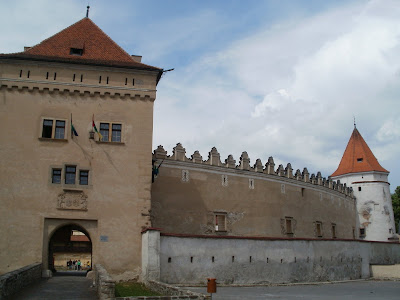
3. The town castle is at the end of the old square. It's got some exhibits in the different towers, like one about a doctor from the town who was the first in Slovakia to take x-rays, and of course arms and armor. At the end of the tour are some rooms with displays on life in the town in the 19th and 20th centuries, including census information that said that the highest number of Jews in the town, before the war, was over a thousand, but that in the 2001 census there was only one Jew. There was also an old wartime street sign for Ulica Adolfa Hitlera/Adolf Hitler Strasse. It was somewhat comforting that the sign had bullet holes in it. 4. The castle's oldest tower has been significantly reconstructed and therefore has the safest stairs in all of Slovakia.

5. The town's lyceum has a library that is supposed to be pretty impressive, but is closed on Saturdays.

6. Here is a tank called Jánošík, across the street from the back of the castle.

7. The Basilica of the Holy Cross, also reputed to be impressive inside, also seemed to be closed (maybe for a wedding).

8. I thought maybe visitors could go up in the Renaissance belltower next to the basilica, but it, too, was apparently closed. Or maybe I just wasn't looking in the right places to go in these sites.

9. I did peek inside the Greek Orthodox church, but it was modern and had no cool icons or anything.

10. The exterior of the New Evangelic Church is light red and green, for some reason. The inside is light, with a very high ceiling and a set of steps leading up to the altar. On the right hand side about halfway down the nave is the mausoleum of Imre Thököly, a Hungarian nobleman who was a native of the town and supported Protestantism.

11. The best reason to go to Kežmarok is to see the UNESCO-listed articulated wooden church. It's right next to the new Lutheran church, and despite the name, the outer walls are plastered, so I wandered most of the way around it going, "What is this strange building?" before seeing the sign that said it was in fact the wooden church.

During the 17th and 18th century Slovakia (among other parts of Europe) had some of those laws that said that Protestants could build churches as long as they didn't use any nails. They also had to build on specific sites outside towns, they couldn't have towers or bells, and parishes had to pay for construction themselves. In the case of this particular church, there are two small stone rooms at the back (actually to the right of the altar, but on the side opposite the entrance) that were given to the church by the town.

The church was built in 1717 on a Greek cross plan. It measures 35 meters long, 31 meters wide, and 20 meters high (115'x102'x66'). The walls are made of red fir, the supporting columns of yew, the hardest wood found in Slovakia, and the altar and pulpit of lime. With the ground floor and six balconies, there is room for 1500 people.

In this picture, taken stealthily from behind the pulpit, you can see that the church looks like the prettiest barn you've ever been in. The ceiling is painted like a partly cloudy blue sky, with saints around the edges. The altar looks like it's marble because it's painted so nicely. Everything is beautifully carved and painted, and most of the writing, like the saints' names and inscriptions near the altar, is in German. There aren't that many pictures of the interior online, which is disappointing, because it is very nice; but on the other hand, pictures aren't as cool as actually walking in and seeing it yourself.

Wednesday, April 27, 2011

Banská Štiavnica

Before we returned to school today I managed to squeeze in one more day trip. Tuesday was a working day, though not a school day, so the buses were running normally, and I found that it was easier to get to Banská Štiavnica on a weekday than on a weekend.

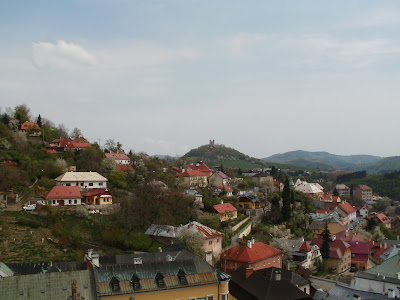
Banská Štiavnica is a former mining town. Back in the olden days, there was gold in them thar hills, and silver, too. The town became the site of a mining academy, and one of the most prosperous areas in Slovakia. It has not one but two castles, many churches, and a lot of handsome buildings.

If you're planning on visiting Banská Štiavnica, the first thing you need to know is that it's in a hilly area, so there's lots of going up. The second is that if you're going by bus, you should get off at the Križovatka stop, which is the one right in front of the Billa. Then, facing Billa, turn left and walk up the street until it becomes Dolna, which takes you right up to the historic center. Ahab: Getting off at the wrong bus stop so you don't have to.

I was in the town for a good four hours, but I don't feel like I did four hours worth of anything. What I did do was visit one of the many museums, the Kammerhof, which had exhibits about mining and the life of the miners. It made me realize that mining would be a horrible job for me personally, and that it couldn't have been fun for anyone. Of the objects on display I especially liked the models of mines built in bottles.

As previously mentioned, the town has two castles, although in Slovak these are zámky, not hrady. The newer, Nový Zámok, has an exhibit on the defence of the town from the Turks, and I walked up the hill to see the castle itself, but didn't go in. Instead I visited Starý Zámok. When I first was reading the various sites' opening hours, one listed the Old Castle as being closed on Mondays AND Tuesdays in April, and for a while I was pretty miffed about it. There was a small door open at the castle itself, though, and there were listed special Easter hours, saying that it was indeed open. Huzzah!

As in Kremnica, this Old Castle is a walled enclosure around a central building. I liked the one in Banská Štiavnica better than Kremnica, for a few reasons. One: there were no workers digging things up and looking somewhat reproachful at visitors. Two: the Old Castle is smaller and cozier. Three: there's a walkway around the inside of the wall. Four: I saw a squirrel there. It used the stairs and ran up and down the walkway and then sat on the roof and ate a nut.

In the towers on the wall there are different displays. One, called Himmelreich, was the prison tower, and still has old manacles and plank beds with iron restraints. Another has various pieces of decorative ironwork, and another has keys and locks and tools all made of iron. I liked going in the bell tower the best. It had big doors that opened up with views of the town (as below), and descriptions of the three bells, the oldest of which is from the 16th century.
I'm not entirely sure what the building in the middle of the complex originally was. In its courtyard and the rooms off it there are displayed a number of sculptures and monumental carvings. On the second and third floors there appear to be offices or something. On one corner there is the most pointless spiral staircase, as it literally just leads into a wooden roof. The cool thing about it is that instead of a plain, solid circular central post, the staircase has a three-part, open Gothic column.

There are lots of things I didn't get to do in town. There are two different parts of old mines that you can tour, other museums and galleries, and a very famous Calvary on the hill opposite the Old Castle. As I got ready to leave, I felt like I hadn't gotten everything I could have out of Banská Štiavnica. Maybe if I had had more time, or gone earlier, or had been with someone who could communicate more clearly than I can? I'm not sure. While it is certainly a nice place to visit, and probably worthy of its UNESCO listing, I was merely whelmed by the town. I did have some delicious mandarinky zmrzlina on the way to the bus stop, though.

Thursday, March 31, 2011

Check This Out

The Daily What has just informed me that Google Maps has street views of (a few) UNESCO World Heritage Sites. They also have street views of historic sites in Rome, Hawaiian beaches, world landmarks, and other cool/pretty things.

To Google!

Friday, March 18, 2011

"Many sink down to the underworld..."

"...and few return to the sunlit lands."

I don't remember why or whose idea it was, but last year we visited a few caves. The first, and by far the least impressive, was the Bystrianska cave, not far from Banská Bystrica. We saw two different kinds of bats there, and that's really all I can think of to say about it.

The next was much more interesting, because it was one of Slovakia's two ice caves. We visited the Dobšinská ice cave on the edge of Slovenský raj. (The other one, Demänovská ice cave, is in the Liptov region.) The ice cave was more than just a hole in the ground...it was a hole in the ground filled with ice. It was quite pretty, though, and not excessively cold. I mean, I licked the ice, and my tongue didn't get stuck or anything.

After last weekend I can be done with going in caves for a while. Domica was on my (very short) list of caves I wanted to visit because of its underground river, and the possibility of riding a boat on said underground river. Domica isn't far away at all, although it's only about two kilometers north of Hungary. Getting there took a little maneuvering because of public transportation being what it is; we couldn't get to Domica from Tisovec on a Saturday, so we went part of the way on Friday afternoon, stayed in a hotel in Rožňava that night, and took a taxi to the cave the next morning. "Hotel?" you say. "Taxi?" you say. "Slovakia," I say, where it was all to be had for a reasonable price. Also, it was Birthday Weekend, which automatically justifies the price.

H and Robin and I arrived at the cave well in time for the first scheduled tour, at 9:30. I decided to pay the 7€ photo/video fee, just in case the cave was rad. (For better pictures than mine and information on other Slovak caves, check out the Slovak Caves Administration's website, which is quite good.) The tour was the three of us and a Slovak couple, and the guide spoke a little English, so he was able to tell us some things.

The cave was pretty big and quite open in places. The boat ride was not as epic as I'd hoped, but it was cool. Of course the idea of an underground boat ride automatically makes me think of The Silver Chair (whence the quote), when Scrubb, Pole, and Puddleglum are escorted through the underland. I think my favorite part of the cave was the area called the Roman Spa, below. It looks totally fake, straight out of Disneyland. I'd been taking a picture of something and when I joined the others I said, "This is fake, isn't it?" It made us all feel like we should be singing "A Pirate's Life for Me" on the boat ride, or looking for One-Eyed Willy's treasure.

FAKE


After the tour finished we took a short walk on a nature trail, ate lunch outside the closed and sort of creepy resort across from the cave entrance, then began our return journey. Theoretically we would take a bus to a place called Plešivec, then back to Rožňava, and then to Tisovec. There was going to be about two hours in Plešivec, a town of which we had no knowledge but hoped would be interesting. Alas, it was not. We briefly considered hopping a fence so I could get a better look at the Gothic church, but decided that would not be the best idea. So we got a taxi back to Rožňava, ate ice cream, went to Tesco, and then came home.

Slovak caves: done. Believe it or not, there are still some castles I haven't been to yet. Yet...
FAKE

Sunday, February 27, 2011

North Wales: Harlech

The challenge of getting to Harlech was that I first had to get to a town called Pwllheli. In Welsh the w is a “oo” sound, and the double l is sort of like “hl” but not really. Needless to say, I was a bit worried about this, but Pwllheli was the bus’ final stop and the driver seemed to understand my pronunciation okay. From there I got a train down to Harlech. Now, you can see the castle from the train station easily enough, and there is a staircase/ramp deal up the hill, but it’s closed pending some safety-review nonsense. Instead, I had to walk up a street to the town. It was probably more dangerous to go that way than to go the way that had been closed for safety reasons.

Harlech is the only of the castles I visited that’s on a substantial hill. It’s not the highest point in the town, though; there’s another hill a bit behind it, and while walking around I saw that on the second hill there was some kind of walkway that I needed to investigate. At the bottom there was a sign saying that it was a wood and that the owners welcomed people to walk in it. After a few minutes I realized that I was walking in the woods in the UK. That was a happy moment.

Harlech is most famous for the song about it that supposedly dates from a siege of the castle during the Wars of the Roses. “Men of Harlech” was featured to great effect in Zulu. I thought maybe they’d play the song somewhere in the castle, in an exhibit or something, but no dice. Luckily I was prepared with my iPod, and stood at the top of the tallest tower and listened to Charlotte Church’s version and thought about armies marching toward the castle and about how beautiful this place was.

In Harlech I finally counted how many steps were in one of the towers—131. I would estimate I went up at least three towers in each of the four castles, and if 130 is the average number of steps in each tower, that equals 1,560 stairs climbed. In Caernarfon on Monday I was fairly worried about falling to my death on some of the stairs, but by the time Thursday rolled around I was slightly less concerned. In all of the castles, at least some of the steps in the spiral staircases had been replaced, and that wasn't necessarily reassuring; it just made me wonder how sound the rest of the old, unreplaced steps were.

There was something at Harlech that I've never seen in any other castle that I can think of, movie castles not included, and that's a staircase on an interior outside wall. In one corner there was this set of stairs that curved with the corner. It was rather narrow, but at least I didn't have to worry about hitting my head on anything.

One thing that struck me about all of the Welsh castles was how many birds there were in and around them. There were pigeons and gulls at all of them, and even ravens in Harlech. Beaumaris even had this "Pozor seagull" sign posted with all the other warnings ("Watch your head," "Do not slip and fall to your death," and one that looks like "Ice cream headache" but is really "Let your eyes adjust to the dark"). I think one of the reasons it was so noticeable was because there aren't a lot of birds around Tisovec for some reason.
Part of me looks at every place I go to and asks, “Is this my home?” Right now I’m preparing to leave Slovakia and go…somewhere else, and at the moment my biggest criterion is that that somewhere else will be an Anglophone place, but I don’t know much other than that. I know that I have a positive visceral response to the UK that I don’t have to Italy, for example, but I’m not sure if that’s enough to try to make a life in a place. On the other hand, I did just move to Slovakia sight unseen, and that’s worked out pretty okay. Even if I don’t ever move to Britain outright (and I shouldn't, because I'd eat cheese and drink cider until it killed me), I’ll certainly go back to visit again. Berwick-on-Tweed, Forest of Dean, Canterbury, I’m coming for you.

Every morning on spring break I woke up to hear seagulls outside, and every day I got to stand and smell the sea nearby. I spent a whole week waking up happy and being happy for the rest of the day. That's what I call a holiday.