Tuesday, May 16, 2017

Animals Roaming Cemeteries Update, and Some Famous Friends

Rome: cats
Amherst: skunk
Green-Wood: groundhogs (?)
Woodlawn: Bronx Ninja Squirrels and wild turkeys

Woodlawn is only 25 miles from my aunt's house in Connecticut!  That's astonishing (just ask my mom).  It also made the wild turkeys less of an inexplicable sight, since they hang out along the Merritt Parkway all the time.

Last time I went there I missed seeing many famous people; and Woodlawn has a lot of famous people.  And not-so-famous peopleit's a flippin' big cemetery.  This time I actually went by the office and filled in the paperwork to take pictures, which was worth it for the chance to talk to a security guard, who was nice in the way particular to New Yorkers.

As it was April, we did get rained on a bit as we drove through the grounds.  The sun came out eventually, though, and the weather didn't ruin the experience at all. 

Famous People I Visited
David Glasgow Farragut
The first admiral of the US Navy; our school in Spain was named for him.

Elizabeth Cady Stanton
Suffragette.

Fiorello LaGuardia
Annie's "mayor five foot two," for whom the airport was named (as well as P.S. 205, the elementary school next to my building in the Bronx).  I quite enjoy the little flower, in tribute to his name and nickname.

Joseph Pulitzer
Influential newspaper owner.  I am grateful to Pulitzer because in 1885 he, via the New York World, helped raise funds to complete the pedestal of the Statue of Liberty. 

George M. Cohan
Born on Independence Day and composer of "I'm a Yankee Doodle Dandy," "You're a Grand Old Flag," and "Over There," among many more.  His mausoleum is appropriately adorned with flags, and we sang him one of his songs.

Ida and Isidor Straus
Among those who lost their lives when the Titanic went down were the co-owners of Macy's.  Their plot features an ark, with their surname on the outside; within the gates are the rest of their personal information, along with the words "Many waters cannot quench loveneither can the floods drown it."  That made me the most emotional of anything there.

Duke Ellington
The bandleader born Edward Kennedy Ellington, famous for such tunes as "Take the A Train," "Caravan," "Sophisticated Lady," and, oh yeah, "It Don't Mean a Thing (If It Ain't Got that Swing)."

The mausoleum below is the size of our house a small chapel, and sports some insanely intricate carvings that would fit in on a French cathedral.  As always, I'm glad that people of the past had enough money to leave behind extravagant tombs for me to marvel at.


Saturday, April 29, 2017

The Fish Church

We took a drive up the coast and back the other week, so I'll be posting some selected sights and sites from that.  The posts will be in no particular order.

First Presbyterian is only a few blocks from the Wedge Inn in Stamford, and I'm incredulous that I'd never been here before.  Known as the "Fish Church" (though it was purportedly not meant to be pesciform*), it was designed by Wallace K. Harrison in the '50s.  From the outside one can only tell that the building is a bit oddly shaped for a church; upon entering its uniqueness becomes much more evident.  The sanctuary is made of concrete, with vaguely triangular stained glass panels comprising the walls of the front half of the fish.  My pictures didn't turn out very well as even with the glass the church is fairly dim.  It's an interesting place to visit if you've got a little free time in Stamford, but I'm not sure I would make a special trip there just to see it.


*If this is not in fact a cromulent word for "fish-shaped" then it should be.

Monday, April 17, 2017

Slovakia Recomposed

The other day I came across this video.  Set to "Spring 0" and "Spring 1" from Recomposed by Max Richter: Vivaldi - The Four Seasons, it features footage of Málinec (southwest of Tisovec).  I think it's beautiful and captures the country wonderfully.


Tuesday, April 4, 2017

I'll always love you, New York

An entertainment event earlier this year* had me thinking about New York.  I assumed, because of my longstanding love for the city, that I had plenty of posts about it on this blog; you may imagine my surprise when I found that the posts tagged New York number only six—and that includes places in the state, not just the metropolis.  (I think this particular entry conveys my feelings fairly accurately, though.)  All the same, I reckon I ought to rectify this general oversight and produce some more content about the greatest city in the world.  Thus, please enjoy various and sundry comments about Nueva York.

While there are lots of songs about New York, from the previous to “NYC” from Annie to Ryan Adams’ “New York, New York” (whence this post’s title), the following is probably the song I most associate with the city.  If you’re familiar with Working Girl, you’ll probably understand why; if not, a quick viewing of the opening credits should provide illumination.  The lyrics never name any particular place, but the connection between song and location has clearly stuck with me over the years.


On the other hand, the October before last I rolled into the city on an Amtrak train, eating an apple and listening to Glenn Miller tunes, including “Pennsylvania 6-5000” (and “Chattanooga Choo-Choo,” which, while not a New York song, is a railway song).  Unlike Metro-North trains, which stop in the Bronx and descend after 125th Street to run south underground until Grand Central, the Acela from Boston and New Haven leaves the mainland to pass through Queens, below, before arriving at Penn Station.  I've flown into JFK, LaGuardia, and Islip, and arrived on buses, and even been a passenger in cars (though you could not pay me enough to drive my own self into the city), but mostly I get on the New Haven Line and in less than an hour I'm there.  And once I'm there, if I can't walk, I'd rather take the subway than the bus—I think that's because I feel less likely to end up going the wrong direction on the subway.  In all, despite the fancy, high-speed trains I've been on, rail travel still strikes me as somewhat old-fashioned, and that fits a timeless city.

In the process of working on this post I discovered that I don’t have as many pictures as I thought I must; I believe many of them are on discs that are still in California, and it rankles me not to have them all.  The best way to rectify this would probably be for me to win the lottery, make a first stop at B&H, and then spend some serious time visiting and revisiting sites around town.

Boogie Down
Of all the boroughs I’ve spent the most time in the Bronx.  Sure, most people think of Manhattan as New York City, but that’s unfair to the other boroughs, which have so much to offer.  I can’t say I’ve ever been to Queens, apart from passing through JFK, nor Staten Island, that I remember—though there are pictures of my family on the Staten Island Ferry sometime in the late ’80s, so I’ve at least been to the ferry terminal there.  Up in the Bronx are the Zoo and the New York Botanical Garden, which are definitely worth visiting.  I’d also recommend Woodlawn Cemetery, whose over 400 acres are home to influential people from Rowland H. Macy and James Cash Penney to Celia Cruz and Edward Kennedy “Duke” Ellington.

Most likely the eeriest thing I ever experienced in New York was in March 2006.  Spring break was just about to start and I took the day off of work to cross the country for a friend’s wedding.  My flight left Islip mid-morning, but I had to take a bus and a subway train and the Long Island Rail Road and a taxi to reach the airport, and in order to get there in enough time—my parents will tell you that I prefer a generous cushion before takeoff—I had to leave my apartment around three in the morning.  I walked to the closest bus stop and waited in silence so nearly complete that I was startled by the appearance of someone just walking four lanes opposite me.  The quiet was strange, disconcerting in its unfamiliarity.  When the bus came, there was only one other passenger on it.  Of course, by the time I reached Midtown and had to walk a few blocks to Penn Station, more people were out and getting ready for the day, but still far fewer than the daytime city streets.

This picture was taken from one of my roommates' rooms.  I got first dibs on rooms, so I picked one of the ones that looked out over Southern Boulevard and the zoo, and I swear sometimes I could hear the lions roaring at night.  But this view of the Bronx is not at all shabby.

And then this one time I was on my way to campus while wearing the Rangers t-shirt I’d gotten at the Goodwill in Manhattan.  A police car was nearby, and as I jaywalked I heard the PA crackle on; for a moment I was sure that I was going to be admonished for crossing Fordham Road illegally.  So you can imagine my relief when what I heard instead was one of the officers complimenting my “great” shirt.

While you’re in the 718, stop by Ivana’s on Arthur Avenue, the Bronx’s Little Italy, and have a pepper and egg wedge for me.  No one else makes them quite as good.

BKLYN
The Bronx may be known as the roughest borough, but Brooklyn’s got the reputation as the coolest.  I, however, can suck the cool out of anything, even Spot Conlon’s territory.  And so the last time I went to New York I made a point of visiting two sites in Kings County: Central Library and Green-Wood Cemetery.  The former is a formidable building with a curved façade opposite Grand Army Plaza.  The grate at the entrance features figures from literature; this chart identifies all of them, though I was fairly certain that the man second from the bottom in the center column was Walt Whitman.  The interior isn’t as impressive as the exterior, given more to function than form and seemingly last redecorated in the 1970s, but above the entrance inside is a carved eagle that once adorned the offices of the aquiline-named daily newspaper.  

I found visiting Green-Wood Cemetery a far more satisfying experience.  Journalist Horace “Go West Young Man” Greeley, Governor DeWitt Clinton, Leonard Bernstein, Samuel Morse, and Louis Comfort Tiffany are buried there, the last under a disappointingly unadorned stone; Green-Wood in June is full of blooming dogwoods and groundhogs.  The cemetery is also home to the borough’s highest point.  From there, near a spot where a Revolutionary War battle was fought, you can see Manhattan’s skyscrapers, and, by shifting a bit to the your left, the Statue of Liberty.  At the Altar of Liberty a statue of Minerva raises her arm in salute to the lady in the harbor.  If you’re there around noon on an early summer day, you might catch the scent of the freshest pizza you've ever smelled in the air.  So please bury me there, because I can’t imagine a better place to be planted than that, with that view and that history and that pie, forever.

Or maybe just cremate me and toss me into the East River* from the walkway of my favorite bridge.  The next best thing to a Gothic arch is a neo-Gothic arch, and there’s nothing more strong and graceful than the stone and wire of the Roeblings’ bridge.  For a New World city, it’s easy enough to find the medieval in New York: there are relocated buildings up at the Cloisters, arms and armor at the Met, and a Gutenberg Bible at the Public Library; St. Patrick’s is even more exuberantly neo-Gothic than the bridge.  But even if the bridge isn't real Gothic, it’s real New York.  I’ve crossed it on a bright late-September day, and on an overcast April with one of my oldest friends, and after watching Nathan’s hot dog-eating contest on Independence Day, and every time was a dream come true.

Who was to know what should come home to me?
Who knows but I am enjoying this?
Who knows but I am as good as looking at you now, for all you cannot see me?
     from “Crossing Brooklyn Ferry” by Walt Whitman

I know I have nothing groundbreaking to say about New York—why do you think I’m linking to songs and quoting Whitman?  The things I want to say have mostly already been said, and more eloquently.  The place is expensive, dirty, and aromatic; it’s uncomfortable in both winter and summer.  But every time a train or bus or plane takes me back I end up in Grand Central, head thrown back to see the ceiling, and I hear Carly Simon sing the sky is a color of blue you’ve never even seen in the eyes of your lover and I wouldn’t trade a minute there for anything.

*It was the movie of the Broadway version of "Newsies," obviously, but I like to pretend to have some dignity. 
*Leaving aside a portion to be tossed into the Rimava into Tisovec, too.

Friday, March 31, 2017

Slovenská hudba

We all know that my favorite Slovak song is "Tota Heľpa," and that, at least in my opinion, there's little better than a crowd of all ages playing instruments and singing folk music.  But to think that Slovak music is all fujaras and people in kroj is just foolish.  As evidence, I offer a few of my favorite non-folk songs from Slovakia.  I will admit that the following selections do not represent a comprehensive overview of recent popular music; they are a totally subjective and not terribly well-informed collection.  Počúvajte and enjoy!

HONORABLE MENTIONS: Not in Slovak
"Crushin' My Fairytale" by Celeste Buckingham
Celeste is like part American and part Swiss and lives in Slovakia and is fluent in the language.  She co-starred in my favorite Slovak movie, Láska na vlásku, and recorded a song for the end credits.  She also sings in English, as in this song.  You might recognize Bojnice Castle as the filming location for the video.

"Princess of the Light" by Lavagance
The video for Lavagance's song "Gabriel" seems to be set in a Baumax (a home improvement store) and downtown Bratislava.  That song seems tailor-made for the final scene in an hour-long drama on an American network, and I'm surprised it hasn't been so used yet.  As far as I know, they only sing in English, but I have made no investigation to prove the contrary.  There are two videos for "Princess of the Light"; the one I prefer features SĽUK, the Slovak national dance troupe.

"Stužková" by Elán
Okay, the song is from 1985, and the band and lyrics are Czech, and you only really hear this during stužková season in November.  But it's so iconic that I can't in good conscience omit it, and the video--made, remember, before the fall of Communism in Czechoslovakia--is amazing.


TRETIE MIESTO: "Môj život je muzika" by Kollárovci
It's either this one or "Neodchádzaj" (which I hope they play at every wedding and ples and stužková from now until the end of time).  This song is folky, but not actually traditional.  All of the music on this album, also titled Môj život je muzika (My Life is Music), is catchy; Dad's favorite is "Mariša," and I have to be careful about listening to or even thinking about "Sokoly" because it gets stuck in my head quite easily.


DRUHÉ MIESTO: "Horehronie" by Kristína
Slovakia's entry in the Eurovision Song Contest back in 2010.  I feel like the recent trend has been for Eurovision songs to be all in English, but I wish more were in their countries' native languages.  "Horehronie" is all about how beautiful the region is, a sentiment with which I agree wholeheartedly.  The song didn't win, but that's Eurovision politics for you.

I also like Kristína's  recent songs "Si pre mňa best," and "Na bieleho koňa" from Johankino tajomstvo, which I still have not seen, dang it.


PRVÉ MIESTO: "Ľahká" by Korben Dallas
 
The album is called Banská Bystrica and its cover features the SNP Museum in the city, so I don't know how much more Slovak you can get than that.  I love Juraj Benetin's voice on this track; its weight and depth is a counterpoint to the addressee, who is lightweight (ľahká), like a nut on the water (ako orech na vode).  For me that line fits the song much better if I don't think about its literal translation, but just picture what it means; and when I do so, the water I imagine is the stream in the hills, north of the spring and near the Jewish cemetery, peaceful and secluded and close to home.

Wednesday, March 29, 2017

Flashback: Locus Maleficarum

The town of Salem has given more power to witchcraft than those accused of and executed for it ever did.

Without its one claim to fame, Salem would just be another New England colonial town.  One could argue that it would be even less well-preserved, were there not such a strong reason to keep its old buildings in good shape.  And yes, Salem does benefit from its sea-going heritage, and Nathaniel Hawthorne and the House of the Seven Gables, and its proximity to Boston and Plymouth.  But the majority of the tourists and their dollars come for the witches.

Had they the chance to offer opinions, neither the accused nor the accusers would likely be able to believe what Salem has become.  Whereas the 17th-century citizenry lived in fear of witches, those who readily confess to using magic now flock there.  As there is nothing to suggest that the area has any innate supernatural vibes, the influx of modern witches to the scene of the crime, so to speak, can be seen as defiant at best--as they claim a space from which their alleged forebears were violently excluded--and crassly capitalist at worst.

I didn't quite realize this on my previous visit, with the seventh grade, but it was patently clear this time.  Still, it is an interesting city, and I'd go back again, if only to visit the Peabody Essex Museum, which is closed on Mondays.  (Also to visit the Olde Pepper Candy Companie, which makes really good cherry cordials.)

On our visit in May two friends and I went first to the Witch Museum, housed in a former church.  The statue out front is of Roger Conant, one of the city's founders, but his billowing cloak and Salem's prevailing preoccupation make it easy to mistake him for a witch.  Inside is a strange display.  Groups of visitors enter what must have been the sanctuary and sit on benches, either in the middle or on the sides.  Around the room, well above head height, are dioramas depicting scenes in the trials.  These dioramas are not particularly state-of-the-art, and are illuminated one at a time as a recording tells the story.  The narration sounds like something out of a B horror film, the dioramas are quaint, and the overall effect verges on cheesiness.  And yet it is not laughable.  I've known about the trials since at least sixth grade, and have read The Crucible, and consider myself generally pretty familiar with the event; but I had a visceral reaction to the dioramas, particularly the ones showing (entirely bloodless) executions.  It's one thing to know the fact that people died, and another altogether to see a representation of that.

After the show, visitors walk through a weak exhibit that gives a very vague history of witchcraft throughout the years.  It includes mannequins of a pair of modern-day witches, whose ceremonial robes are made of panne velvet, the likes of which few real witches would likely be caught dead in.

We also visited the poorly-named Witch House.  The house is the only one left in Salem that has a direct connection to the trials; Jonathan Corwin, a judge, lived there.  It's a nice two-story colonial house, set up as it may have been for its inhabitants, with herbs hanging near the hearth and one of the upstairs rooms dedicated to explaining the experience of childbirth in the colonial era.  Despite the name, the house gives no information specifically about the trials.  It was, however, easily one of the most historically edifying things we saw.

Of course the highlight of the trip was visiting the Burying Point.  Compared to others I have visited it was somewhat sparse, but residents include Justice Hathorne, Nathaniel Hawthorne's forebear and trial judge, and a Mayflower passenger.  We also enjoyed the tombstone of Nathanael Ward, a young man who had been a librarian at Harvard and who died at only age 23.  Adjacent to the Burying Point is the Witch Trials Memorial.  Executed as they were, the accused were buried in unmarked graves; the memorial names them all and records their date and manner of death. 

Many of the shops in town cater to an occult audience, and offer psychic readings.  And, of course, there's a store where you can buy all kinds of Harry Potter merchandise (with some Game of Thrones and Doctor Who goods thrown in as well).  I'll admit that I was tempted by the Salem Quidditch t-shirt, but was deterred by the school group crowding the store.  The adjacent shop claimed to sell wands, though every time we tried the door it was locked; just when we were about to give up someone noticed us at the door and let us in.  The interior was somewhat modeled after Ollivander's, though was much less precariously stocked, and there were a variety of hand-turned wands in different woods.  The shop also offered things like wax seal kits and quill pens.  I'd rather have something or be somewhere that looks like it's from the world of a story than something officially branded and cheaply produced, so I much preferred the wand shop to its neighbor, whose products you could find in any mall.

Salem is an odd place.  My previous visit presented a more well-rounded overview of the area's history, including its seafaring and literary ties.  That Salem seems almost like a different town than the witchcraft-obsessed Salem.  It is worth a visit, and also contemplation: not only of one of our worst episodes, but of why we--as individuals and as a society--revere and visit the places we do.

Monday, March 27, 2017

Birthday Weekend in Beaufort

I'd originally hoped to go to Savannah for birthday weekend a fortnight past, but it turns out they start their St. Patrick's Day festivities a whole week in advance.  I wasn't feeling too keen on facing the gathering crowds, so instead we stayed in-state to visit Beaufort.  (Despite there once being a French settlement near the city, the first syllable rhymes with hue, not hoe.)

On I-95 south we saw a lot of Canadian cars.  Apparently it was spring break for them up there.  It was certainly the beginning of the Canadian-American Days Festival in Myrtle Beach.

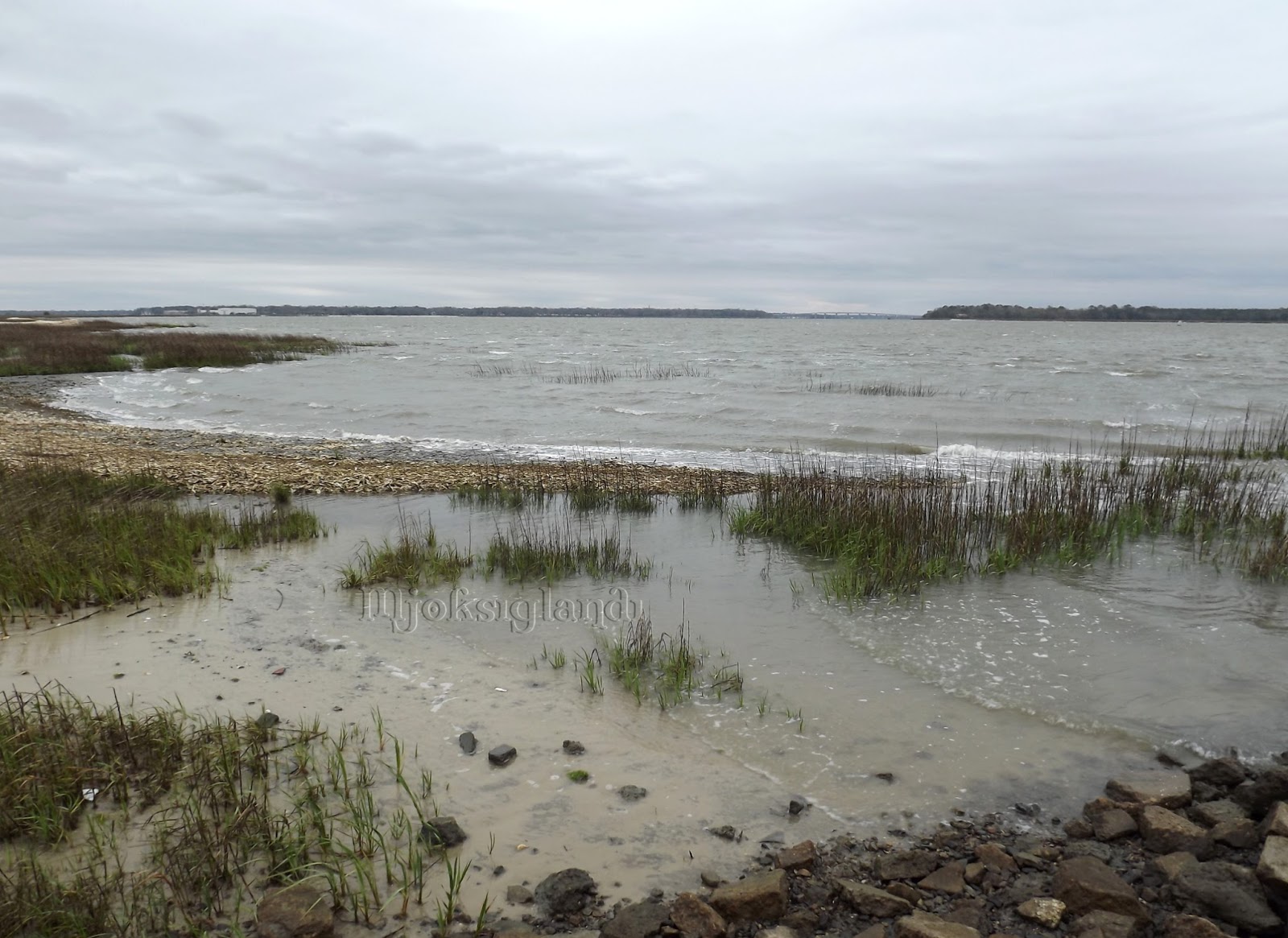
Beaufort is the second-oldest city in South Carolina.  Right on the coast, it's connected by bridges to several of the state's Sea Islands, including Hunting Island, Lady's Island, and Parris Island.  At the latter there was a short-lived French settlement, Charlesfort, in 1562, and later a Spanish one, Santa Elena.  The islands have long been home to the Gullah community; the Penn School (now Penn Center) on St. Helena Island was one of the nation's first schools for freed slaves.  The whole area has a rich and varied history, and distinctive Southern atmosphere.

Not far from Beaufort are the ruins of Old Sheldon Church, formerly the Prince William Parish Church.  Surrounded by trees dripping with Spanish moss, the brick walls and columns could not be more picturesque if they had been planned.  The first building was finished by the 1750s and burned by British troops during the Revolution.  It was rebuilt around 1824, though in the 1860s it was again damaged, allegedly by Union troops, though the extent of the damage is in question.  Whatever the case, the church was never restored, and stands among scattered tombs.  It is gorgeous.  Though there are no major signs marking the site, it's visible from the road, and opposite it is a dirt parking lot.  It's worth stopping if you're passing, and I'd say it's worth driving out of the way to see.

Meanwhile, in the midst of Beaufort itself is the Parish Church of St. Helena.  Established as a Church of England parish in 1712, its sanctuary was built twelve years later and enlarged in 1842; it's now one of the oldest churches in America.  During the Civil War, the church's interior furnishings were nearly all destroyed, so Union troops stationed in Beaufort passed their time carving a new altar, which is still in use today.  The churchyard is not predominantly grass, as I expected, and contains some historically and architecturally interesting graves.

One of those buried is Colonel John Barnwell, also known as Tuscarora Jack.  Though he got his nickname by fighting Native Americans, it still sounds flippin' cool.  Also cool is that Jack was born in Dublin in 1671 and came to the colonies in 1701; he died here in 1724.  Imagine that: spend the first 30 years of your life in a city in Ireland, and then, reportedly "out of a humor to goe and travel but for no other Reasson," move to the wild New World.  The chutzpah of our early colonists is so astounding and inspiring. 


If plain old sweet tea just isn't cutting it anymore, you can always try a sweet tea float at Scout Southern Market.  The float is made with sweet tea and a few scoops of sorbet; Mom had mango, while I went with the classic lemon.  On a warm day the float would be a perfect way to cool off as you strolled Bay Street.

The Visitors' Center and Museum are located in the old arsenal.  The arsenal was built in the late 18th century, rebuilt in 1852, and renovated in 1934.  The building's crenellations and pale yellow paint job vaguely reminded me of the Alcazar in Sevilla; given that a Spanish colony, Santa Elena, was established nearby in 1566, the architectural style is not as terribly out of place as it might otherwise seem.

On Saturday evening one of us was really invested in having seafood for dinner--which makes sense, as we were in fact quite close to where sea creatures live.  My crab cakes were good, but the she-crab soup was really excellent, so thanks, Dad.

There are lots of lovely old homes in Beaufort.  Around the city there are little plots of undeveloped land, many with views of the Harbor River (though a few of them seem to be people's backyards...they must be used to visitors gawking, though).  One house had a particularly fine gate, with ivy growing on the posts and real gas lanterns lit.  With azaleas in bloom, Spanish moss hanging off everything, and grand little houses with porch ceilings painted pale blue, Beaufort really does exude that stereotypical elegance and charm that Southern cities are so known for.  Though Saturday was clear and bright, Sunday was overcast; and the grey sky lent an otherworldly aura to the sights.

Parris Island is the site of the United States Marine Corps Recruit Depot.  Male recruits from east of the Mississippi and all female recruits train at Parris Island.  It's a really pretty island--likely less pretty for those whose stay includes slogging through mud and getting yelled at by drill instructors--and I couldn't help but wonder how much the land would go for if it were to be sold.  Millions, definitely.  Though there weren't many people around when we visited, we did see recruits being trained, marching and jogging around the base.

Visitors are welcome, and the depot is home to a good museum on the area and its use by the Corps.  In one section visitors learn about the training that recruits go through, from arrival on the island to graduation; in another there are displays of uniforms and equipment from the wars in which Marines have fought, from the 18th century through the present.  I would recommend the museum to any visitor to the area, regardless of whether they have ties to the Marine Corps or not.

Also scattered around the island are statues related to Marine history.  One, known as Iron Mike, depicts a Marine from World War I, and is a memorial to fighters of that war.  Out past the golf course is another, the Santa Elena memorial, which has something to do with the island's early use as a Spanish fort; unfortunately, the road to that was closed due to storm damage.  The statue I got the best look at was the monument to the flag-raising at Iwo Jima, located right in front of the parade ground.  A few years ago I learned that one of the Marines who helped raise the flag, Sergeant Michael Strank, was born in Slovakia (then Czechoslovakia) on November 10, the Marine Corps' birthday.  By all accounts Sgt. Strank, who died not long after the iconic moment, was admired for his leadership and devotion to his men.  That a Marine who shared the Corps' birthday was so highly regarded seems fitting, and his willingness to work in and fight for his new country typifies the immigrant experience.  I'm very proud to share some of my background with such a hero.

While Beaufort hadn't been on my radar, much less my first choice, it was a satisfying trip.  It may not have the cachet of its older sibling, but there's not much reason for that, in my opinion, and I'd certainly recommend Beaufort as a destination to visitors.