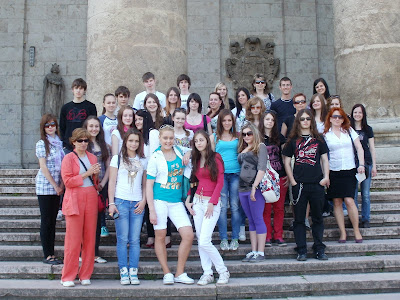
 In my time living here I have come to internalize a bit of the rivalry between Slovakia and Hungary. I think Slovakia is better than Hungary in almost every way (except at having Cherry Coke and Dr. Pepper). I’m especially perturbed by the Hungarian language and its complete linguistic isolation from any neighboring language. And even though Slovakia lost in the hockey, at least this time they didn’t lose to Hungary.
All that said, it’s a little hard for me to get into the message behind our class trip to Hungary: that we should be proud of Hungarian history because it is our Slovak history as well. For about 900 years present-day Slovakia was part of Hungary, first in the kingdom of Veľká Morava and later in the Austro-Hungarian Empire. Most of any current antipathy between the two countries originates in the post-World War I era, when Hungary lost about two-thirds of its land under the Treaty of Trianon.
We—almost 30 third years, three history teachers, the financial secretary, and the secretary and her family, including her brother, who drove the coach—left Tisovec just after 7 on Wednesday morning and headed south and then west. On the way students gave short presentations (in English) on the history of the Hungarian kingdom. I took notes like a good
 student myself. We actually crossed into Hungary twice—we went in, then back into Slovakia, then back into Hungary again. I must admit I’m not sure why we did this, but it was a good illustration of how open the borders are.
Just across the Dunaj/Duna/Danube from Štúrovo (known as Párkány during the Hungarian years) is Esztergom, or Ostrihom if you’re Slovak. The basilica there is the third largest in the world. It was completed in 1856. I thought the most interesting part was the crypt, with brick arches and epic statues of Eternal Life and Eternal Perdition. It was also here that I discovered that the kids were going to take more pictures of themselves than of anything historical.
The
 next stop was Visegrád. There are two castles there: the reconstructed royal palace (királyi palota) near the riverbank and the citadel (fellegvár) up on a hill. The citadel is older, and the palace dates from the time of one of the greatest Hungarian kings, Matthias Corvinus. Matthias’ wife, Beatrix, was Italian and brought the Renaissance to Hungary. The royal palace has a Renaissance courtyard with the “Hercules Fountain” depicting baby Hercules strangling some snakes. The original, fragments of which are preserved inside the palace, was made of red marble, and ran with wine during banquets. The citadel of course has lovely views of the river and also wax-work dioramas of scenes of castle life that the headmistress and I agreed were full of silly inaccuracies (like lemons and oranges as garnish/decoration). The really great part was leaving the palace and getting on the coach to go up the hill to the citadel. In my non-teacher life I would’ve had to walk, and I’m grateful I didn’t have to do that with my kids.

We got a bit behind schedule somehow and arrived in the town of Szentendre around 5:30. Originally the kids were supposed to have free time and get dinner there, but we went straight to the restaurant. After we ordered I went back to the ATM we’d passed to get some forints. The ATM was only one turn away and should’ve taken about a minute and a half, tops, to get to. Even before my first lap around the block I was already thinking, “Oh, Ahab, you know better than to wander around a foreign town by yourself,* especially in your current fatigue-addled state of mind.” I managed not to get irreparably lost, though, and made it back to eat my beef stew. It was so good.
Our hostel was on the outskirts of Buda. It was a quick trip from there to t
 he castle hill on Thursday morning. We walked around the president’s palace, Matthias Church, and the Fisherman’s Bastion. I was called upon to review the characteristics of Gothic architecture outside the church; I was hoping we’d go in, but we didn’t, alas for me. From there the bus took us to Pest and we went to the House of Terror. I think that it seemed even worse to me this time since I’ve been teaching 20th century history. Some of the kids were upset by the museum, as they should have been, so at the end of the visit the headmistress and I tried to explain why we visit museums like that, and concentration camps—lest we forget. As we left one of the girls told me that it was the first time she’d realized how bad things got during the socialist era (Hungary tried to rebel against the Soviets in 1956 and the attempt was answered with great cruelty). She said, “I thought after World War II it was better.” I told her I’d thought so, too, before I became a history teacher.
 After all that, the headmistress let the kids exercise their democratic rights, and they voted not to visit the art museum. We had a brief stop at Heroes’ Square (Hősök tere, left) and then took the metro to some other square whose name is frankly unimportant. Then we all got two hours of free time.
Last time we visited Budapest we didn’t get to go in the big market hall when all the stalls were open, so I headed there. I will miss European markets when I leave. Most of the greengrocers had strawberries out, and when I walked by the first stall and smelled them I had to have some. I consulted my phrasebook and found a vendor who was not busy and looked pleasant. Standing in front of the strawberries I smiled and said hopefully, “Fél kilo?” It worked like a champ. I paid about 500 ft. for my half-kilo, rinsed them at a little sink, took them outside, and ate about half of them straightaway.
Then I succeeding in locating both Cherry Coke and Dr. Pepper, and of course got a milkshake from Mickey D’s.
When we reconvened (the kids had almost all gone to McDonald’s, too, and shopping), we took the metro back to Hősök tere and the bus met us there. You have not seen a bunch of kids more eager to go home from a pleasant two-day trip than these ones. Admittedly it was noticeably warmer in Budapest than in Tisovec (a thermometer as we were leaving said it was 32°), but when one of the girls described the weather as “tropical,” I LOL’d.
My biggest concern during the trip was whether or not these kids were actually making any connections between what we were seeing and what they’d learned in class. I’m certain a few of them were willfully ignoring any possible educational tidbit—I do teach them, after all, I know what they’re like—but I think most of them got something. And though one girl got a little sick, no one got drunk or arrested or woke me up in the middle of the night, and that’s really all I could have asked for. It was fun to laugh at them and the silly things they did and said, too; two of the girls were giggling about something as we walked to Hősök tere and I asked what they were doing. Miška said, "Majka fell in love with the construction worker" we'd just passed. Majka defended herself with "He has beautiful eyes!" and looked for him very unstealthily the next two
 times we passed by the same place. Teenagers.
In the end, no matter how much I complain about not understanding Slovak and Slovakia, there is no mistaking the sense of relief I feel when I get back from having left the country.
*Clearly I do not truly know better.


