Showing posts with label churches. Show all posts

Sunday, March 11, 2018

Flashback: DC

Back in August we took a quick trip up to Washington, D.C. (and Virginia, and Maryland for crab-eating purposes) this week.  Though there wasn't much time for sightseeing, we did take a few hours on Thursday morning to visit Arlington National Cemetery and Washington National Cathedral.

If you visit Arlington in August, I would certainly recommend taking the trolley tour.  It loops around the over 600 acre cemetery, and passengers can disembark at a number of stops to visit popular locations, like the Kennedy family plot, Arlington House, and the Tomb of the Unknown Soldier.  We were able to see a guard change at the Tomb, which happens every half hour in the summer, as well as a group presenting a wreath there.  There is a small museum between the Tomb and the amphitheater behind it that documents the history of the Tomb, and displays some gifts left by foreign dignitaries.


Then we went to the National Cathedral, over near Georgetown.  The cathedral, an Episcopal church, was designed in imitation of Europe's great Gothic cathedrals.  Make sure not to miss the observation gallery on the seventh floor, accessible by elevators from the entrance.  When we visited there was a small juried exhibit of modern stained glass on display, and photos by the windows showing landmarks in the capital and Virginia.  The gallery also gives information on the 2011 earthquake that damaged the cathedral's towers.


Wednesday, October 11, 2017

Wednesday, February 8, 2017

Old St David's Church and Cemetery

We begin with a brief programming note: I'm back in South Carolina for the time being, so expect to see more posts on the Southeast.

Somebody actually gave me the keys to a historic church.

Said key is kept at the Chamber of Commerce in Cheraw, South Carolina, a few blocks away from Old St David’s Church.  This information was posted online, as were the Chamber’s opening hours; though I arrived pretty much smack dab in the middle of those hours, no one was at the Chamber and the door was locked.  As I’ve had problems with doors in the past, I did put some effort into trying to open it several ways before realizing that it wasn’t just me.  I was about to call the office’s number to see if someone was hiding in the back when a woman appeared from the adjoining insurance office and let me in.  She was able to let me in and told me the staff had a meeting and would probably be back in an hour—this after I’d driven half an hour specifically to visit this church and cemetery.  If the entire staff leaves during your scheduled opening hours, maybe put a sign on the door.

Fortunately, the kind non-Chamber-employee was also able to give me the key.  Now, when I’d read online that you could pick up the key, I expected to have to sign for it, at least, and probably to have to produce my driver’s license and have them make a copy until I brought the key back.  Given those expectations, I was a little surprised to be handed the key, no further questions asked, and told that if no one was in the office when I came to return it that I should just slip it in the mail slot.  Obviously I of all people would never purposefully do anything to damage a place of worship, but they didn’t know that.  Apparently I look trustworthy and benign (though in reality I am more the former than the latter).  Anyway, the greater danger was that I would decide to live there and never return the key.

(Spoiler alert: I did not.  And there wasn’t that much that looked valuable that could be easily stolen, so I suppose that curtailed many concerns.  Still.  One hopes that normal operating procedure entails a bit more circumspection.)

Old St David's predates the Revolution, and was the last Anglican church built in the state while it was still under George III's rule.  As is common with churches of the time, it features box pews.  The interior is whitewashed, with wood accents; there isn't a painting or lick of gold to be seen.  Keyholders enter through the door on the east side.  Once inside, the raised pulpit is directly opposite the door.  The entry at the front of the church is only used when ceremonies take place there, but the stairs to the small balcony are found there.  At the other end of the church, past the altar, is the vestry, with shelves full of hymnals and information on the area during the war.  The interior door in the vestry does not lead to a bathroom; if there is one in the church, it's well hidden.  There is, however, a quality Union Jack near the back door.


Though I'm not much interested in the Civil War, I neither can nor will ignore the fact that it happened.  The monument to Confederate soldiers in Old St David’s is interesting in that it was erected in 1867, quite soon after the war ended, and while the area was still occupied by Union troops.

Despite its long history, the cemetery does not have an overabundance of Revolutionary era graves.  Of those that do exist, the most notable are not of patriots.  In June 1780 the 71st Highlanders arrived in Cheraw.  Against advice from local Loyalists, they camped near the Pee Dee River, itself not far from the church.  According to the regimental surgeon some two-thirds of the 300 soldiers suffered from fever, and several died, though their names were never recorded, even by their own officers.  In fact, a large plaque in the churchyard says that “The official Muster Rolls for this Regiment are some of the most incomplete of all the Public Records of the British Military in the 18th Century.”  There are three sites at Old St David’s where Highlanders were buried: one near the entrance, one near the vestry door, and one on the west side of the churchyard.  This last has the biggest marker, and the aforementioned plaque is nearby.  I can't help but feel a little sorry for the soldiers who died so far away from their homes and families, even if those soldiers were enemies.

Other interments of note include that of the first Bishop of Texas (who was born in Society Hill, South Carolina, not far from Cheraw), and one-half of Laurence Lempriere Prince.  Perhaps this is not as unusual a situation as it seems at first glance; one assumes that the halves are in the form of cremains, and families often split up their loved ones.  And there are bits of saints divided up all over Europe, and Shelley's heart is buried in his plot in the English Cemetery in Rome.  Still, this was unexpected, to say the least, and a bit puzzling.  An Internet search revealed no obituary that might help explain Mr. Prince's motivations, but it did return a picture of the other half.  I must say, I was somewhat let down that it was so similar to the one in Cheraw.  I was hoping that it would be different, at least, or that there would be some further scavenger-hunt aspect to it.  Which gives me ideas...

Saturday, March 19, 2016

Murtaugh in Montréal

Last weekend I learned that I can't travel now the way I did when I was eight years younger.  That may sound silly and obvious, but it's been fairly upsetting to me.  Even before I left I thought--at the time rather jollily--that sometime after my first overnight bus I'd find myself repeating the famous words of Detective Murtaugh in "Lethal Weapon"; little did I realize how true they would prove to be when I was exhausted and hobbling around on astoundingly blistered soles.  Mostly I'm sorry about missing the opportunity to go shopping and buy souvenirs for people, and to look for this book in a used book shop (and in case you were wondering, it's not too late to get me a birthday present).  Rather than dwell on all that, I'll pretend that I don't feel like a failure and just present the things I did manage to do and see.

The weather was better than forecast: though chilly, it was bright and sunny most of the time.  The temperature seemed to fluctuate; at times it was almost warm, but then the wind picked up and it cooled off again.  Still, and as usual, the weather was better than it should have been for spring break.

Early in the morning we twenty or so passengers were roused from the bus and made to go into a building, where Canadian border patrol agents questioned us briefly.  Fortunately, I knew this was going to happen, as I'd read about it online.  I'll admit to being incredulous at the idea; the last time I crossed a border on a bus where we actually had to stop was between Hungary and Romania, and there the guards took our passports and checked them, leaving us to wait on the bus.  Getting off of the bus to be checked out is probably preferable to surrendering one's passport in a foreign country where one doesn't speak the language.  This time I was asked where I was going, why, and for how long, whether I was meeting anyone there and whether I planned to leave anything in the country.  Apparently I seemed safe enough to let enter, and it didn't take too long for everyone to be allowed in.

Despite the obvious border crossing, and despite the fact that most people I heard spoke French, it didn't seem that I was really in a different country.  I'm not sure why that is.  In addition, a lot of people online (particularly on the TripAdvisor forums) say that Montréal feels European, a sentiment I did not share.  No one can deny that the city was influenced by its early French inhabitants, but influence is not ambiance.  I didn't have much trouble because of the language difference, though I did realize that my French sounds better in my head and that my receptive skills are not fantastic.

Though I don't often drink coffee, I definitely needed some upon disembarking at a quarter to six.  There was a Tim Hortons not far from the Gare d'Autocars, and I managed to get a small coffee and a beignet aux pommes (it's not what I'd call an apple fritter, which is what the website claims it is).  Thus fortified I returned to the métro and took the blue line to Jean-Talon.  The métro itself is fairly easy to use; there are only three or four major lines, and you just need to know toward which terminal you're headed.  My problem came whenever I had to leave a station and figure out which way to head on the street.  This is not something I did well at all.  However, this first time I managed to find my way to the Marché Jean-Talon, a daily market.  Though the market supposedly opened at 7, most of the sellers were still unloading their goods when I arrived.  Most of the stalls were produce, but there were others selling other types of food, like bread and pastries, seafood, and foie gras poutine; few of these were close to opening so early.  I was excited to see several stalls with different kinds of apples, though most seemed to be selling them by the basket, rather than individually.  There was also plenty of freshly-pressed apple juice, and lots and lots of maple and honey products.  I bought some juice, and found a stall selling apples singly; the man there was unpacking McIntoshes but let me pick a few.  Then, when I went to pay, he said there was no charge, and gave me another apple, a small plum-colored one, as well.  I couldn't even think of how to ask if he was sure (being fairly sure myself that the only foreign word I could recall at that moment, "Pravda?", wouldn't do the trick), and he insisted, so I got three free apples.  It was so kind that I almost cried.
 
I knew that there is a Polish cafe somewhere in Montréal, and I believe it was that fact that led me to grab my phone at 10 PM to search the Internet for places that might sell Kofola.  A comment somewhere noted that a Romanian deli named Bucarest stocked it at one point, so I made my way there.  Bucarest is on what seems to be a highway that runs through the city--it reminded me of how Fordham Road becomes Pelham Parkway in the Bronx.  Its location means I absolutely would never have found it if I hadn't known where to look.  The deli, which is a good size, had all sorts of Central and Eastern European goods, including the hoped-for Kofola, in one- and two-liter bottles.  I bought two one-liter bottles, for ease of carrying, and a Milka bar; I didn't want to get much more than that and have to carry it around all day.

Theoretically not far from Bucarest, though you would not know it from the somewhat meandering route I took, is l'Oratoire Saint-Joseph du Mont-Royal.  L'Oratoire was conceived of by a monk named Frère André and is dedicated to St Joseph, Jesus' earthly father.  Visitors can ascend the steps in front of the basilica--and pilgrims can climb on their knees--or people who are just mildly interested and have already walked a lot can take a shuttle bus from the parking lot to the entrance.  From the outside it looks like a pretty standard, though large, sacred building, one that wouldn't be out of place in Vienna; the inside is a different matter.  For one thing, l'Oratoire has more escalators in it than any other church I've ever been in.  

On the first floor is the shrine, with statues of St Joseph in his different roles, like Model of Workers, Protector of the Church, and Terror of Demons.  There were candles before the statues, and between them racks with canes discarded by those who had been healed.  Behind the shrine was an alcove with a statue of the Virgin Mary in front of a raw, dripping rock wall, part of Mont-Royal itself.  On the next level up is a gift shop, the terrace, with windy views of the city, and the basilica proper.  This is where the stylistic disconnect between exterior and interior was most obvious and jarring, because while the outside is very neoclassical, the basilica is quite postmodern and almost brutalist, made mainly of concrete.  It strikes me as an odd choice to make--though the interior was finished in 1966.  Among the decorations are the apostles, arranged in groups of three, carved from wood and larger-than-life; their size means that they are literally looking down on the viewer, and their expressions are all fairly unimpressed as well.  In the other, larger gift shop, located in a building adjacent to the oratory, among the usual rosaries and such, they also sold prayer cards, though these were printed not on paper but on plastic, the size and weight of a credit card, with the prayer on the back in French, English, or Spanish.  I, of course, bought one featuring St George, with a prayer in French.

If one church is good, more is better.  My next stop, in Vieille Ville and near the old port, was Notre-Dame-de-Bon-Secours.  Because of its location the chapel became known as a site to which sailors came to give thanks for good weather.  On the port (as in waterfront, not the opposite of starboard) side, the chapel is topped not with a Touchdown Jesus but a Touchdown Mary statue.  The port side also has an interesting wooden gallery attached to the stone building, to what purpose I'm not sure; I think it's part of the museum that I didn't visit. 

The interior of the chapel is decorated relatively sedately and was certainly the brightest of any of the churches I saw that day.  The vault was wood, painted in pastel hues, and I was amused to see that hanging from the ceiling were lamps in the form of small ships.  Despite the fact that it was Saturday, there seemed to be a small school group there, with a docent giving a talk.  That's something I would like to do, I think, though I might have a problem if I thought the kids were being disrespectful.  Still, I think it would be satisfying to work in a beautiful, historic church. 

I did basically no shopping on my trip, but I did wander into a store in the old town that sold Inuit art.  Though there was some jewelry and a whole room of fur coats and accessories, as well as fur rugs, most of what was for sale was sculpture.  Most of the sculptures were of animals, my favorite of which were the dancing bears.  They're just so joyful.

I also spent some time walking around the Vieux Port.  The Saint Lawrence River was moving swiftly, but, as you can see, the marina was still iced over.  There were a few yachts moored there, despite the fact that I thought you were supposed to take your boat out of the water when it might freeze.  But I don't own a yacht, so what do I know?  There was also a truly huge freighter docked in the river, near the Molson building and the Jacques Cartier Bridge.  The Vieux Port has many activities that are better suited to warm weather than when there are still mounds of snow on the ground; no one was taking advantage of the beach umbrellas when the sand below was mostly covered in ice.  The clock tower at the end of the quay was open, and I believe free to ascend, but I chose to sit on a bench by the river and rest my feet.

The first thing I said when anyone asked what I planned to see in Montréal was "the basilica"--that is, Notre-Dame Basilica.  (Oh, francophone Catholics, we know you love Mary, but did you really have to name every dang thing Notre-Dame de Whatever?)  In Place d'Armes, the square opposite the entrance, is a monument to the people who founded the city, which was first known as Ville-Marie (come on, Catholics!): Paul Chomedey de Maisonneuve, Jeanne Mance, Charles Le Moyne, Lambert Closse, and the Iroquois.  From the outside the basilica looks like a small two-towered Gothic cathedral, made of fairly nondescript stone, just like you'd see in any number of towns in England or France.  It's certainly nothing to write home about.  The interior, on the other hand, is a different story.  It's well worth the five dollar (Canadian or American) entrance fee to see it.  As so often seems to be the case, pictures do not do justice to the decoration.  The interior is probably what many of the cathedrals of Europe looked like before their paint jobs were faded by the centuries; it is magnificent, though I can see how it might seem a bit gaudy to someone used to the aforementioned faded style.  The basilica reminds me a little of the one in Kraków, and even like some of the restored synagogues in Central Europe, particularly the Spanish Synagogue in Prague. The blue around the altar was glorious.  I was more than a little put off by the number of people taking pictures of themselves or others in front of it, but I tried to focus less on the annoyance that my fellow visitors were causing me and more on the sublime beauty of the church itself, and what that beauty was created to represent and exalt.
I wandered around on my own long enough that I was there when the next free tour in English started, so I figured I'd stay for that.  "Tour" was a bit of a misnomer, as the group merely sat in a few pews and listened while our guide spoke, but the wedding about to happen in the chapel at the back might have curtailed our group's ability to move around.  Or maybe the tours are just talks after all.  Whatever the case, Julie, our guide, pointed out some things that I'd noticed and some that I hadn't known, and some that were a combination of the two.  For example, the stained glass windows along the walls depict not Biblical stories nor saints' lives but scenes from the history of Montréal, which I had noticed; but I didn't realize that those windows can be opened, an uncommon feature.  I also didn't realize that the vault and even the columns were made of wood.  That's part of the reason why the windows open: the wooden construction is warmer than stone, which is more pleasant in the winter than in the summer.  Julie also told us about a number of hockey players who were married in the basilica, a bit about the pipe organ, and that one of the towers holds ten bells while the other only holds one, named Jean-Baptiste.  Cast in London and weighing 11 tons, Jean-Baptiste is so big that when it was still being rung its vibrations were damaging the tower.  It is no longer rung, only struck on special occasions.  The ten-bell carillon is still used.

One might think that with all of the churches and cathedrals I've been to, I would be less moved by them at this point.  I'm thankful that that isn't so.  

The last significant thing I did was eat poutine.  Poutine is simply cheese curds and gravy on fries.  Restaurants around the city offer a number of variations, including lobster poutine and vegan options, but I went for the classic--or la Classique, as it's called at La Banquise.  La Banquise only offers two sizes, régulier or grande; I got the regular and only ate about half of it, saving the rest for my breakfast the next morning.  It was just as good (if not perhaps better) then.

My trip didn't turn out anywhere near how I thought it would, and I know now that things have changed and will have to change the next time I travel anywhere farther than a few hours away.  I can't say I'm pleased with or prepared for this turn of events, and that discovering these seemingly new limitations hasn't put me off the idea of traveling somewhat.  I hope in time that feeling will fade, and I'll soon be eager to go again, but right now I don't feel sure that will happen.  I'll be here if it does, though.

Wednesday, September 30, 2015

A Distinct Lack of Lifts

Monday morning found me once again heading to the King's Cross-St Pancras area to catch a train.  (The two are purportedly distinct, though to my perception they kind of flowed together into one huge station.)  Though the UK's rail system is not exactly inexpensive, it still seems less expensive and is certainly more convenient than rail travel in the US.

When buying my ticket I used a machine, which gave me the option of selecting one for a high-speed train.  As this cost a few pounds more, I did not go with that option.  Then, ticket in hand, I looked at the trains in front of me, all of which had the words 'high-speed' emblazoned on them.  So over I went to the railroad employees, who I hope were getting time and a half for working on the holiday and who were all just as pleasant as they could be, and asked if I'd need the high-speed ticket.  I would, but it was no problem to simply pay for the surcharge without buying entirely new tickets.

The trip was uneventful as the train made its way eastward and somewhat north.  I kept thinking of the most recent Robin Hood film, because one of the train's stops was in Gravesend, and in the film the returning Crusaders pass through that area on their way back from France.  As I was preparing to alight at Rochester, the punk who'd been sitting in the same carriage woke up and asked, very politely, if we'd already passed one of the previous stations.  I felt bad that he'd missed his stop, but was pleased by his good manners, and by being proved wrong in my assumptions based on his style.

As the train approached Rochester I could see the tower of the castle, and grew dismayed as we kept
going.  Though the station did not appear as near as I'd hoped to the attractions I was visiting, they turned out to be not very far away at all, and easy to find.  I walked up a small hill and found myself on a bunting-canopied historic, and rather empty, street.  At first I was worried that everything was going to be shut up because it was a bank holiday, but then I considered that it was not yet 10 a.m., and that things would probably open later.  As it was, the only people I saw as I strolled were a group of voluble French students.

I soon gleaned that the bunting was decoration for the Dickens Festival, which would be happening at the following weekend.  Rochester was a favourite of Dickens, and he patterned many locations in his works after real buildings in the town; these are marked with plaques noting in which novels they appear and what they are called there.  There are also lots of shops whose names contain Dickensian references, like Pip's greengrocers and Sweet Expectations.

I was about halfway up the street when suddenly to my left there was an open area, rather than the row of shops that preceded and followed it, and the cathedral appeared.  A set of steps led up from street level into a little grassy courtyard with benches and a fountain in the middle; beyond that was a wrought-iron gate into the cathedral grounds, leading to the main entrance.  Directly opposite the west doors of the cathedral is the castle.  I don't believe two places I've been to visit have ever been so conveniently located before.


Founded in the 7th century, Rochester is the second-oldest cathedral in England, though the present building only dates from the 11th century.  If I remember correctly, it is also the shortest in length of all England's medieval cathedrals.  One of the things I liked best about it was the bathroom, because it was hidden behind a little door in a very medieval-looking corridor.  It was also impressive how modern and comfortable the bathroom was, given its location; it must have taken some work to plumb everything in.  Like St Albans, Rochester was also a pilgrimage site, and includes a set of steps that were used by penitent visitors as they made their way to the shrine behind the altar.  The stone steps have become so worn down and concave over the years that wooden steps have been built over them to make the ascent easier (and likely safer).  The cathedral's quire screen was especially nice, carved with saints and patrons of the church, but I also enjoyed seeing memorials to military service, including a regiment in Gibraltar, and the poppies arranged by the Great War memorial.

On the side closest to the cathedral is the castle's former moat, now grass-filled, which features a small plaque noting Dickens' desire to be buried there (they stuck him in Poets' Corner in Westminster Abbey instead).  Beyond the moat is a wall enclosing the castle grounds, and within is a large grassy area with a few trees.  As this part is free to enter, it seemed as popular with the locals as with tourists; in the afternoon there were people picnicking and playing cricket there, and a group of teenagers had climbed onto the roof of the building that housed the toilets and were getting a talking-to from an employee as I used the facilities.  The 'castle' is really just the keep, a large rectangle rising up at one end of the grounds, and it is there that you must pay if you want to see any of what's inside.
I have told several people this story before, and by George I will tell it again because it may be one of my favourite things that I have ever read about a castle.  When I was deciding where to go on the bank holiday Monday, I read a bit about Rochester and saw that it was fairly easily reached from London.  Knowing that I delved deeper, and came across the TripAdvisor page for the castle.  TripAdvisor lets users rate and review attractions, and among the many four- and five-star ratings I saw that the castle had three one-star, or Terrible, ratings.  I had to check these out; I can't think of a castle I've been to that I would rate so poorly, but perhaps these reviewers had experiences that I ought to know about before I decided to visit.

The first of the Terrible reviews was about the Christmas market, so I felt safe ignoring that one.  The next two left me flabbergasted.  Both were from Brits, and both said that they'd visited with people who had some kind of handicap.  And both reviewers were upset that there was no lift in the castle.  (That's an elevator, for all of our Spanish-speaking friends.)  Yes: not one but two people expected that the castle that was begun in the 12th century would have a lift inside.  I must admit that I was pleased to see that these reviewers were from the UK and not the States.

As it is just a tower, there's not a lot to see inside.  One room near the bottom has a display showing a diorama of the castle at its most complete, and includes a timeline of its history, but as the majority of the building is devoid of a roof or floors that aren't in the corridors, there is no furniture or decoration.  There are informational panels describing, in English and French, what the various rooms would have been, with illustrations showing them filled with people at work.  All the same, it didn't seem like it would have been a comfortable place to live; the squareness of it must have been somewhat monotonous for its inhabitants.  I was very slightly unsettled by Rochester Castle--not actively uncomfortable, but vaguely aware that something seemed off.  Eventually I realised that it was mainly because of the arches.  With possibly one or two exceptions, most of the arches are Norman (or Romanesque, if you're on the Continent).  This means that they are the rounded kind, rather than pointed Gothic ones.  For someone used to seeing mainly Gothic arches, their marked absence in Rochester was odd.

Before I left I decided that I ought to get fish and chips.  There was a chipper on the street near the cathedral entrance, and from there I ordered cod and chips.  What I got was the biggest piece of fish I've ever eaten.  It was easily nine inches long.  Of course it was good, crisp and hot and filling, and I ate it sitting on a bench near the cathedral.  Would that there were more meals in such locations in my life.

On the way back to London someone came round to check our tickets, and I presented both my original Rochester-St Pancras ticket and the one for the upgrade.  'And you've got the other bit as well, aren't you very good, my love,' said the conductor checking tickets.  Yes, I am, I thought, well pleased with myself and with having been in a cathedral and a castle and having eaten my fill of fish and chips in a pleasant town.

Sunday, September 13, 2015

St Albans

...I Ioon Maundeuyle kniȝt, if al it be þat Y be not worþi, þat was ybore in Engelond in þe toun of seynt Albanes...

St Albans is the dream.  That's what I kept repeating to myself as I walked its streets, and that remains my best description of it, though I have a hard time articulating what exactly I mean by it.

St Albans is like Sandford, Gloucerstershire, but (one assumes) without all of the murder.  It's likewhat you'd imagine if someone told you to envision the prototypical small English city.  Half-timbered buildings, houses with roses climbing up the front, a busy market on the high street on Saturday morning, an Oxfam book shop, Roman ruins in a large, beautiful park, and a cathedral rising above the trees.  It's the dream.

The city is less than an hour north of London, making it a perfect day trip.  That was something that recommended it, to be sure, but the real reason I went was because of John Mandeville.  Whether or not he truly existed, the medieval explorer claimed St Albans as his home.  I'd seen things related to Marco Polo in Venice; now I had the opportunity to give Mandeville his fair share.

(Walking through St Pancras on the way to my train I heard a little girl say, "Mind the gap, Mummy.")

I found my way from the St Albans City station to one of its main streets, at one end of which was St Peter's Church.  The church is set in a large churchyard that includes gravestones, gardens, and wild-growing plants.  It was on the walls of St Peter's that I first encountered walls made with irregular flint.  Inside the church is not terribly remarkable, but in its children's area it had a banner that I want to recreate, because it pays tribute to Queen Elizabeth II with Her Majesty's silhouette, a large crown, and Union Jack hearts.  It was the most English thing and I love it.

As I headed toward the cathedral I passed an Oxfam book shop and stopped in.  This proved to be an advantageous decision, as they had boxes and boxes full of old postcards, separated by English county, other country, and subject.  I picked a few of the ones I liked best, including one of Southwark Cathedral, one of Harlech Castle, and one of the Book of Kells.

Market stalls were set up along both sides of the street down to the clock tower, selling everything from fresh produce to lengths of fabric.  The clock tower was built in the early 15th century; once again I chose not to go up in it, at least not before I'd been into the cathedral itself, my main objective.  But I didn't go straight to the cathedral, instead choosing to see the Roman ruins first.  This led me down roads where toadflax grew from walls studded with white seashells, and terraced houses with colourful doors.  It was delightful.

Though now named after England's first martyr, St Albans was called Verulamium by the Romans, who left bits scattered around the city.  I went out to the site of the ancient theatre, but chose not to pay the fee to go in and see what was undoubtedly a series of small walls.  I was charmed by the gatehouse, with wisteria a contrast to the light-colored stone, and the fields beyond it.  Nearby is Verulamium Park, one hundred acres of land that contains playing fields, a lake with a small island, a section of Roman city wall, and the remains of a hypocaust with a mosaic floor.  The mosaic is a decently sized chunk, which makes it all the more impressive that it's survived.  Now, of course, a building has been erected over it to protect it from the elements, along with walkways that allow visitors to view it from a few feet above.  Nearer the city in the park is the section of wall, now surrounded by a low fence to keep people from climbing on it.  I didn't linger long there, because that was when it started raining--just enough to require getting out my umbrella and making my way toward the cathedral.

As I skirted around the lake I saw a couple walking their dog, and had to ask them if I could take a picture, because he was the first and only bull terrier I saw while I was there.  He was a nice brown brindle who sat still enough for me to snap a picture to send to Dad, and then I chatted with his owners for a bit, explaining that my dad had asked every time we'd talked whether or not I'd seen a bull terrier yet.  The dog, for his part, was more interested in exploring his surroundings than talking to me.

I passed Ye Olde Fighting Cocks, named by Guinness World Records as Britain's oldest pub.  The main building was formerly used as a pigeon house and is octagonal.  I pressed on to the cathedral, passing through the gate that used to be the entrance to the monastic complex but now belongs to the school.  The Cathedral and Abbey Church of St Albans was founded near the site of the martyrdom of St Alban, and his shrine has been a pilgrimage site since his beheading.  In addition, the monastery was home to one of the most well-known monks in English history, Matthew Paris, an author and illuminator.  And, much to my joy, one of the columns on the west end bears a painted inscription about John Mandeville. 

I arrived at the cathedral in time to join a free tour.  As we gathered at the west end and our guide began giving us information, there was a wedding going on in the Lady Chapel, and we could hear faintly the ceremony going on.  At one point the congregation sang "Jerusalem" and it was perfect.

Like all medieval cathedrals, St Albans has not remained static, in its original form.  The earliest architecture is Norman and makes use of rounded arches.  Some of these still bear their medieval decoration, and the faded red stripes on the rounded arches reminded me of the Mezquita in Cordoba, which was an unexpected comparison to be able to draw.  A number of columns are painted with saints who have been there since the 13th century.  The western end of the cathedral was built when the Gothic had become popular, and the two architectural styles meet without finesse.  Adding to the somewhat unsophisticated appearance is the fact that two of the Norman arches on the north side collapsed and were repaired with Gothic arches, meaning that the aisle is asymmetrical.  Still, despite the fact that it seems like three or more different buildings shoved together, the cathedral is beautiful.

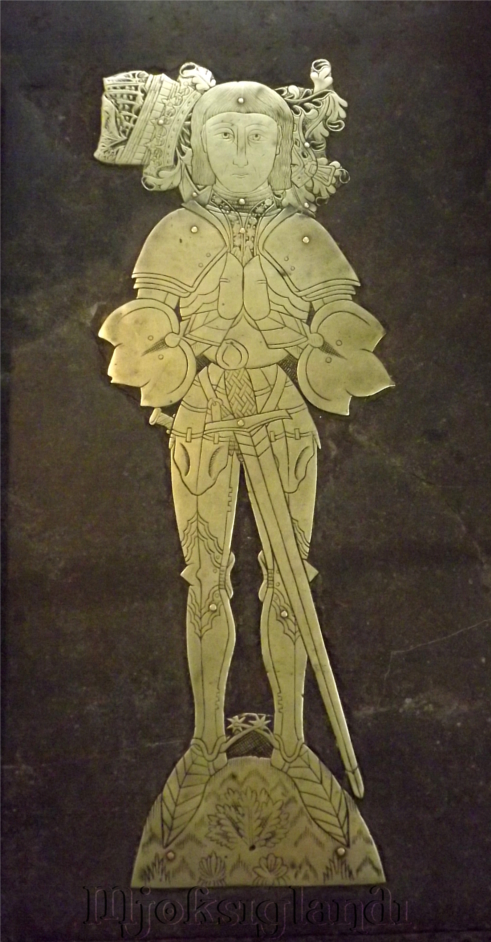
The Alban shrine is at the back, between the altar and the Lady Chapel.  The pilgrims came up the south aisle, and in order to keep an eye on them monks were stationed in a wooden viewing stand.  It was not dissimilar, in purpose if not in appearance, to a deer stand.  At the end of the tour I asked the guide something about the tiling on the floor, and then she offered to show me some of the brasses still in the floor.  These were covered by mats so that they wouldn't be damaged by people's walking on them.  Like bells and other metal decorations, many medieval brasses did not survive because they could be melted down and used for other purposes.  The young man to the left was some noble lady's brother, though I can't remember who.

Then, on my way back to the train, I ate a pasty.

I really enjoyed St Albans and highly recommend it, at the very least as a day trip from London.

Thursday, September 10, 2015

Cambridge

Wednesday morning found us boarding a coach (driven by a gentleman whose first language sounded like Polish or Russian) for a trip to Cambridge.  It doesn't take long at all to pass from London centre--depending on traffic, of course--into the surrounding neighbourhoods, and from there into the countryside.  The trip is around two hours, but the time went by fairly quickly.

Cambridge is a little like Santa Barbara: they're both college towns, and so beautiful that it's a wonder students ever go to class.  In the case of the former, though, the college buildings themselves are a major part of the grandeur.

After a stop at a campus cafe to get a drink and use the loos we visited the English faculty library.  In part because of the university's organization, wherein there are a number of separate colleges to which students and faculty can belong, there are departmental libraries whose resources can usually be used by anyone, regardless of college affiliation.  The English faculty library has its own room devoted to Shakespeare and works related to him; it's smaller than you might expect, but then, the library itself, while modern, is on the snug side.  It also features stress-reducing services like a graffiti wall (which, according to the staff, was adorned with many Terry Pratchett quotes and pictures of daffodils this spring) and Tea at Three, where the head librarian makes tea and supplies cake for students.

Next we went to the Judge Business School, where we heard a presentation on user experience.  The important thing about the Judge is that the interior looks like a shopping mall designed by set decorators for "Doctor Who."

Our last visit before lunch and free time was to the Wren Library at Trinity College.  Getting there meant wandering among the back streets, and then behind the college.  The area where some of the colleges border the River Cam is called the Backs; Trinity's backyard includes a well-tended lawn.  Though we weren't able to walk around the college grounds, we did see the quad, which was surrounded by columned walkways and filled with immaculate grass in the middle.  As the name implies, the Wren Library was designed by Christopher Wren.  The library is beautiful, with a black-and-white checkerboard floor and dark wood shelves decorated with crests carved in lighter wood.  It also includes covered display cases that house things like Newton's first copy of the Principia and a manuscript of Winnie-the-Pooh.   Before we went in we were asked to be especially quiet, as there were two students taking exams in the library.  It struck me as not an ideal environment for exams, in part because of the distraction of visitors coming in and out, and in part because the grand surroundings must have been intimidating.  Perhaps the students become inured to such things over time.
Lunch was at a pub, of course, where I had shepherd's pie and a pint of cider.  I must admit that I'm not used to midday drinking.  That did not stop me from trying to adjust, though.
After lunch we had a bit of free time before meeting our coach and returning to London.  Whilst walking we'd passed by a few churches that I wanted to return to.  The first, very near the pub, was St Bene't's.  (According to the church's website, the wonky spelling is because the name is a contraction of Benedict.)  It's not only the oldest church in the city but the oldest building in the whole county.  Therefore, as you might imagine, it's on the small side, with thick walls.  Though there are plenty of later touches--most of the arches are Gothic, as are the present windows--there is one stained glass window high in the west wall that I assume is original to the Saxon architecture, mostly because of its location, which would have been more protected than the lower windows.  The interior is whitewashed, with dark roof timbers and painted angels supporting them; it also features modern suspended light fixtures that would be much more at home in the 1960s than the 1100s.

Next I visited the Church of St Mary the Great, otherwise known as Great St Mary's.  Nearly opposite King's College, its tower is touted as one of the best places to look over Cambridge.  I glanced briefly at the stairs before deciding against ascending, though it likely would have been worth the exertion and fee.  The present building dates from the 1400s and is the University's church; it was built to accommodate greater numbers than the other churches I visited in the city, and has a second storey of pews for seating.  Great St Mary's has plenty of stained glass windows, and figural finials, including a unicorn, on the ends of some of the pews.

I was most excited to visit King's College Chapel.  Despite the name, the chapel is large; it appears to be even bigger than Great St Mary's, or longer, at the very least, since its profile is long and tall.  It's supposed to have some of the best medieval stained glass and vaulting in England.  I walked up to the college gates, excited to see all of this, and asked the porters if this was the entrance to visit the chapel.  You can well imagine my dismay when I heard that the chapel had closed to visitors some fifteen or twenty minutes earlier.  I was told I could come back for evensong, though I couldn't, as our coach was leaving before then.  Not being able to see the chapel was perhaps the greatest disappointment of the entire trip.

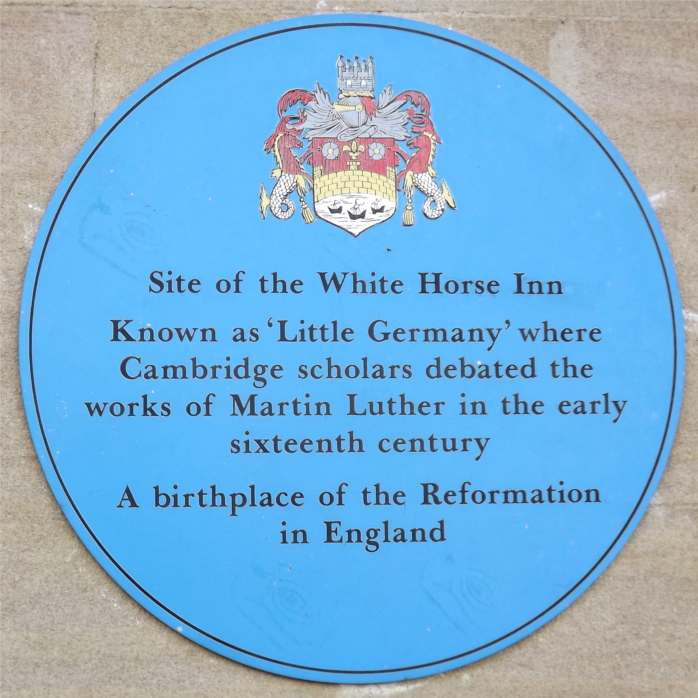
After choosing some postcards from a nearby shop I started wandering back toward the coach pick-up point.  As I went I passed a plaque that marked the former location of the White Horse Inn, where Luther's Reformation ideas were debated.  I also stopped in St Botolph's, another of Cambridge's many churches.  The church's website says that it was near the south gate in the city's walls, the one that led to London, and was the first church encountered by visitors crossing the Cam from the west; given that, it's no wonder the church was named for a patron saint of travellers.  Like St Bene't's, St Botolph's is old and smallish and somewhat plain, though it does have a carved screen before the altar that was installed in 1460 (though the paintings on it are from the 19th century).  I think the pendant lights in St Botolph's are even worse than those in St Bene't's; St Botolph's are just big frosted globes that look utterly out of place.  I understand that wiring and lighting a mostly-medieval church must be a challenge, but surely something can be done that's less jarring.

I've no idea which college this is; it's just a typical Cambridge view
As I walked back to the park where we were to meet our coach I passed a horde of schoolchildren, possibly high schoolers, speaking Czech, and wondered if they'd come by coach all the way--some of the EGT kids did, in my first year.  You could not pay me enough to sit on a coach with a bunch of students all the way from Central Europe to the UK.  I was glad to get back on ours and watch the pretty countryside pass by until we reached London again.