 |
| Plzeň, April 2009 |
 |
| Plzeňský Prazdroj |
 |
| Katedrála svatého Bartoloměje |
 |
| the view from St. Bartholomew's tower |
 |
| Moravský Krumlov, June 2010 |
 |
| Mikulov, June 2010 |
 |
| Český Krumlov, October 2010 |
|
| Plzeň, April 2009 |
|
| Plzeňský Prazdroj |
|
| Katedrála svatého Bartoloměje |
|
| the view from St. Bartholomew's tower |
|
| Moravský Krumlov, June 2010 |
|
| Mikulov, June 2010 |
|
| Český Krumlov, October 2010 |
 |
| on the castle end of Karlův most |
 |
| somewhere in Old Town |
 |
| St Vitus Cathedral |
 |
| St George's Basilica, in the castle complex |
 |
| the Museum of Communism |
 |
| the art deco Palác Adria |
 |
| Old Town and Petřín Hill from the clock tower |
 |
| an old market hall |
 |
| from across the Vltava, in Letná Park, on a grey All Saints' Day |
 |
| Jerusalem or Jubilee Synagogue |
 a little tiny bit too tall for the bunk, the overall sleeper-cabin experience was much more comfortable than the bus had been. We (Tika, Robin, and Anička, who teaches in Košice) arrived just after 7 a.m. on Friday morning, and dropped our things off at the Old Prague Hostel. This hostel definitely had the previous one beat for proximity to the Old Town. Once we'd left our big bags behind, we walked into the center, and I got to talk about Jan Hus and the Reformation and whatever else I could remember/make up about Old Town Square. And then we went to Bohemia Bagel and ate some bagels and drank some fresh-squeezed OJ and coffee, and that right there made the whole trip pretty much worth it.
 turn through Prague, horseshoes through Český Krumlov. I really like bridges, and the idea of living near a river, so I was quite taken with the town. It retains its medieval streets, most of which lead up to the chateau, whose round, painted tower is a landmark. The chateau's former moat has been home to bears since around the 17th century, but the bears seemed to be hiding when we looked for them. One of the highlights of our visit was the restaurant we ate at for lunch. Both Rick Steves and Lonely Planet mentioned U dwau Maryi as a good place to eat, and I was all for going, because it's a medieval-type place, but I didn't want to foist my weirdness on anyone else. When we found it, we all agreed that it looked good, so in we went. We sat at the back, right out by the river, with blankets and hot wine to warm us, and I had millet casserole with ham and cabbage, mostly because when I read the words "millet casserole" I was instantly fascinated. It was good, although, as you might imagine, rather hard to describe. The closest thing I can think of would be some kind of casserole made with grits, and yet it wasn't like that at all.
Besides the religious sites, the other really cool thing about Josefov is the Art Nouveau architecture. There are so many beautiful buildings in the area, and in other parts of the city as well. 

 In the afternoon, I went to the Convent of St Agnes of Bohemia (Klášter Sv Anežky České), which is home to the National Gallery in Prague's Bohemian and Central European medieval art collection. It took me a minute to find the convent, because the signs pointing it out seemed to lead to dead ends; but the entrance is sort of in a corner. The art collection was much larger than I'd expected it to be, and was almost exclusively religious art. There were lots of Madonnas and crucifixes and saints, and the tags in English were very well-written, but made me laugh, because they just use such silly expressions to talk about art sometimes. You could also walk around the oldest parts of the convent, dating from the 13th century, with markers where St Agnes and Wenceslas I and his wife Cunigunde are buried. As trite as it sounds, I had a feeling of peace walking around looking at the art and architecture.
That night being Halloween, we had to go out, although most of the actual parties had been the night before. We managed to end up at Prague's Australian bar, Fat Boy's, which was fantastic because A) it was a non-smoking establishment, B) they had Magners, and C) there was an NFL game (Patriots and Vikings) on the telly. What more can you want out of your Halloween than that?
Monday morning it behooved me to cruise around the mall, and then we watched the astronomical clock ding at noon and had some real hamburgers for lunch. After that I took off for a wander. I ended up on a hilltop park to the northeast of the castle, where there were real Praguers enjoying their day off, walking and playing and running with their dogs. From that vantage point, this is what I saw:  And lo, as I looked over the Vltava and the city, I said to myself, 'Hey, isn't there a big cemetery over there in Žižkov? And isn't Alfons Mucha buried there?' And myself said, 'I think you're right. We should go find it.' And though a third part of myself said, 'It's already three and you're supposed to meet the others at five; you'll never make it in time,' the rest of me was ready to go from the word "cemetery." So we all speedwalked down the hill, across the river, past the bus station, and up another hill into Žižkov, and finally reached
  the cemetery. In the picture above, it's to the left of and past the big TV tower.
The cemetery, Olšany Cemetery, was gorgeous. It turns out that Mucha isn't buried there, and I only got to see a fraction of it, but it was supercool. By the time I got there it was late afternoon, and there were fallen leaves and ivy everywhere, and some of the older mausoleums were broken down and boarded up...it was everything I've ever wanted in a cemetery. I just wish I'd gone earlier so I could have looked around more. It's possible that it was the highlight of my trip. There I felt accomplished and in awe and a little tiny bit creeped out (there were LOTS of angel statues, and it reminded me of "Blink," my favorite episode of Doctor Who) and like I couldn't have picked a better day than All Saints' Day to go. Because it was dusky when I was there, a lot of my pictures are a little out of focus, but I think it adds to the ambience, if photographs can have ambience. 
On Tuesday before we left we stocked up on bagels and I had a lemon-lime-ginger presse that was both exorbitantly expensive and wonderfully delicious. Then we got on our trains and subsequent buses and made it back into our dear Slovakia and home to Tisovec.
In conclusion, I have a message for the people of Prague: I hate to break this to you, but I'm pretty sure your city is fake.
 You really expect me to believe that that's real? I mean, really?
The 600 Years from the macula on Vimeo.


 Brno, my dad asked why he'd driven out to the back end of beyond. On the map it doesn't look like that bad of a drive, but it kind of is. There's really not much interesting about the town itself. The interesting thing shouldn't even be there. The chateau in Moravský Krumlov houses the Slav Epic, a series of paintings by renowned Art Nouveau artist Alfons Mucha (which is not, in fact, pronounced "Moo-cow," as we called him). Mucha was born in the nearby village of Ivančice. He wanted the Slav Epic to be in Prague, and the government was supposed to find or build a home for the paintings there by this year, but so far that hasn't happened. The chateau isn't a bad site for hosting exhibitions, but it's out of the way and needs to be fixed up. I was concerned about the paintings from a conservation point of view, because although there were barometers about and the exhibit is only open during the summer, it gets humid there, and these paintings really need to be protected.
The old town of Mikulov is very pretty and well-preserved. It's kind of like a Disney version of a late-medieval/Renaissance town. That probably sounds denigratory, though I don't mean it to be. Somehow--and this could have been more to do with me and when we visited than with the place itself--Mikulov didn't seem like an authentic old town. It had a slightly surreal quality in some way. This is not to say that I didn't like it. If I ever find myself in that area again I'd like to go back, because Mikulov had a significant Jewish community for nearly 500 years, beginning in the 15th century. One can visit the former ghetto, and there is an old cemetery that is supposed to be really cool.
Here's a view of the borderlands from the grounds of the chateau.

 Those crazy Austrians, with their sustainable energy sources.
 When we got to Vienna and checked in to our hotel, we went into the center and looked in St. Stephen's and then ate dinner and I had an Almdudler and saw a woman in a kilt playing the bagpipes near the plague column. Then I had the least uncomfortable flights I can ever remember and then we went home and watched all three Jason Bourne movies within the first 48 hours we were back.
 Fortuitously, it did not rain on Saturday. It had, however, been raining pretty much all week before that, and so the place where the festival was held was a morass of unfortunate-smelling mud. Once we got to the site and I knew how to get there, I returned to the center of town on my own. After I’d explored the city to my satisfaction, I came back to the festival and spent about an hour with garbage bags on my legs, squelching through the mud, listening to a band cover “Sweet Home Alabama” and other classic rock, and drinking a Paulaner hefeweizen. It didn’t suck. About an hour was the proper amount of time for me to be there.
 reason. Many of them depict Roman deities, like Neptune and Mercury, and there’s a Caesar fountain as well. In the biggest square, Horní náměstí, is the town hall, with the astronomical clock in one wall. By the time I reached the square I’d totally forgotten about the renowned clock, and walked around the corner and went, “Oh, right! Famous astronomical clock.” The various dials and faces of the clock are surrounded by mosaic work from the Communist era. The figures include symbols of the months, with peasant workers getting on with whatever agricultural task needs doing in each month.¹ I liked that the clock also included the name-day calendar.
 In the square there was a display of photographs taken by two Czech photographers in Afghanistan of joint Czech-US military operations. I didn’t know that the two countries worked together in that part of the world, so it was informative to see the photos. There was also a McDonald’s in the square, and I had a strawberry milkshake and the world’s hottest fries and am unashamed.
 has a lot of churches. The first one I went in was kostel Panny Marie Sněžné, the Church of St Mary of the Snows. The interior is being restored, and is very Baroque. I really liked the organ (right), which was intricately carved with angels playing instruments. I also saw the exteriors of the Evangelic church, a gray, square building, and its polar opposite, the Orthodox church of St Gorazd, in Palm Beach pink and teal. I went in dóm sv Václava (St Wenceslas Cathedral), kostel sv Michala (St Michael church), and chrám sv Mořice³ (St Moritz/Maurice Cathedral). St Wenceslas is all painted on the inside, with patterns of flowers and stars on the white walls.
 Because come on, they weren’t even charging anything to go up! So I went up the stone spiral staircase, which, to be honest, was a little terrifying, since there were chinks big enough between some of the steps to see through to things below. Those stairs went up to the first landing, which wasn’t very far up at all. There were some artifacts on display, a few old metal crosses from the steeples, that sort of thing, and a metal spiral staircase to see the bells. There are four bells of different sizes, and a view of part of the city. The best part was that I was the only one there the whole time, so I didn’t have to worry about anyone trying to pass me on the stairs. Now that I’m consulting the Lonely Planet to get some facts straight, it says that “The western tower is a remnant of its 13th-century predecessor.” I suppose that explains the scary stairs.
 Cieszyn, one of the largest and, at 300 years, oldest Protestant churches in all of Poland. We sat in the balcony, but there were two more galleries above us. As we’ve previously discussed, Slovak and Polish are not terribly similar, for all they’re Slavic languages, and every time I thought I’d be able to join in the hymns in Polish, they got harder and harder. The two examples I wrote down from the hymnal were przyjdż (no clue what that means) and wszystko (all, which I deduced because it sounds close to the Slovak všetko). After church we went to the supermarket and then had a three-course pierogi lunch, with potato to start, followed by meat with sautéed onions and peppers, and sweet cheese for dessert. And we watched “Shrek” in Polish as we ate, and then took a train and two buses back to Tisovec. And we all lived happily ever after, the end.
 or, Five Days in One Pair of Jeans
 One of Prague’s famous sights is Charles Bridge, or Karlův most. The bridge crosses the Vltava River; one end is near Old Town Square, and the other in Hradčany, the general castle area. On the Old Town side you can go into the tower over the bridge. There are lots of statues on the bridge, mostly of saints, and once the day begins there are artists and vendors and lots of people trying to take pictures. Guidebooks warn of pickpockets on the bridge, and in Prague in general, but no one in our group had any trouble. At left is the detail from one of the statues. It's probably morbid, but the grimace on the poor arrowed sheep's face makes me laugh.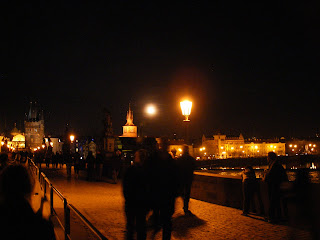
 Another attraction is Old Town Square (Staromestské námestí) and the Astronomical Clock in particular. On the hour the Astronomical Clock chimes and the apostles appear in a pair of windows. It’s really not that spectacular, even at noon, but huge crowds form to watch it. On the hour is a good time to ascend the clock tower, because everyone else is watching the display. I am hereby ranking the clock tower among the best towers in Europe for the ease with which one can go up and down. From the third floor of the building a ramp takes you up the tower. At the top of the ramp is one spiral staircase with a stoplight at the bottom. When you’re descending, you push a button that makes the light at the bottom red, which prevents people from trying to come up. It’s such a good idea. The views from the top of the tower are good. It was a pleasant tower.
 f buildings. The thing that you see from afar is St. Vitus Cathedral on the castle grounds. The cathedral is huge and wonderful. In the morning the sun was shining through the stained glass on one side. My favorite window was the one designed by Mucha. After St. Vitus we went to the Basilica of St. George, a much older and simpler building. Another building holds the Story of Prague Castle, an exhibit about the history of the castle with lots of artifacts, including what seemed like kind of a lot of clothing. The exhibit seemed to double back on itself all the time, and I’m not sure I saw everything before I left. Behind the basilica is Golden Lane, a row of cottages where soldiers used to live that are now shops, and at the end is Daliborka tower, which has a little exhibit of old torture devices. There’s even an oubliette.
 Prague has a lot of cool Art Nouveau architecture that I really enjoyed seeing. It also has a less well-known style called Czech cubism. And a quite popular modern building is near the river south of Charles Bridge. It’s called the Dancing Building.
 An easy day trip from Prague is to the town of Plzeň. From Florenc bus station it takes about an hour and a half to get there. You can travel by train as well, but the bus is a little bit cheaper. Why go to Plzeň? you ask. Well, boys and girls, you go to Plzeň to visit Plzeňský Prazdroj. Since that name probably doesn’t ring any bells either, another hint is that the anglicized name for the town is Pilsen. That’s right, Plzeň is the birthplace of pilsner and the home of the Pilsner Urquell brewery (that’s the prazdroj). You can tour the brewery and see beer being bottled or canned, watch a video of some guys making a huge barrel, learn about the history of the brewery and how the beer is made with a triple-mash process, and taste some unfiltered, unpasteurized beer. I found it as unpalatable as any beer, but I did not embarrass myself or the crew by not finishing my sample--it helped that it wasn’t very much. We bought gifts and ate late lunch at the brewery restaurant, where the service was slow but the food good. I had the garlic soup.
 tone stairs part of the way up, but then they switch to the wooden ones, and eventually you’re going up a glorified ladder. For me the going up is draining, but the going down is nigh well terrifying. I always feel like my feet are too big for the steps and that I never have a good place to step, and falling going down is much worse than falling going up. The views were pretty good, and I did not die on the way down. There is a picture of me coming down the stairs and smiling, but I’m also clutching the railings on both sides. However, I then found genuine cherry Coke at the potraviny. I don’t get how it can get all the way to the eastern Czech Republic, but it can’t get into Slovakia. We ran out of time for the underground tour of Plzeň, and I was also interested in seeing the General Patton memorial museum. Once again, I guess I’ll just have to go back.
 estivities. Prague has a few Easter markets, one in Old Town Square and one at the end of Wenceslas Square. The booths sell mostly souvenir junk or traditional crafts. These include decorated eggs and special whips made of braided sticks or twigs. On Easter Monday it is tradition for boys to whip girls with these sticks, throw water on them, and put perfume on them. This is supposed to make the girls prettier and give them good luck. In return the girls are supposed to give the boys alcohol or chocolate. Our Tisovec boy found a whip at the bus station on the way to Plzeň, so he “whipped” us on Monday. I was a bit surprised that I only noticed one boy whipping a random girl; she happened to be American and immediately started to complaining to her friends about how “you just don’t do that!” The Easter markets also had food booths selling sausages inna bun, trdelnik or tube donuts, beer and medovina, and the two things that most pleased me, Spanish-style churros (called pikle) and slushies. Since it was so nice, too, the ice cream vendors were doing good business.
