Sunday, May 31, 2026

Flashback: French FAQ

How long had it been since you last visited France before this trip in April 2025?

I kind of don’t want to think about it. Apart from a layover in Charles de Gaulle when I was coming back from Slovakia in 2023, my most recent visit to France was to Paris in 2000. My first visit, to the same part of the country that we traveled to this time, was in the early ’90s. On this trip we revisited some things that I know we’d been to my first time around, but that I didn’t have much memory of. This included the Tour Magne above the Jardins de la Fontaine in Nîmes, where, I was told, I’d complained about climbing up to. This does not sound like me at all.  On this trip I made sure to get dropped off at the tower, rather than down in the jardins, so I didnt have to climb up to the tower before I climbed the Roman tower itself.

How long were you there before you could articulate a full sentence in French?
Until about the penultimate day. I would sit there and think up fairly fluent sentences in my head, but they never came out of my mouth when I needed them. Fortunately, I didn’t need to speak anything more than broken French. Our host spoke French, and many of the people with whom I interacted spoke at least a little English. It surprised me how much English I saw on signs (and that’s not including obvious loanwords). Of course I can’t think of any examples that I saw, and seem not to have taken any pictures that would demonstrate this phenomenon.

At one point you were worried about not knowing Occitan. Was that an issue?
Of course not. It was interesting to see it used on signs, and I was surprised to hear that it’s taught in schools—for some reason I’d thought it was more endangered than that. To the best of my knowledge I didn’t hear anybody speaking it, but I don’t think I’d have been able to aurally discern it from French anyway.  (The two definitely look different: here
s the Wikipedia page on the Tour Magne in French and in Occitan.)

Was anyone on strike while you were there?
Not that I know of.

Did you drink a lot of wine?
More than I expected to, and I enjoyed it more than I expected to. Apart from the regular bought-from-the-supermarket wines we had with dinner, we got to try a couple of unusual varieties. One was vin sable (“sand wine”), a gris named for the sandy soil of the Camargue region. Since it was a local specialty I bought some in Aigues-Mortes.

More exotic than the vin sable were the wines we tried at a place called the Mas* des Tourelles. Mas des Tourelles is a winery built on the site of a Roman amphora workshop and winery. Their exhibit includes artifacts found on the property, as well as recreations of different aspects of the ancient industries. This includes using a Roman-style winepress during living history events. In addition to producing regular modern wines, the vineyard also makes three Roman-style wines based on ancient recipes. I love a tasting at the end of a tour, but I was especially excited to try these.

The Roman wines, carenum, mulsum, and turriculae, are based on recipes, or at least descriptions, gleaned from period texts.  Mas de Tourelles’ website calls them “Archeological roman wines,” and their French ecommerce site describes them as beverages with a wine base (though I wouldn’t be surprised if French law were very specific in defining “wine”).

Of the turriculae, the International Wine Review blog says, “It’s delicious and well-balanced,  revealing sherry-like aromas and flavors with herbal and dried stone fruit notes.”  Turriculae has fenugreek in it, which gives it more of a savory flavor than the others have.  It also has a bit of seawater in it as well.  One of the others, possibly the carenum, would make a tasty mulled wine.

*When I asked what a “mas” was I was told that it was a farm, which made me accuse the French of making up new words in the many years since I had studied the language in school and learned the word “ferme.” Same with “brebis” being used more than “mouton.”

How did you get around?
Our very accommodating host drove us pretty much everywhere we wanted to go. A few times I took the bus from the house to the center of Nîmes and back. It was convenient, safe (enough; various drivers were possibly overconfident tackling some of the city
s curves and hills), and easy.

Should I use Google Maps for driving directions in a small town in any vehicle larger than a scooter?
Probably not! Especially not in, say, Saint-Gilles.  Many towns have quite narrow streets that are easy enough to walk through, but not accessible to even compact vehicles.  In Saint-Gilles, just park in the little public lot and walk through the gate up to the abbey; it’s a five-minute walk at most.

They just have tons of old stuff lying around in Europe, don’t they?
They sure do, and Nîmes has a surfeit of it. The Pont du Gard, a three-tiered Roman aqueduct north of the city, was built in the first century. Les Arènes, the amphitheatre in Nîmes, was built only slightly later (and I felt like I was also about 2000 years old when I was climbing around inside of it—some of those blocks of stone are rather tall and not the easiest to scale). It’s still being used as an entertainment venue all these years later: we just missed the beginning of Nîmes’ Roman festival, but the amphitheatre also hosts rock concerts, too. The Maison carrée, a temple for which the modern French name translates as “square house,” was finished in 2 AD.


Is there a public restroom in the Jardins de la Fontaine?
Yes. It’s toward the back and on the right side if you enter through the main gate on the Quai de la Fontaine. There’s also a public restroom on the lower level of the Carré d’Art, across the street from the Maison carrée.

Did you successfully pack only things that you actually wore or used this time?
Alas, no. Since we went in April, which is fully spring, and since I planned to complete a circuit of the city walls of Aigues-Mortes, I packed a straw sunhat. Had this hat been at all water repellent it would have been useful, because that day it rained more than it did any other day. Which is great! The weather kept calling for rain, and in general it was wrong—it’d be overcast for a while, or get overcast, but it didn’t outright rain that much. Except for when I was walking the 1640 meters (1.01 miles) around the walls of Aigues-Mortes. My alleged raincoat isn’t at all waterproof, so it only slowed down the drenching. I ended up buying a souvenir t-shirt so I wouldn’t have to sit in a wet shirt the whole drive home.

I did, however, get to use the tool that I was most keen to, and had brought for only one purpose. (Bringing something that you’re only planning to use or wear once flies in the face of so much packing advice, advice I otherwise try to heed. In this case, it was worth it to make an exception.) Various sites online suggested that some of the best pictures of Carcassonne were to be taken at night, specifically from the Pont Vieux; so I brought my small tripod for that purpose. Given the weather that afternoon I was a little worried that it would be raining by nighttime, but after dinner—we wanted to get takeaway from a restaurant near our accommodation, and at first they didn’t recommend us getting the meals we wanted to go, as they wouldn’t travel well in their takeout containers; the advantage of having a fluent French speaker along was that she and the waiter arranged that we could carry everything over in their actual dishes and return them when we were done, which was very cool—and watching some French TV, including dubbed episodes of “Airwolf” («Supercopter»), I headed out. We stayed fairly close to the bridge, so it wasn’t a long walk, and I was able to find a few places to set up the tripod and get some shots. I’m really glad I was able to do it.


How many roundabouts would you say you drove through?
I can’t even begin to estimate, but it was a lot. And many of them were two lanes, not just one. It would have driven (ho ho!) many an American motorist bonkers.

Since you mentioned it on Facebook but never actually divulged the answer, how many churches (/cathedrals/abbeys/basilicas) did you go into on this trip?
If I’m counting correctly, nine:

Église Saint-Paul in Nîmes
Église Sainte-Jeanne-d'Arc in Nîmes
Église Sainte-Perpétue et Sainte-Félicité de Nîmes
Église Sainte-Baudile in Nîmes
Basilique des Saints Nazaire et Celse in Carcassonne
Cathédrale Saint-Just-et-Saint-Pasteur de Narbonne
Église de Notre-Dame-de-la-Mer des Saintes-Maries-de-la-Mer
Abbatiale de Saint-Gilles
Abbaye Notre-Dame de Sénanque

On the way back from Carcassonne we detoured to Narbonne. From a distance the cathedral looks massive—it must be on a bit of a rise, because much of it is visible, standing tall over the center of the city. When you’re inside, though, it seems smaller than it ought to be. It turns out that that’s an accurate assessment, because the building didn’t get finished. At the back of the quire the whole thing stops abruptly. If you walk around the outside to the back you can see framing for where part of the rest of the building was meant to be; they ran out of both money and space to complete it, as adding the rest would have required dismantling part of the city wall. While the cathedral has a nice cloister, the overall impression I got of it was of oddness, because of its truncation.

What song got stuck in your head after visiting Sénanque?
“How Do You Solve a Problem Like Maria?” Maria’s not an asset to the abbey!

Even if you don’t recognize the name, it’s entirely possible that you’ve seen a picture of Sénanque. There’s a long field of lavender in front of the abbey that looks lovely when it’s in bloom—or at least it does online. Since lavender doesn’t bloom until the summer, we weren’t treated to the sight. As it’s still a monastic community, there are some parts of the grounds that are off-limits to visitors. You can tour the medieval building, though, with the aid of virtual reality-enabled tablets. The tablets give information about the different parts of the abbey as text; then, when you hold them up, they overlay the present rooms with recreations of what they might have looked like in the Middle Ages. I thought this was a novel way to give visitors a better idea of medieval monastic life.

What site you visited had the best gift shop?
Chauvet, even though they didn’t have anything with the bear on it.

Last year I read a book called The Cave Painters about prehistoric artists and the discoveries of the sites in which many examples of their art were found. Then we watched Werner Herzog’s Cave of Forgotten Dreams about Chauvet. Having done all that, when we started searching for places to visit, I was excited to see that the site was within a reasonable driving distance of Nîmes. Visitors cannot enter the actual cave, in order to protect it from deterioration, so, as at Lascaux, a replica has been built. Grotte Chauvet II is the impressive result. The team recreated the whole interior of the cave (though made it safer and more accessible in the process), from the paintings and etched art to the cave bear remains to the texture of the walls. On a tour a group of people enters the replica cave together, each one with a radio-frequency headset with narration in their own language; when you reach certain marked spots in the cave the headset automatically begins the proper description.

Though masterfully done, Chauvet II surely isn’t able to replicate the entire experience of the original cave, with the smell of damp stone and chilly air, and the flickering firelight that would have brought the animal portraits to life. It’s probably a good thing that I personally wasn’t able to go in the actual cave; I would have been overwhelmed.

Since this question was about gift shops, the items that I most liked and bought several of from the Chauvet shop were lenticular bookmarks and mini notebooks. They showed various artworks from the cave system in 3D.

Runner-up goes to the gift shop at the Pont du Gard, which is where I remembered that my true calling in life is to tell gift shops what they should sell. I feel like I’ve said this before, but here again is my free idea for museums of the world: have a 3D printer in the shop and let customers print themselves little replicas of the most famous items in your collection. (Yes, I know based on complexity it could take a while to print. Make it an app and put a QR code on the tag for those items so that people can send their job to print while they’re still walking around. Sorted.)

How many statues of Jehanne did you see?
At least four, one of which was on the apex of the roof of a church dedicated to her.

Along with the St. Christopher medal that I wear while traveling long distances, I took my St. Joan medal. (Am I a bad Protestant or, as has just occurred to me, a really bad Catholic? Feel free to share your thoughts.) But I didn’t ever actually wear the latter while I was in France, because the far right has co-opted the image of the saint to support their own xenophobic agenda (by their way of thinking, fighting against an English takeover of France in the 14th century means that she would also fight against immigration to the country in the 21st). Since I don’t want to be mistaken for a supporter of the far right, I kept the medal out of sight. I did, however, light a candle in the Église Sainte-Baudile and stuck it in front of her statue there.

Would you be okay being buried in a French cemetery?
Yes. The two I was able to visit were wonderful. I’ve seen pictures of Père Lachaise in Paris, but, knowing the kind of famous people buried there, I wouldn’t have considered it typical of cemeteries throughout the country. Unfortunately, the larger of the two I visited, a Protestant cemetery in Nîmes, had a clearly posted and unmistakable sign prohibiting photography. This is of course fair to request, but a bummer for me personally, because it was very cool. Maybe I need to learn to sketch so I can draw things I’m not supposed to take pictures of. In terms of personality and ambiance the cemetery was somewhat reminiscent of Highgate in London. The other, where photography is allowed, is smaller, and stands just outside of la Cité in Carcassonne. It’s an impressive neighbor to have. What struck me most in both was not necessarily the graves themselves, but the decorations on them. Instead of real or artificial flowers, many graves had ceramic flowers left on them. Some of these were affixed to plaques with sentiments like “Regrets” or more personal messages, while others were on similarly ceramic crosses; but many were wreaths or swags of flowers. The practice makes a lot of sense to me, since these flowers looked better for far longer than silk or plastic or even natural flowers would. Had we passed a store that sold them, I might have bought a little arrangement to keep at home.


What’s a good time of day to visit Carcassonne?
If you don’t mind crowds, any time is fine. But if you want to see it without many other people around, go around eight in the morning, if not earlier. We first went up to la Cité after we’d gotten settled into our lodging on Monday afternoon, and despite the wind and threatening clouds, there were plenty of fellow tourists clogging the narrow reconstructed medieval streets. (La Cité is a worse than usual ship-of-Theseus-medieval situation.) The next morning I returned not terribly early, but early enough that there were more people just starting their workdays within the walls than there were tourists around. I even crossed paths with the garbage truck more than once as it made its rounds picking up rubbish, which I imagine it may have to do more than once a week.

Thanks to this trip I finally ordered a new (used) copy of Robin Hood: Prince of Thieves, some scenes of which were filmed in Carcassonne. (The DVD I’d had was so old that you have to flip it over halfway through the movie, like it’s a record.)

Whats that on top of the wall at Carcassonne? 

ENHANCE


Quel majestueux canard.

Is the south of France as terribly picturesque as the travel bloggers make it seem?
They were.

When we were leaving the airport in Marseille, the landscape—the hills with scrubby vegetation, and the knobbly piney trees—reminded me of Southern California. Later, Saintes-Maries-de-la-Mer reminded me of southern Spain, with blocky white-washed houses near the sea. (I always forget that the south of France is really on a similar latitude with the north of Spain, rather than the south of Spain. I guess it’s because both countries have a Mediterranean coast. True to her name, the Med will always feel to me like a, if not the, center of the world, and it was good to see her again.)

Within not so great a distance we visited several varied landscapes.  The Camargue is low-lying and generally flat, with fewer trees than other areas; we drove through hillier areas to the north and west, along winding roads above gorges, though from what I can tell we just skirted the actual mountains of the Massif Central.  (We were also within a hundred kilometers of Spain at one point, and it made me wish for even greater freedom to roam.) 

What is that symbol that’s ubiquitous in the Camargue?
I was surprised to learn that the croix camarguaise or Camargue cross is only about a century old.  The cross portion is made up of three goads used by gardians, those who work with the bulls and semi-wild horses of the region.  The heart represents charity, and the anchor hope.

With this trip, you’ve now gone up to the roof of two churches, haven’t you?
Indeed I have, and though the two were in countries that border each other, the experiences were quite different. There’s a massive difference in scale between the size of the Duomo in Milan and the church in Saintes-Maries-de-la-Mer; the former is, according to Wikipedia, “the largest church in the Italian Republic,” while the latter, as a fortified Romanesque church, is somewhat squat and of course thick-walled.  Wikipedia says that threats to an earlier church on the site came from “Saracens and Vikings,” while bandits during the Hundred Years’ War inspired increased fortifications to the present building.  It’s best known for being a site of devotion for the Roma, since the Saintes Maries had a servant named Sara who may have been Egyptian or Roma herself, but was almost certainly Black.

The spiral staircase up to the roof is therefore not very tall, but it was quite narrow.  Once you emerge at the top it is obvious that, in true European fashion, you are responsible for your own safety in not tumbling over the walls to your death, or at least your extreme discomfort.  One can walk around the edge of the roof, or go right up to the railing at the peak.  While I was there I watched multiple people scamper up to and down from the top with apparent ease, but it was steep enough and my trust of the shingles little enough that I had to hunch over and keep one hand on a rib that ran up the side so as not to lose my balance, skid down the shingles, and tumble headlong over the wall to the square below.  Then when it was time to leave I gradually scooted down the slope again, trying to look casual and cool the whole time.

You’ve spoken before about how it’s not bad for tourists to do touristy stuff. Do you have anything to add as a counterpoint?
My one “like a local” thing that I really like doing is going to a regular old grocery store in a foreign country. Buy the bread and cheese and a fizzy drink and sweets at the same place normal residents do. The best is if you can buy a reusable shopping bag from said store, like the one I got at the Carrefour.

Doesn’t it seem like the limon Fanta is less intense than it used to be?
Maybe it’s a regional difference. I think the Fanta I got in France was citron twist or something, not just straight limon. I enjoyed it, but it didn’t have the intense crispness that I was hoping for. I did have a really, really delicious fresh-squeezed orange juice in Saintes-Maries-de-la-Mer, though. You simply cannot beat a fresh-squeezed orange juice in a Mediterranean country, particularly if you’re on the coast, where it tastes like distilled sunshine.

What souvenirs can you buy in Munich airport shops?
Aside from the usual liquor/perfume/chocolate stuff in the duty-free shops, they had: a giant Haribo gummy bear-shaped tin filled with actual gummy bears; several varieties of Toblerone, Ritter Sport, and Ricola; four-packs of bottles of beer; and tinned and jarred sausages. You can bet I came home with like four flavors of Ricola that I’d never seen before, including cranberry and orange ginger, and a couple of Ritter Sports, one of which was white chocolate lemon.

When on this trip did you feel most yourself?
Charging up the hill to Carcassonne, wearing the previous day’s outfit and hair barely brushed, shoving a scone in my mouth as I went.

Monday, May 25, 2026

One Hundred Ninety Two

Tomorrow will be nineteen years since my first post on this blog.  By coincidence, this past weekend I returned to the same place I first wrote about here: Ninety Six National Historic Site.  They were celebrating the 245th anniversary of the siege of the Star Fort, and, since activities were promised and I hadn't been there in a while and I actually didn't have to work this Saturday for the first time this month and I thought it would be appropriate to visit a Revolutionary War-related site in this the 250th year of our nation, I went.  It was a longer drive this time than last time, and alas, the activities, particularly the musket demonstration, were curtailed by the humidity and threat of rain.  But I did get a guided tour with a ranger, which improved my understanding of the site.  I was impressed to hear that the tunnel begun by Kościuszko and his men in an attempt to undermine the fort's walls was, by virtue of being dug into thick clay, still intact when the federal government took over the site in the '70s; and, somewhat meanly, I chuckled as the ranger said that the reinforcements that the British army intended to bolster defense of the fort, previously held by American Loyalist militiamen, came directly from fighting in Ireland and were kitted out in uniforms suited for that environment and not for marching the approximately 170 miles as the crow flies from Charleston to Ninety Six in June.  It all reminded me of what a miracle it is that we won.

the Black Swan Tavern in the Logan Log House

Thursday, January 23, 2025

Wednesday, January 22, 2025

"Life moves pretty fast.

You dont stop and look around once in a while, you could miss it.
Ferris Bueller 

The last weekend in December I traveled to Chicagoland for a family event.  I left work just after 1 on Saturday and got home around 3:30 on Tuesday.  So many things that could have gone wrong along the way didn’t, by the grace of God.  

I’ll admit that I experienced some stress while preparing for this trip, because if you’ve ever been to the Midwest in winter you know that its usually pretty cold, and it often snows.  I checked the weather quite a bit in the days leading up to the trip.  While snow wasnt forecast, rain was; still, I wanted to be as prepared as possible while also not taking too much stuff.  As I contemplated my choices, I thought more than once of the time I went to Prague and wore the same pair of jeans for five days straight, though that was in the spring.  Alas, now that I am no longer a young adult with a big backpack, I feel that I ought to pack more than one pair of trousers for a trip.  The night before I left it was about as cold at home as it was forecast to be in Illinois, so I stood outside in a couple of different coats and combinations of layers to see how theyd work.  I’d hoped that a wool coat over my beloved Adidas track jacket would be warm enough while imparting the coolness of Bender from “The Breakfast Club,” but it was not to be, on either count. An old coat of Dads turned out to be the warmest and most waterproof.  It didnt fit in either of my carry-on bags (one of which was a new spinner that Mom got me for Christmas), but no one objected to me just toting it along on the plane.  

My seat assignment on my first flight got changed at least once after I checked in, and for some reason I ended up in an exit row.  Dont get me wrong, Im not complaining; Im just curious about what internal airline machinations led to this. 

In my great wisdom I decided that I would not take my digital camera, but my instant camera and a regular 35mm film camera.  This meant that I took a bunch more photos with my phone than Id expected to.  It also made me wonder, to myself and aloud to Pal, Am I a hipster?”  (No: see above about my lack of fashion sense.) 

Chicago seems most like itself when its overcast and cold.  It was dark by the time I arrived, but that was close enough.  Though the weather in the suburb all Sunday was drizzly and chilly, I was inside, with good friends and mango lassi.  The weather couldnt possibly have kept me from enjoying the day.  

(While I was getting ready I caught part of Mass broadcast from Mercy Home for Boys & Girls, and it did my heart good to hear the priest’s accent.) 

As fulfilling as it was to attend the event and see friends I hadnt seen in one whole year, it would have been a quick turnaround to come back on Monday or even Sunday evening.  Id done a similar short jaunt before, and even though the flight is less than two hours, I found it rough flying so much in such a short time.  I also thought that fewer people might be traveling on New Years Eve itself, rather than the weekend or day before.  So I elected to return on Tuesday morning, meaning I had all day Monday to fill, alas.  I even roped Pal into coming to Windy City to explore. 

With her penchant for staying in historic hotels, Pal booked a room at the Chicago Athletic Association.  If you want to do anything in the Loop, you cant find a better-situated hotel; its on Michigan Avenue, opposite Millennium Park, where the Christmas tree was still lit and a skating rink erected in front of the Bean, and therefore just a tiny bit north of the Art Institute.  “Labyrinthine seems a fairly apt descriptor for its layout.  The Library of Congress actually has architectural plans for the building available onlinethey even include detailed drawings of some of the woodwork, tiles, and stairways

It seems to me that the present hotel must include some real estate that was not part of the original 1893 building, but I may be wrong about that.  Much of the interior design is inspired by the buildings sporting past: the parquet paneled-elevators feature the logo of the citys fencing club of years ago, key cards are printed with photos and names of famous athletes associated with the association, and the guest bathrobes are modeled on boxers robes.  The view from the terrace of the bar on the 13th floor, while rather chilly at night, despite the fire pits, was a great one of Millennium Park, and down toward the Field Museum and the Shedd Aquarium.  They didnt even make you buy a drink to check it out!

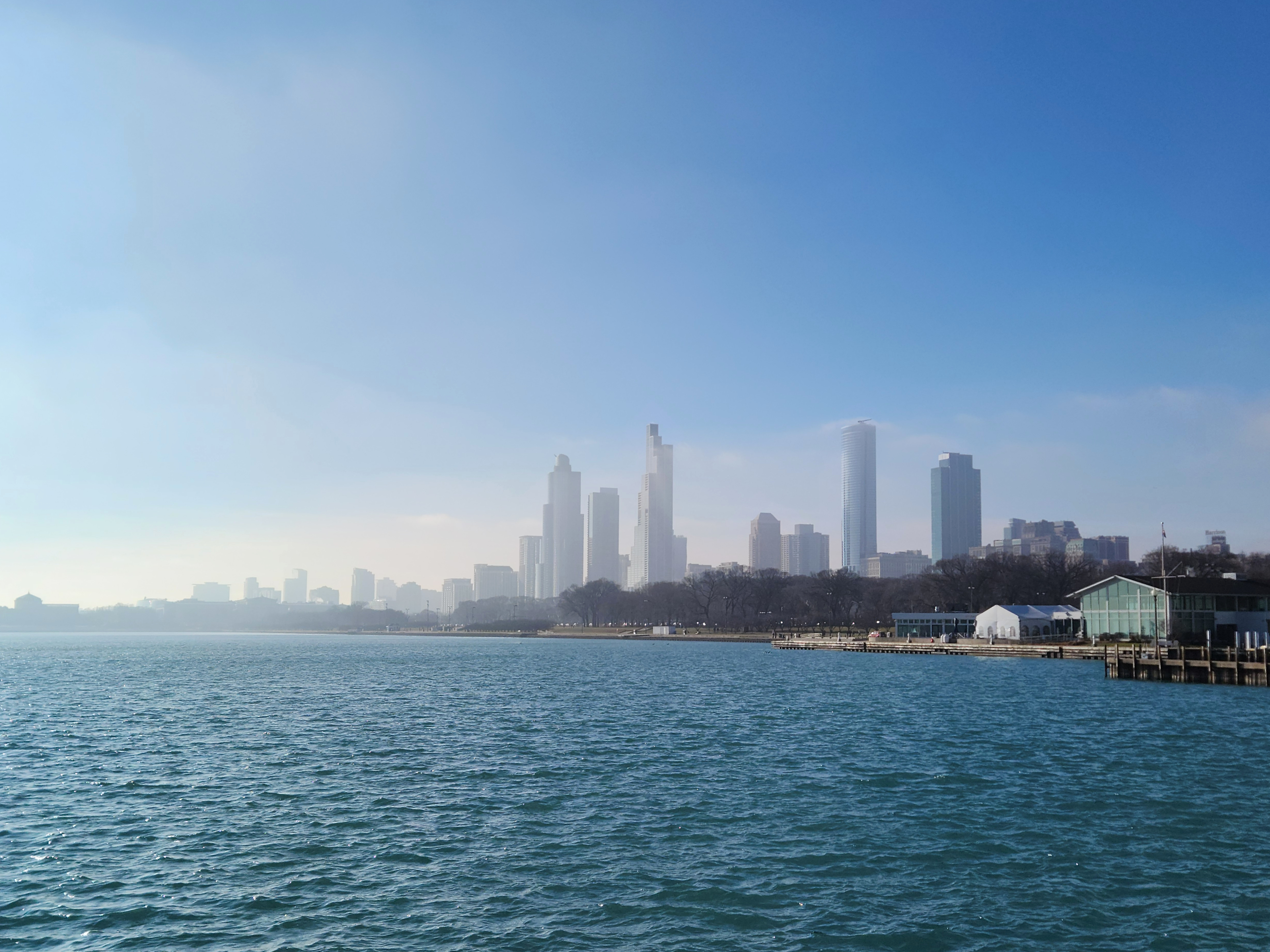
Though the forecast called for overcast skies, even as I lay in bed Monday morning, by the time we made it outside it was almost completely clear and sunny.  I appreciated the lack of rain and ice, and can’t deny that the cheerful weather was beautiful.  We’d gone to visit the Bean—Cloud Gate, if you’re being pedantic—the night before, but stopped by again to see it in daylight; then we proceeded to the lake, the great inland sea, which from the terrace the previous evening had been a disconcerting void beyond the city lights.  After a walk along the lakeshore we turned inland again and took the Red Line (sadly at an underground stop, though we were elevated by the time we reached our destination) to Cermak/Chinatown.  A few blocks from the stop is Ping Tom Memorial Park, dedicated to a local businessman who helped revitalize the Chinatown neighborhood.  The park has great views of the city, and features murals with traditional motifs.  While we visited, a group was practicing a dance with parasols, perhaps preparing for a Lunar New Year celebration. Props to Pal for finding the park. 

I, meanwhile, found a place to eat.  Chinatown Square is full of them, but we went to the enigmatically-named Saint’s Alp Teahouse and Gourmet.  I’d expected it to be more of a beverage place with incidental food, but it turned out to have a full food menu, with extensive drink options, as well.  Since they had scallion pancakes I had to get those, and decided that two appetizers would be a good lunch, so also ordered potstickers.  Pal got a normal meal.  While the scallion pancakes were not as good as I’d hoped (doughier and less scalliony than I wished), the potstickers were both really good and quite hefty.  I didn’t finish either and ended up toting them around for the rest of the day.  I also got a frothy milk green tea with boba that I kept thinking about after I’d finished it.  I have even now paused writing this to read a recipe on how to make boba pearls at home. 

We headed back to the Loop and stopped into the Chicago Cultural Center, where I waltzed right in, despite not having finished my tea.  The center has exhibition spaces, an artisans’ shop, and meeting rooms, but I think for most visitors the main draw is the dome.  They say it’s the largest Tiffany glass dome in the world, and it’s surrounded by mosaic work and quotes celebrating books and the written word—after all, the building was originally the city’s main library.  They just don’t design public buildings the way they used to. 

Once done ogling the architecture we walked back the block or so to the hotel, collected our bags, and got on the Blue Line to O’Hare (though after years of flying into Midway, I always immediately associate traveling to or from a Chicago airport with the Orange Line). Pal’s flight home was Monday evening, so once I dropped her off there I headed to my third hotel in as many days, where I ate leftover scallion pancake slices and a potsticker for dinner. 

Next time, we’ve vowed, we’ll go to Chicago when it’s a little warmer, and the days are longer, and we’ll have deep dish and time to visit Bohemian National Cemetery.  But I have no complaints or regrets about this trip, much-needed and much-appreciated as it was.

Wednesday, March 27, 2024

As Seen On TV

Two drifters, off to see the world

Back in November Pal and I met up at JFK to board a Turkish Airways flight to İstanbul.  It was her first time crossing the Atlantic, and the first visit to Türkiye for both of us.

(Part of the reason this wasn't posted sooner is because I've been trying to post pictures as a rotating gallery on here.  I sort of figured out how to do it, but there were issues with the image sizes and it was a whole thing.  As you can see, I've stuck with the tried and true format for now.) 

I'd wanted to go to İstanbul since at least 2011, if not earlier.  I think one of the particular features that led me to add it to my wish list was the Norse runes in Ayasofya/Hagia Sophia (at left), as well as the general historic character of the city.  You know me: I'm happy to go look at old stuff and not engage as much with contemporary culture.  While Pal is also interested in history, she, being younger than me, is more engaged with modern life.  That led us to some different destinations than I would have chosen on my own, ones that I really enjoyed seeing.

This was the first trip I'd taken to an entirely new country since about 2010.  Every other foreign country in the past decade-plus has been a repeat visit.  That was the source of some trepidation beforehand.  I wasn't much worried about my lack of Turkish language skills; I knew some polite phrases, and figured in tourist destinations people would speak enough English that I'd be okay.  The world political situation being what it is, we discussed whether or not we should actually travel to the area; the State Department's advisory was (and still is) at Level 2: Exercise Increased Caution.  (For reference, the other levels on their scale are 1: Exercise Normal Precautions; 3: Reconsider Travel; and 4: Do Not Travel.  Currently Denmark is at Level 2 and Jamaica is at Level 3.)  To be on the safe side we registered online with the Smart Traveler Enrollment Program, and, as the State Department advises, tried to exercise situational awareness and avoid crowds.  We actually arrived on a national holiday commemorating Atatürk, so saw the town festooned with many a flag, banner, and bunting; on top of that, the hundredth anniversary of the republic had been at the end of October, so there was still much decoration up for that.  The holiday didn't affect our arrival at all, at least as far as I could tell.

(Though I think about the Armenian Genocide a normal amount and rarely have cause to discuss it, part of me was certain that I'd get to Türkiye and be unable to stop myself from talking about it, which I feel would not have gone over well.  Türkiye still doesn't acknowledge that the event was a genocide.)

Some things I read online and others that Pal tipped me off to made me a bit anxious.  One was that tap water from the city's pipes is not potable--and not even just unsafe for drinking, but for brushing one's teeth or washing fruit with.  The idea of having to put so much effort into something I usually do without much thought was almost tiring, even before we left.  Also tiring was the idea of the 11-hour flight from New York, particularly since I'd just been to Slovakia in September and therefore hadn't had time to forget the rigors of that journey.  On top of that, Turkish Airlines' website lists different restrictions for carryons on different pages of its site, which caused me some confusion and angst.  They do, however, have a generous checked baggage policy, even for economy.  I also really liked the amenity kits we got on the way over; the fabric was a colorful Türkiye-themed print, and while I can't wear the little slippers or socks in there, I've put the included eye mask to good use.

(I promise I didn't compare Türkiye to Slovakia the whole time.  If anything, I more often compared it in my mind to Spain.  It's the Islamic arches and tiles among palm trees.)

(BUT I was intrigued to learn that the Turkish word for sour cherry is vişne, not unlike the Slovak višňa.  What is their common root??  Something Proto-Indo-European, no doubt.

Sour cherry juice was one of the options on the flights and not only did I have that with my meals, but I also bought a carton of cherry juice at the mini-mart we frequented and enjoyed that at the hotel for several days.)

Before this trip I did the usual looking up of sites to visit, but when it came to modern Turkish culture I'd gotten most of my information from Turkish media.  I've seen a couple of dizi (TV series)--all of "Maral: En Güzel Hikayem," "Yüksek Sosyete," and "The Protector" and "50m²," the latter two both on Netflix, and some of "İçerde" and "Sen Çal Kapimi"--and movies, like "Paper Lives," "Delibal," "Miracle in Cell No. 7," and the Turkish Top Gun.  (Did you know there was a Turkish version of "The O.C."?  It truly was an iconic show.)  (Also, given the aforementioned holidays, we saw many advertisements for a movie or possibly miniseries about Atatürk, starring an actor we enjoy, as well as a Netflix movie starring one of the country's biggest stars.)  Upon reflection it turns out I've seen more Turkish media than I thought.  Anyway, it was where I learned a few phrases and got a basic feel for the city, where most of the dizi are set.  Of course TV could not completely prepare me for everything we saw and did, but if it could, there would be no point in traveling.

That I'd learned so much from watching media seemed somewhat lowbrow to me at first.  The more I thought about it, though, the more I realized that that was silly at best.  There's a lot of ambient knowledge around about places like Italy, and some of that comes from TV and films, whether they're factual or fictional.  Why should it make a difference how you're first introduced to something if it leads you to seek more knowledge and a greater understanding of it?

in the harem at Topkapı Palace

Pal, who's watched even more dizi than me, did a lot of research to find filming locations.  Some of them were obvious, like Sultanahmet Square, while others were further afield.  One of my favorites was a café that was featured in "İçerde."  It's a small place, apparently popular with university students, as it's in the area of Kadir Has University; the menu is limited to a few dishes each day, and the food is inexpensive, plentiful, and extremely tasty.  We had a chicken stew served with pilav, and while the chicken was good, I don't know if I've ever had rice as delicious as that pilav.  Plus, there were a few photos of the scenes that were filmed in the restaurant, and it was exciting to realize that we were sitting in nearly the exact same spot as some of our favorites.

(I've thought often about the İskender kebap I had for dinner one night.  A CNN Travel article describes the dish thusly: "Thin slices of doner meat are reverently laid over pieces of plump pide bread, smothered in freshly made tomato sauce, baptized with a dash of sizzling melted butter and served with a portion of tangy yoghurt, grilled tomato and green peppers.")

Things we saw that I recognized from the shows (apart from sites/locations):

  • çaycılar delivering hot tea
        (I've seen çaycı (singular) variously translated as tea server, waiter, or porter.  If you use my foolproof method of consulting Google Images to literally see what words mean, though, you'll notice that a çaycı, besides being a person, also seems to be a teapot.)
  • men counting on prayer beads
  • toplayıcılar (collectors) hauling giant bins for collecting recyclable waste
  • young women who looked vaguely familiar
  • cats and dogs roaming free
  • simit, a common and inexpensive snack sold from carts

Things the shows neglect to depict:

  • traffic: cars at a standstill on city streets, with pedestrians weaving through them to cross; and a total disregard for things like turn signals and lane markings that somehow does not lead to mass carnage
  • the hills...  It's not like I didn't see any pictures of the city before I left, but I severely underestimated the hills.  Some of them are STEEP.  Even though there are public transportation options to help avoid having to trudge under one's own power, there are times when the hills simply must be ascended.
  • trams at rush hour, which apparently starts at around 3:30 PM
  • the general mass of humanity that fills a metropolis
  • the call to prayer from several mosques overlapping 

One evening I was sitting on the roof terrace of the hotel when the evening adhan began.  I heard it from Sultanahmet, the closest mosque, and Ayasofya, as well as at least one other mosque nearby.  In the short space of time that we were visiting I got so used to hearing the call to prayer multiple times a day that I expected to hear it when I got home, and assumed that noises I heard in the distance were the adhan.

It should have come as little surprise that Türkiye is full of mosques, and yet I was still amazed at how many there were in the city.  They range from magnificent grand edifices surrounded by towering minarets to humble neighborhood temples whose minarets barely rise higher than the buildings around them, though the former are more visible. 

Despite the number of opportunities, we only visited three mosques: Süleymaniye (pictured here), Sultanahmet, and Ayasofya, in that order.  Just as some cathedrals enforce modest dress codes for their visitors, the mosques require modesty of dress and head coverings for women.  The modesty did not seem to be a problem for anyone as it was, as previously noted, November, and not particularly balmy; I can imagine summer visitors having to be asked to cover up.  In terms of head coverings, there are plenty of vendors around Sultanahmet Square selling scarves, for those who want a souvenir with immediate practical use.  The mosques and the Relic Room at Topkapı Palace will also loan visitors scarves, if necessary.  Pal and I both brought scarves with us, just in case we needed them before we were able to purchase some.  This worked out well.  I enjoy putting things on my head (and yet am somehow not a hat person), so I appreciated being in a place where it was socially acceptable and not unusual to do so.  In addition to the modest dress, worshipers and tourists alike must also remove their shoes before entering the mosques.  You can carry them with you if you have a bag big enough, or stow them in cubbies near the entrance.

All three of the mosques that we visited are very large, to say the least, and very beautiful, yet Ayasofya is the most popular with tourists; it's the only one we had to wait in line to enter, and the only one with any kind of security screening.  We managed not to have to wait very long, though.  Ayasofya seems the most well-known of the city's mosques, and one of the best-known of the world.  It, like many in İstanbul, was originally built as a church and was converted to a mosque during Ottoman rule; in fact, the massive Hagia Irene on Topkapı Palace's grounds is the only Byzantine church not to have been converted, though it was used as an arsenal. 

I found this article a cut above the usual encyclopedic information, as it also discusses the decision to convert Ayasofya from a museum to an active mosque again.  Since our visit it's changed further still; now visitors can only access the second story mezzanine and not the mosque floor, whereas for us it was the opposite (meaning I didn't get to see the runic inscription).  It now costs 25 euros for visitors to enter, too.

I'm used to reading reviews of Christian places of worship that say things like "I'm not Christian/religious, but [place of worship in question] is really beautiful/inspiring/whatever."  To be honest, I've often rolled my eyes at this.  But my uppance has come, because I experienced the same reaction in the three mosques.  I'm not Muslim, but seeing the detail and enormity in the architecture and decoration--the very small and very large manifestations of believers' devotion--was awe-inspiring.


Recommendations:

Hotel Sarı Konak: A relative actually recommended this hotel and because of that I thought we might not be able to afford it.  But we could!  True, the Sultanahmet area does seem to cater to tourists, so you have to run the gauntlet of restaurant hosts and shopkeepers trying to entice you into their places whenever you step out of the hotel, but despite that, it was a fairly quiet neighborhood (in November; your mileage may vary in peaker seasons).  The breakfast was abundant and tasty, and the views from the rooftop terrace, including of Sultanahmet, at left, were better than I ever could have imagined. 

Albura Kathisma: We ate here twice and the ball mahmudiye was so delicious that Pal ordered it both times (I got köfte the second time and it was very good, too, but I need to find a recipe for ball mahmudiye).  Ball mahmudiye is an Ottoman dish of chicken with apricots and almonds over rice, all drizzled with a honey glaze.  The restaurant touts itself as a "hassle-free zone," meaning that the hosts don't harangue passers-by to get them to come in; once you've decided to join them, you're in the company of attentive waitstaff and Madams Sylvester and Gold, as well as other cats.

Dubb Ethnic Restaurant: We also ate here twice!  Several restaurants we went to offer a dish that's cooked over a fire in a tall clay pot with a lid; at some places, the waiters make a show of the cooking by raining what I assume are coals over the pot while encouraging diners to clap along.  The show at Dubb Ethnic Restaurant was by far the most impressive, as you can see if the video below works.

I think both restaurants asked us to review them online, on places like Yelp and TripAdvisor.  While I look at the latter quite often, I don't have accounts on either site; so here I am, reviewing them on my blog.

Welcome Pickups: While the Internet assured me that it would be manageable to get a bus from the airport to somewhere near our hotel, I was not keen on trying navigate a new big city after a long overnight flight.  Instead, we opted to book a driver with Welcome Pickups.  He contacted us over WhatsApp, and when we landed he sent us photos of where he was waiting and of himself.  I greatly appreciated having someone take us directly to our hotel and not having to lug my suitcase over uneven streets.

eSIMs: Speaking of WhatsApp, after my last two trips I am fully converted to using eSIMs for international travel.  No more paying the phone company a daily fee for international roaming!  The eSIM I bought to use in Slovakia included a phone number, while the one I got for Türkiye was just data.  But that allowed me to use WhatsApp to call home, and to look up directions and times while we were on the go.

the hop on-hop off bus: Recommended if only for the cleverness of the company's name, Bus for Us, being a play on Bosphorus.  It's the only hop on-hop off I've ridden that drives between two continents, and allowed me to snap a photo of the sign that says "Welcome to Europe."

Piyerloti/Eyüpsultan: When we were first thinking of going to İstanbul I of course searched the Internet for historic cemeteries to visit.  One of them, unfortunately, had been the site of a murder and a few robberies; though those were years ago, it did give me pause.  We decided that if we didn't linger in the cemetery, and went during the daytime, it would probably be safe enough, and it was.  Eyüpsultan Cemetery covers one of the city's steep hills.  Luckily, a cable car makes a short ascent to the top of Pierre Loti Hill.

There seems to be no shortage of places in the city where you can get a wonderful view, and the plaza there showcases the Golden Horn all the way to the Bosphorus.  Get a table at one of the cafés and have a tea before you walk down the hill through the cemetery, admiring the Ottoman-style gravestones.

public transportation: Get yourself an Istanbulkart and get riding.  The reloadable cards are easy to buy at stations, from machines with several foreign language options.  Most rides we took cost 15 lira, or about half an American dollar, and you can add money to your card whenever you need.  I occasionally had difficulties getting the tram station entrance gate to read my card, but I think that was user error.  We mainly took the tram, but also the metro, two funicular lines, two cable cars, and the ferry, with fares on all of those various methods of transportation paid by Istanbulkart.

so much history they just leave it lying around (outside the archaeology museum, at least)


on the ferry on a bright, beautiful day

Sultanahmet/the Blue Mosque at sunset

On top of all of the things we saw and did and ate, I got to wake up in a room whose window opened onto cool air, seagulls calling, and the smell of salt water.  That small thing always fills me with contentment and gratitude. 


Footnote: I thought of "Moon River," probably because of the line quoted above, while on the trip, and listened to it several times there.  Here are three versions I enjoy.
one, two, three