Showing posts with label Massachusetts. Show all posts

Wednesday, March 29, 2017

Flashback: Locus Maleficarum

The town of Salem has given more power to witchcraft than those accused of and executed for it ever did.

Without its one claim to fame, Salem would just be another New England colonial town.  One could argue that it would be even less well-preserved, were there not such a strong reason to keep its old buildings in good shape.  And yes, Salem does benefit from its sea-going heritage, and Nathaniel Hawthorne and the House of the Seven Gables, and its proximity to Boston and Plymouth.  But the majority of the tourists and their dollars come for the witches.

Had they the chance to offer opinions, neither the accused nor the accusers would likely be able to believe what Salem has become.  Whereas the 17th-century citizenry lived in fear of witches, those who readily confess to using magic now flock there.  As there is nothing to suggest that the area has any innate supernatural vibes, the influx of modern witches to the scene of the crime, so to speak, can be seen as defiant at best--as they claim a space from which their alleged forebears were violently excluded--and crassly capitalist at worst.

I didn't quite realize this on my previous visit, with the seventh grade, but it was patently clear this time.  Still, it is an interesting city, and I'd go back again, if only to visit the Peabody Essex Museum, which is closed on Mondays.  (Also to visit the Olde Pepper Candy Companie, which makes really good cherry cordials.)

On our visit in May two friends and I went first to the Witch Museum, housed in a former church.  The statue out front is of Roger Conant, one of the city's founders, but his billowing cloak and Salem's prevailing preoccupation make it easy to mistake him for a witch.  Inside is a strange display.  Groups of visitors enter what must have been the sanctuary and sit on benches, either in the middle or on the sides.  Around the room, well above head height, are dioramas depicting scenes in the trials.  These dioramas are not particularly state-of-the-art, and are illuminated one at a time as a recording tells the story.  The narration sounds like something out of a B horror film, the dioramas are quaint, and the overall effect verges on cheesiness.  And yet it is not laughable.  I've known about the trials since at least sixth grade, and have read The Crucible, and consider myself generally pretty familiar with the event; but I had a visceral reaction to the dioramas, particularly the ones showing (entirely bloodless) executions.  It's one thing to know the fact that people died, and another altogether to see a representation of that.

After the show, visitors walk through a weak exhibit that gives a very vague history of witchcraft throughout the years.  It includes mannequins of a pair of modern-day witches, whose ceremonial robes are made of panne velvet, the likes of which few real witches would likely be caught dead in.

We also visited the poorly-named Witch House.  The house is the only one left in Salem that has a direct connection to the trials; Jonathan Corwin, a judge, lived there.  It's a nice two-story colonial house, set up as it may have been for its inhabitants, with herbs hanging near the hearth and one of the upstairs rooms dedicated to explaining the experience of childbirth in the colonial era.  Despite the name, the house gives no information specifically about the trials.  It was, however, easily one of the most historically edifying things we saw.

Of course the highlight of the trip was visiting the Burying Point.  Compared to others I have visited it was somewhat sparse, but residents include Justice Hathorne, Nathaniel Hawthorne's forebear and trial judge, and a Mayflower passenger.  We also enjoyed the tombstone of Nathanael Ward, a young man who had been a librarian at Harvard and who died at only age 23.  Adjacent to the Burying Point is the Witch Trials Memorial.  Executed as they were, the accused were buried in unmarked graves; the memorial names them all and records their date and manner of death. 

Many of the shops in town cater to an occult audience, and offer psychic readings.  And, of course, there's a store where you can buy all kinds of Harry Potter merchandise (with some Game of Thrones and Doctor Who goods thrown in as well).  I'll admit that I was tempted by the Salem Quidditch t-shirt, but was deterred by the school group crowding the store.  The adjacent shop claimed to sell wands, though every time we tried the door it was locked; just when we were about to give up someone noticed us at the door and let us in.  The interior was somewhat modeled after Ollivander's, though was much less precariously stocked, and there were a variety of hand-turned wands in different woods.  The shop also offered things like wax seal kits and quill pens.  I'd rather have something or be somewhere that looks like it's from the world of a story than something officially branded and cheaply produced, so I much preferred the wand shop to its neighbor, whose products you could find in any mall.

Salem is an odd place.  My previous visit presented a more well-rounded overview of the area's history, including its seafaring and literary ties.  That Salem seems almost like a different town than the witchcraft-obsessed Salem.  It is worth a visit, and also contemplation: not only of one of our worst episodes, but of why we--as individuals and as a society--revere and visit the places we do.

Saturday, April 23, 2016

Gravestone Onomastics

Recently I decided that a fun project would be to create a list of all of the legible names from tombstones that I've photographed around here.  I actually made a spreadsheet listing surname, maiden name, given name(s), honorific or rank, spouse's name, parents' names, year of death, age at death, and the cemetery and state; the dates were to note when the name would have been given.  Then I didn't know what to do with my spreadsheet, and while it may not be completely on-topic here, it's the best place I have to put it.

There are 466 individuals from graves in 11 cemeteries: Wethersfield (Connecticut; to be written up in the near future), South Hadley, Old Hadley, Amherst, Maplewood in Springfield, Calvary in Holyoke, East Parish Burying Ground in Newton, and Copp's Hill, King's Chapel, Granary and Central Burying Grounds in Boston.

This list is not at all comprehensive; it's only based on what I could decipher while embiggening on my photos (though I was kind of shocked at how detailed some of them were, even when zoomed in). I did not set any strict cut-off dates, so these date from about 1630 to about 1920--all 11 of the Winthrops, spanning almost three centuries, are on the same stone--though the majority are from the 18th century. I also listed every spelling variant separately. Of course "Abigail" and "Abigaile" are basically the same, as are "Lowel" and "Lowell," but if the point is to make an amateur study of the names, those variants can be noteworthy. The names are given in descending order of frequency.

Female Given Names Male Given Names Surnames
Mary (34) John (30) Smith (13)
Elizabeth (19) Samuel (25) Warner (12)
Sarah (18) William (17) Winthrop (11)
Abigail (12) Thomas (13) Griswold (10)
Hannah (7) Joseph (12) Buck (8)
Rebecca (7) Jonathan (9) Cook (8)
Anne (6) James (8) Montague (8)
Ann (5) David (6) Day (7)
Lydia (5) Benjamin (5) Stillman (7)
Ruth (5) Edward (5) Wolcott (7)
Eunice (4) Isaac (5) Dickinson (6)
Rebekah (4) Ebenezer (4) Fuller (6)
Anna (3) George (4) Green (6)
Elisabeth (3) Josiah (4) Beadle (5)
Huldah (3) Moses (4) Deming (5)
Jerusha (3) Stephen (4) Hanmer (5)
Martha (3) Elisha (3) May (5)
Mehetable (3) Enos (3) Parker (5)
Deliverance (2) Henry (3) Ward (5)
Eliza (2) Timothy (3) Williams (5)
Harriet (2) Adam (2) Bernard (4)
Lucy (2) Daniel (2) Blin (4)
Miriam (2) Eleazer (2) Goodman (4)
Polly (2) Elias (2) Goodrich (4)
Prudence (2) Francis (2) Moody (4)
Sally (2) Joshua (2) Nash (4)
Susannah (2) Michael (2) Porter (4)
Abiah Nathan (2) Robbins (4)
Abigaile Peter (2) Wells (4)
Annah Robert (2) Woodhouse (4)
Azubah Seth (2) Wright (4)
Barbara Aaron Chapin (3)
Betsy Abraham Crane (3)
Beulah Alvin Dix (3)
Billisent Ansell Hale (3)
Bridget Ashbel Hall (3)
Caroline Boyssou Hammond (3)
Catherine Caleb Hide (3)
Charlotte Charles Judd (3)
Chloe Chow Skinner (3)
Deborah Christopher Stoddard (3)
Desire Crafts Treat (3)
Dorcas Crispus Welles (3)
Editha Elihu White (3)
Elizebeth Elijah Woodbridge (3)
Emily Eliphas Alvord (2)
Esther Ephraim Ayres (2)
Experience Ephriam Ballard (2)
Grace Fitz John Belding (2)
Hopestill Hezekiah Bingham (2)
Jean Hiram Bordman (2)
Jemima Humphrey Bryant (2)
Johana Jabez Butler (2)
Johanah Jacob Chester (2)
Julia Jahleel Clap (2)
Katherine Joel Copp (2)
Kezia Jotham Drew (2)
Lucretia Lemuel Fox (2)
Mabel Leonard Francis (2)
Marcy Levi Franklin (2)
Margaret Loomis Harkness (2)
Maria Lorenze Harrison (2)
Meriam Lowell Holland (2)
Naomi Luke Hopkins (2)
Olive Martin Lewis (2)
Patience Mathew Lowell (2)
Phebey Matthew Merritt (2)
Rachel Nathanael Mitchell (2)
Roxa Parsons Moodey (2)
Sabra Patrick Mountague (2)
Seferanna Paul Murdock (2)
Susanna Philip Parkman (2)
Tamesin Prince Peirce (2)
Thankful Robart Pitman (2)
Thankfull Roger Preston (2)
Ruggles Russell (2)
Salmon Sampson (2)
Solomon Scoot (2)
Sylvanus Standish (2)
Thadeus Trowbridge (2)
Wait Still Varney (2)
Walter Willes (2)
Zechariah Winsor (2)
Woodward (2)
Worthylake (2)
Adams
Archer
Armstrong
Arnold
Attucks
Balston
Barns
Blake
Boltwood
Boyes
Brewster
Brown
Bulkley
Bunce
Burrough
Bush
Buttolph
Byles
Caldwell
Carr
Cheevers
Cheney
Church
Clark
Cogswell
Crouch
Cutler
Davis
Dawes
Demery
de Monplaisir
Dolbeare
Doubelde
Downe
Dwyt
Dyar
Dyke
Eastbrook
Eaton
Ellis
Elliott
Eustis
Fosdick
Foster
Frances
Gardner
Garrett
Gibbs
Giles
Gillburt
Gladding
Gleason
Goodwin
Gray
Greenough
Greenwood
Griswould
Hammatt
Hancock
Harris
Harvey
Hedge
Hollowell
Holmes
Holms
Hubbard
Hunt
Hurd
Hurlbut
Indicott
Jackson
Johnson
Kellogg
Kilborn
Kingsbury
Knock
Knowles
Labbe
Lamson
Lancelott
Latimer
Lee
Leonard
Long
Loring
Loud
Lowed
Lowel
MacCarty
Malcom
Man
Manderien
Marion
Marsh
Mather
Maverick
Maxwell
McKean
Newman
Nickols
North
Otis
Page
Pain
Park
Parsons
Pearce
Phillips
Pigeon
Raynolds
Revere
Rice
Richardson
Ridgaway
Ridgway
Riley
Rogers
Rowlandson
Sanborn
Sanders
Scollay
Seymour
Shannon
Shaw
Simpson
Snider
Sprague
Spring
Staples
Sterling
Swan
Tapping
Truesdell
Tryon
Tyler
Viburt
Voeax
Wakefield
Waterman
Waters
Watts
Webb
Wheat
Whitney
Wickam
Will
Winchester
Wiswall
Wiswel
Wollcott
Woster
Young

Sunday, April 10, 2016

Quabbin Gate 40

In the late 1930s the powers that be decided to build a nice big reservoir to help supply Boston with fresh water.  And, as you do when building a nice big reservoir, they had to destroy a few small towns: Dana, Enfield, Greenwich, and Prescott.  When the residents had moved elsewhere, mostly into surrounding towns like New Salem and Pelham, their former homes were razed, leaving only stone walls, foundations, root cellars, and wells.  (A few buildings were moved rather than destroyed; the Joseph Allen Skinner Museum in South Hadley is housed in the erstwhile First Congregational Church of Prescott.)  Then lo and behold, as the waters of the Quabbin Reservoir rose, they fell far short of the abandoned streets of Dana.  Because of that, one can visit empty Dana today.

From the parking area at Quabbin Gate 40 on Route 32A visitors walk a bit on asphalt to reach Dana Common.  I say "a bit" because various websites I consulted said either a mile and a half or two miles, and once again the idea of using my phone's pedometer function to track the distance did not occur to me until I was more than halfway back to the car.  It took me just under an hour to get there, so I'd estimate it closer to two miles; but I did stop to take photos along the way.  The road is mostly level, and easy to walk.  As a further practical tip, please note that the port-a-potties one website talks about are apparently seasonal, and as such were entirely absent on this visit.

The town was named after a legislator, Francis Dana.  Mom asked if he was related to Richard Henry Dana, of Two Years Before the Mast and Dana Point fame, and while I scoffed, she was right to suggest it, as Francis was Richard Henry's grandfather.

Walking to and through the old town was eerier than I expected.  This was a site not destroyed by war, or depopulated because of epidemic or massacre; it was just bureaucratically "disincorporated."  If any of the former causes had led to its abandonment, one might expect to find the atmosphere sad.  While I wouldn't call Dana sad, it was quiet, and felt a little empty.  I don't think the place is haunted, but I would be entirely unsurprised to hear that someone else thought it was.

The common.  The school and town hall were to the left and the hotel to the right;
across the green would have been the church, stores, and a few homes. 
In the middle stood the World War I memorial.

I did wonder if the atmosphere would be even creepier for someone who didn't know the history of the area, and decided that it probably would be.  The ignorant visitor (who in this case would not notice the informative signboard inside the gate) would first likely remark on the drystone walls that line the road.  Nae problemo, though; those are typical New England.  But then he might observe that some of those walls run up the hill on one side of the road, dividing nothing but trees from other (possibly inimical) trees.  Before too long he could not help but observe the right angle of a pair of walls, and would conclude that they must have been part of a building. 

And looking into the brush he might pick out the dark entrance to a root cellar, now the perfect hiding spot for any number of critters.  He would see rusted metal, in the form of cables and wire fences and drums and other less easily-identifiable bits.  Upon reaching the common he would see sidewalks that led nowhere and doorsteps the crossing of which would lead to a fall of several feet and likely injury.  Of course, on the common our visitor would see more markers, with photos of the town's buildings, including the town hall, school, Congregational church, and a hotel, where now only their foundations remain.  He would read the marker erected in 1996 and learn that this had been the common from 1801 to 1938, but would not ascertain what exactly occurred to flatten all of the architecture.  There are lots of possibilities to choose from, most more titillating than the truth; and if he chose the theory that this place had been (and could easily be once again) Extreme Witchcraft Murder City, I can certainly understand that.  I visited on a bright, sunny day, knowing why the town had been left and knowing that witchcraft had nothing to do with it, and that's still a little bit of the vibe I got.

They want you to believe this was a cellar, but this is some kind of wolf pit or
something. Yes, there used to be wolves in Mass, and yes, I watched
"Ladyhawke" last night.
The foundation of the school.
Nature taking back a road.

Artist whose "Very Best of" album I got 80% of the way through on the drive there: Jethro Tull.
Artists to whose works I could have referred in this post and did not: U2, Shel Silverstein, Eddie Izzard.

Sunday, November 22, 2015

Boston Burying Grounds

Some of Massachusetts' most famous burying grounds prove once again that there's a good reason stereotypical old graveyards in films look the way they do (though I can't for the life of me find a picture of one of said films that illustrates my point).

Until last week the weather had been pleasant, with temperatures into the 70s at the end of last week and bright, clear skies.  Acutely aware that this trend would not last--and indeed it has not--I wanted to take advantage of it, and of the driving that I'd be doing anyway.  So I did some plotting and made a plan to visit three of Boston's burying grounds two Mondays ago, a number that increased by one in the course of the day.

Transportation tip: If you're taking the T, aboveground stops may not have machines where you can buy tickets.  You can buy them on the train, but the machine can't give change, so don't use too big a bill, or you may end up with unused fares.

Below is a general map of my route, starting from the North T station and ending at the Boylston Street station (both on the green line).  I mapped it out because I really just wanted to see how far I'd walked; it felt like more than two and a quarter miles, but the number of lunges I did while taking pictures certainly contributed to that feeling.  By vaguely following the Freedom Trail and my recollections of last spring's visit with Mom's class, it was easy enough to find the way from the North End to the more central sites.

Copp's Hill
For some reason I seem to refuse to believe that any East Coast city has hills.  I'm not entirely sure why this is, particularly when the word itself is in the names of places; but I did indeed have to charge up a bit of a steep one to reach the first stop.  Despite Mom saying something about their proximity, I was also surprised to see that Copp's Hill is about a block from Old North Church, with the entrance to the church visible from the cemetery gate on Hull Street.  In fact, a school group came through while I was there.

Copp's Hill is the largest of the cemeteries I visited.  The half of the burying ground furthest from the gate is hilly, revealing a view of the bay.  There is also a square section along Hull Street that is set a few steps down from the rest of the cemetery; it seems to have later burials than the rest, and certainly fewer.  Of the four described here, Copp's Hill and Central burying grounds are the two that allow you to walk among the stones--Copp's Hill does have paved paths, but no barriers or markers asking you to keep to the walkways.  I appreciated this, but unfortunately, so did the family that let their children sit on the (restored) tomb of the Mather family.

King's Chapel
King's Chapel is the oldest burying ground in the city.  It's adjacent to the church of the same name, and on the small side.  Like the Granary, King's Chapel is bordered on three sides by buildings that keep most of it in shadow.  Some of the stones are nearly entirely sunk into the ground.  Several members of the Winthrop family are buried there, including the first governor of the colony.  There is also a grave dedicated to William Dawes, Paul Revere's less well known partner in midnight riding, though whether or not he's actually there is uncertain.

Granary
Interment place of Crispus Attucks and the other Boston Massacre victims, Benjamin Franklin's parents, Samuel Adams, Paul Revere, John Otis, and John Hancock, the Granary is arguably the most significant of the city's burying grounds.  I felt satisfied by being able to answer a man when he asked if I knew where Crispus Attucks was buried, though I certainly didn't explain the location very eloquently.

When I arrived, there were dozens of bags of leaves arrayed near the entrance, and before I left more were added by a team of hardworking groundskeepers.  I suppose it's necessary to remove the leaves, since the burying ground is such a prominent tourist destination, and since it would be a hazard if they were to spill out into the busy city street outside; but I missed the autumnal scenery.  And, while I appreciate the work that the crew was doing to clear up, I also wondered what they thought of the tourists wandering around while they were working.

Central
Unsurprisingly, the batteries in my camera died shortly after I arrived.  Central is on the edge of Boston Common, just near the Boylston T station, and is squirrel paradise.  I don't know if I've ever seen so many squirrels in one place.  Now the question is would I rather be a cat in an Italian cemetery, or a squirrel in a Massachusetts one?

Between my camera being kaput and the approach of the time I'd appointed for my return to campus, I didn't spend much time at Central.  It has quite an odd feature, though.  Part of the cemetery is as you see in the picture, but off to the right there is a large ditch that surrounds what I assume must be mausoleums, though they're covered with grass.  That area is where Washington portraitist Gilbert Stuart is buried; I didn't get to see him on this trip, but I did get a glimpse during the infamous Forced March through Boston Common of 2008.

Tuesday, October 27, 2015

East Parish Burying Ground

And we interrupt the London recap once again. At this point I think the remaining UK posts will be headed for the Flashback file...


If there's one thing Massachusetts is good for, it's old cemeteries, and if there's another, it's autumn.  In my opinion this is the best time of year to visit a cemetery, because combining the aesthetics of turning, falling leaves with old stone makes for some pretty gorgeous contrasts.

Once again, I briefly thought of going to Salem this week before my class in Boston.  It's still just a bit too far to justify, though, and I wouldn't have had enough time to spend in the burying grounds there.  But in the course of looking over my cemetery spreadsheet I noticed a name that's become familiar on my jaunts on the turnpike: Newton.  The town is basically in Boston, and only about five miles from campus if the GPS is to be trusted, so I could certainly make a stop there.

East Parish Burying Ground is one of three old cemeteries in Newton.  Without having visited the other two, I'm still confident in considering this one the best.  It's also the oldest of the three, occupying the spot where the first meetinghouse in Newton was built in 1660--and now across the street from Boston College's law school.  Using the school's address for GPS coordinates might be a good idea, since most websites only listed the cemetery's location as the corner of Cotton and Centre Streets; that is indeed where the entrance is.

The only problem with the cemetery is that there isn't anywhere convenient to park.  Parking is prohibited except for weekends and holidays on Cotton Street, and some other streets in the neighboring residential area are similarly marked.  I figured the law school might not be amenable to foreigners using their lot, so I finally decided to part in front of someone's house around the corner from the cemetery entrance, within sight of a one-hour-parking sign.

The earliest graves are from the 17th century and the latest (and least) from the 20th.  The southern end, the section nearest the entrance, seems to have the older graves, and they get newer as you move north.  The cemetery isn't all level; there are a few mounds near the entrance that hold mausoleums covered over with grass, and the ground slopes a bit higher above them as you move further in.  Then it falls away toward the north.  I liked the uneven terrain.  It wasn't hilly enough to be too challenging to walk through, but enough to provide interest.  And as I'd hoped, there were a few trees in a really prime state of leaf-changing.

The thing that sets East Parish apart from other cemeteries is the quality of the carvings.  Of course there are some toppled stones, and reassembled ones, and lichen-streaked ones, but there are a number of 18th-century slates whose carving is fantastically crisp and fresh.  It was almost unbelievable; several of the stones looked like Halloween decorations, both in their design and in their apparent newness.  I was really very impressed, and still am a day later.  Plus there were some wonderful old names, like Sylvanus Wetherbee, Deliverance Hide, General Michael Jackson, and my favorite, Patience Pigeon.

East Parish had great light, great leaves, and great graves.  While you may not be guaranteed the first two on your visit, you'll definitely get the latter.  I highly recommend visiting if you can.

Tuesday, May 12, 2015

An Educational Day in Boston

A few weeks ago was my mom's annual trip to the East Coast.  This year I was able to meet her and her students for a short time--if only their trip hadn't been right before one of my final papers was due, I would have been able to stay with them for another day.  As it was, I was happy to see my mum, and I got to see some new and interesting things in Boston.

Too excited about seeing Mom to get much work done, I left on Monday afternoon, even though I knew they wouldn't be arriving at their hotel until 8 or 9 that night.  It rained the whole time I was on the turnpike, and there were plenty of people ignoring the new "wipers on, headlights on" law.  I ate pot roast in a diner somewhere around Quincy before heading on to the hotel; by that time it was getting dark, and, knowing that the destination was on a narrow peninsula, I had the distinct feeling that I was going to drive right off of the world and into the ocean.  That feeling wasn't lessened when I parked outside of the hotel, where, beyond the railing, the beach was invisible in the dark, but the white crests of the waves were moving out in the water.  It was also satisfying to think that the Bluebird had now gone almost completely from one coast to the other.

When they arrived and got settled in, Mom shared some chocolates she'd bought earlier that day at Ye Olde Pepper Candy Company in Salem.  The cordial cherry was especially delicious.

Tuesday started a bit gloomily, with somewhat foreboding weather.  That soon changed, though, and by the time we reached Boston (after a circuitous shuttle journey to the nearest T station and, for me, a big loop around Quincy attempting to find a place to park followed by a power-walk back to the station) the weather was practically perfect.  I'm sure the visitors may have thought it a little cool still, but I was comfortable walking around without a jacket for the first time in years a while.

The first stop we made was Fenway Park.  Though I'm by no means a baseball fan, I enjoyed visiting the park; it's part of American cultural life, and the tour revealed things most spectators there for a game wouldn't be able to see.  The tour took us through the stands and to the newest seats, behind the Green Monster in the outfield (from which the picture below was taken).  We were also able to go into the press box, the vantage point from which reporters watch the game.  The park as a whole struck me as fairly small for a major sports venue; unlike the one I'm most used to driving by back home, Fenway Park isn't surrounded by acres of parking lot, but by businesses.  The produce truck parked outside of a restaurant just outside of the park's gates added to the feel of the place and the sport as old-fashioned and part of the community, rather than just a commodified pastime. 

From there we made our way half a dozen subway stops and a few centuries back to the Old North Church.  On my previous visit, we'd gone into the sanctuary and heard a short presentation about the box pews, the organ, the clock, the angels, and of course the lanterns.  This time, though, we started by going into the tower.  Up the first flight of steps is a small room, all paneled in white-painted wood, lined on one wall with bookshelves and displaying a print of the church made (if I recall correctly) by Paul Revere, as well as two replica lanterns.  Then we ascended a second, even narrower and steeper staircase to the top of the brick portion of the tower; above is the wooden section that houses the bells.  The brick room is where the bell-ringers do their thing.  There, with the ropes looped overhead, safely out of reach from curious tourists, our guide told us about the bells and showed us a short video on how they're rung.  I liked the round windows, and the fact that they showed how thick the tower's walls are--they must be a good two feet of brick.  From the top of the church we descended to the bottom, to the basement crypt.  Portions of it are still used for internments today.  The first commander of the USS Constitution is buried there, as is Major John Pitcairn.  Walking through the crypt is a bit of a strange experience, as overhead you hear the creaking of floorboards from people in the church, the corridor is filled with pipes and bits of plaster are missing around some tombs, and, if you're taller than average, you have to do a lot of ducking.  We ended the tour inside the church, where I missed the opportunity to sit in the box Teddy Roosevelt sat in in 1912.


Since the marathon had been run the day before, the city was still dotted with people in brightly-colored jackets from the Athletic Association, or even with finishers' medals around their necks.  We saw the most of them between Old North Church and Quincy Market, where we ate lunch (expensive but filling calzones for Ma and me).  After our stop there we hurried to the Old South Meeting House, where the group had an appointment and where I left them.  I would rather have stayed than driven back to the west, but the only thing I dreaded more than the idea of leaving was the idea of leaving in rush hour traffic, so I said goodbye to my mother and went.  

By some fortuitous circumstance, my route from the Meeting House to the nearest T station took me by a graveyard.  It was across from a hotel and enclosed on three sides by tall buildings, some of which seemed to contain apartments--it hardly needs to be said that I would be thrilled to live somewhere overlooking a colonial cemetery--and I wasn't so pressed for time that I couldn't cruise through.  The plaque at the gates named it as the Granary Burying Ground, home to several leading personages in American history, including Benjamin Franklin's parents (theirs is the large while memorial in the center), the victims of the Boston Massacre, Samuel Adams, Mother Goose, Paul Revere, and John Hancock.  Many of the tombstones were well-carved and deeply, and are still quite legible for their age--if they're reproductions, then they're good ones.  I was glad to go, but I'll need to return to spend some more time there.

In Quincy I had a similar opportunity, since to get back to where I'd parked I had to pass Hancock Cemetery.  The Adams presidents and their wives were buried there, but have since been moved to the crypt of a nearby church.  Though smaller and less impressive than the Granary, and though nearby road construction detracted from the ambiance somewhat, Hancock was nice for a brief walk through, and, like the Granary, was graced with some strong carving.

While I wish I had been able to spend more time with Mom in Boston, I was glad to see for the little while I was there.  And we were blessed with good weather and safe travel, for which I was thankful.

In conclusion I'd just like to add that Blogspot has changed the way you can position photos in relation to text and I hate it.

Friday, February 6, 2015

An Observation about Stereotypes

The people of Massachusetts really are into their Irish-Americanness.  You hear "Shipping Up to Boston" by the Dropkick Murphys playing when the Patriots run out onto the field or on Sam Adams commercials and you think, Sure, that song's about Boston, those things are Boston-adjacent, it works.  But there's a place in Holyoke--I believe in front of the high school, whose mascot is a knight--where there's a big shamrock painted in the middle of the road for no apparent reason; and in subbing at the middle school here I've noticed several kids with almost aggressively Irish first and last name combinations, to say nothing of the strawberry blond/redheaded and very freckled twins Bridget and Sean.  Of course there are plenty of people of other ethnicities, but I'm bemused by the breadth of this assertion of heritage.

Friday, December 5, 2014

Cemetery Shaming

You'd think the cemetery that was the eternal home to one of the greatest poets in American history would be better taken care of.

I was heading toward Amherst the week before Thanksgiving and decided to do a quick check to see if there were any cemeteries there that I ought to visit.  To my surprise I saw that Emily Dickinson is buried in Amherst's West Cemetery.  Even if it didn't appear that there were many colonial or Revolutionary graves there, I still had to stop in to see Dickinson.

Despite being on the National Register of Historic Places, West Cemetery is disappointing.  It could be a really great cemetery to visit--it's ever so slightly hilly, with a few nice trees scattered around, and clear paths for driving.  Whoever manages the cemetery can't be blamed for the fact that the ground is uneven and pocked with small holes that make walking a bit treacherous.  But there are many broken, fallen, or precariously leaning stones, which I'm willing to attribute to the soil itself; but I can find little excuse for the trash--not just litter, but bags of trash and what appear to be pieces of clothing--left around the grounds.

There are many Dickinson graves there, but the important one is easy to find (that's it, second from left above).  Emily and her family are fenced off by what would be a nice iron fence, provided by distant relatives, but for two things: one, that the fence is only a few inches from the carved face of the tombstones, and therefore two, that the fence passes right over where the Dickinsons are actually buried.

As you might expect at a famous poet's grave, people have left little tokens for Dickinson.  There are small rocks piled on top of her headstone, along with pens and a necklace or bracelet; that all makes a fair amount of sense.  The framed picture of John Lennon and the gray Converse high-tops make a little less sense to me, but then again, the cemetery is within walking distance of the UMass campus, and you know what English majors are like.

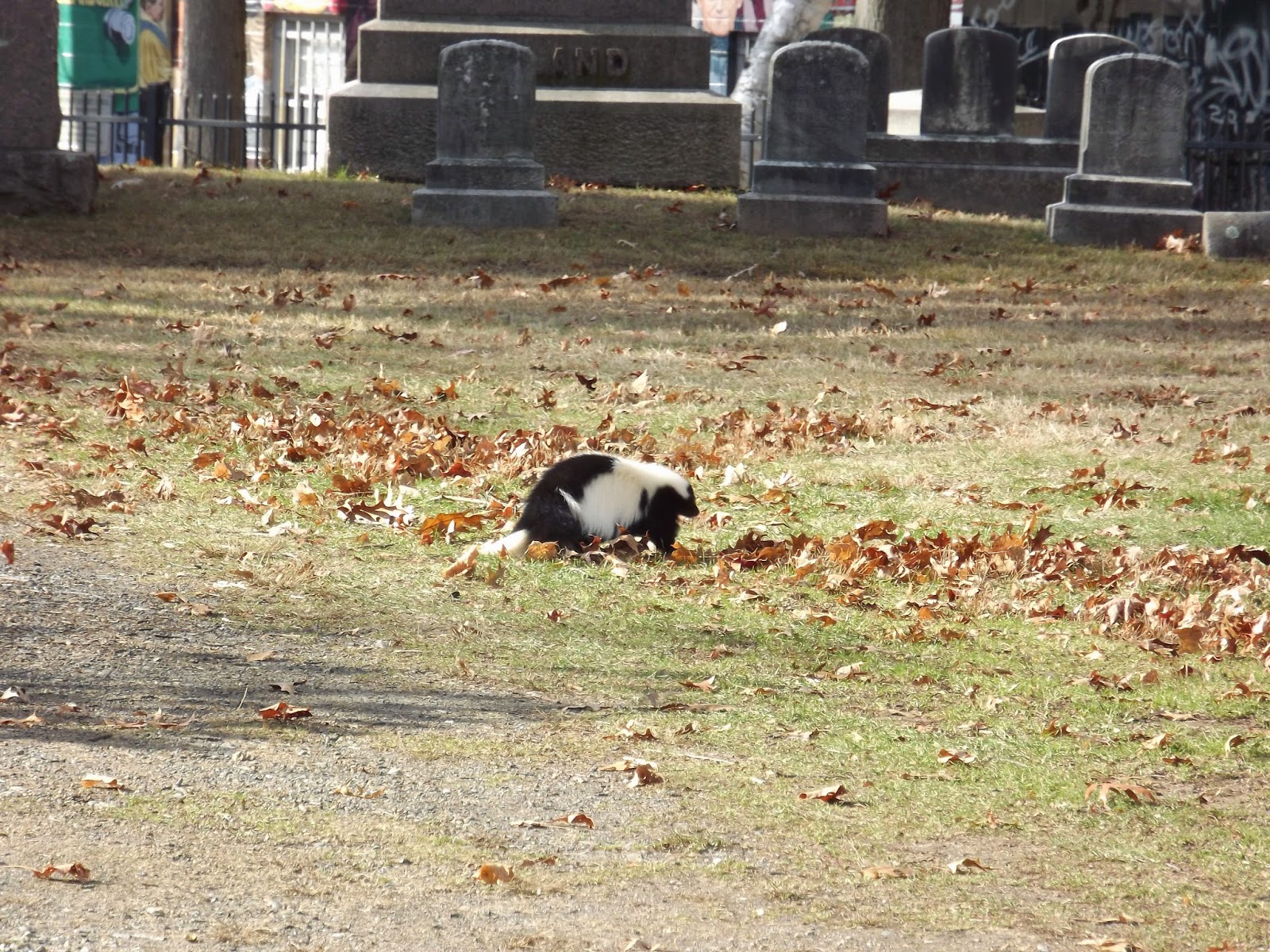
The most exciting part of visiting West Cemetery came as I was getting back in the car and saw a skunk trundling around.  I've seen cats and squirrels and chipmunks in cemeteries before, but this was a first for skunks.  So my verdict is go see Emily Dickinson if you like, but don't expect too much, and watch out for the wildlife.

On a practical note, Google seems to believe that the cemetery is at 586 S. Pleasant St.  It isn't.  That appears to be someone's house.  I used the entrance on Triangle St., but it might also be possible to enter from N. Pleasant.

Wednesday, October 29, 2014

In which I am better prepared

Earlier this week I was feeling tempted to go to Salem to see how insane it was the week before Halloween.  It's nearly two hours from here to there, though, so common sense prevailed in the end.  Instead I looked at my list of burying grounds/historic cemeteries in this general area and decided I could take a little time to visit the Old Hadley Cemetery, a mere quarter of an hour away.

(Maybe someday I'll visit a place in Mass that's not a cemetery.  But they're so pretty in autumn, and I'm not about to pass up the chance to see old graves.)


Old Hadley Cemetery is located on Cemetery Road, across from a cornfield and adjacent to a now-harvested field of something.  That's the road and the cornfield above, along with the blur of a leaf in the process of falling.  I found information about the cemetery, and the coordinates for directions, on Grave Addiction.  Probably three-fourths of the graves are from the late 19th and 20th centuries.  The grass was trimmed short, and though it looked a little dry, it had obviously been looked after recently.  I first stopped near where I thought there might be some old stones, but when they turned out to be 19th century I moved the Bluebird closer to where the old graves really were, which Grave Addiction tells me is the west end of the cemetery.


These oldest graves haven't been moved from anywhere else; the cemetery was established in the 17th century.  Though I'd read that before I visited, I sort of forgot about it for a while, and was therefore surprised when I came across graves from that far back.  The old section had the most trees, and therefore the most leaves on the ground, but not in a hazardous manner.  Near the short iron fence (short enough that I was prepared to get myself over it if the gates had been locked) that ran along Cemetery Road was a strange lump of a hill that turned out to be a mausoleum facing the road; you can see it on the left in the first picture on the page.  The year 1859 was carved on the lintel, but there was no sign of a family name. 

In this old section are members of some of the area's colonial families; a plaque in a rock says that Nathaniel Dickinson, who was born in England, founded Hadley in 1659 and died there in 1676.  Surrounding the rock are plenty of Dickinson graves, like that of Captain William Dickinson's at left, who died at 67 on June 24, 1742.  There are also people whose names have made it into street names in the area, like Lymans and Chileabs. 

As I made my way from the street side further back, the graves generally got older.  The ones nearest the road were late 18th century; towards the middle they were mid-18th.  I saw a 1742 death date and was excited about that until I came across a 1725.  Then there was a 1718, and then a pair of stones raised like tabletops, illegible with age but with plaques in front of them indicating that they were of Rebekah (below) and the Reverend John Russell, who died in 1688 and 1692.  Original 17th century gravestones!  There were also a few replacement markers for graves from the same era, like the one at right, but originals are so much better.  Shortly thereafter my camera's batteries gave up, but I was well satisfied. 
the Russells' graves at center

I was struck by the extreme simplicity of the early 18th-century stones when compared with those from the late 18th century.  Captain Dickinson's headstone just has the barest facts, carved in simple capitals with no decoration, while by the time of the Revolution most stones have more information, variation in typography, and symbolic ornaments.  Perhaps the matter-of-factness of the early headstones is a mixture of humility and austerity.

On a final note, I feel like I'm getting better at photographing graves.  It helps to try to get as level with the face of the stone as you can.  I did a lot of squats yesterday.

Saturday, October 25, 2014

In which I have not learned from my past unpreparedness

Before I left for Springfield on Thursday morning, where I was to get my fingerprints taken, I thought, "Maybe I should take my camera with me."

"Nah," I then thought, "it's supposed to rain."  So I left, taking the things I thought I might need but leaving my camera in my room.

When I was nearly to the storefront where the fingerprint place was, in a part of Springfield I'd never been before, I saw on my left a small cemetery with oldish stones surrounded by a carpet of fallen leaves.  Right next to it was a much larger one, with an impressive tower in the center.  On the left on the way there means on the right on the way back, and on the right means it's easy to turn in.  I filed this information away and continued to my appointment.

Once it was finished (those new digital fingerprints are so easy compared to the old way) and I'd gotten a pumpkin pie Coolata at Dunkin Donuts, I made my way back to the cemeteries.  The first I came to was the larger, Hillcrest Park as the signs named it; once inside the gates it was easy to see that this was a cemetery in the new style, with no visible stones.  Maybe there were some in the back, but all I saw was trees, that big tower, and some Canada geese.  It would have been a lovely park, but as a cemetery it was a disappointment.  The disappointment was allayed by the fact that I knew there was a better one just next door.

Had I actually brought my camera along, I likely would have spent much longer at Maplewood cemetery.  At least I had my camera phone.  Even if I'd had the real camera, I don't think the pictures would really do justice to the atmosphere; though it was off a decent sized road it was quiet, and with the thick accumulation of leaves it seemed obvious that no one had been hanging out there recently, making it a little oasis.  Unfortunately those leaves also meant that I nearly tripped over a small marker that had been all but hidden.  Of course I apologized, and was more careful afterward.

Maplewood hadn't come up in my research on old cemeteries in the area ("old" in this case meaning with graves from the colonial or Revolutionary period); the oldest graves I saw were from the mid-19th century, which is not too shabby. 

According to the Internet, Maplewood is now controlled by Hillcrest Park next door.  The cemetery is in fairly good condition overall; the grass wasn't too tall, and there weren't any toppled stones.  It's even possible the leaves had been cleaned up sometime before my visit, because they've been coming down like nobody's business recently, and I'm sure that accumulation could have happened in a few days, if not overnight.  Unfortunately, the leaves covered the place where it was safe to drive, and since I couldn't back out (because I would have been backing out into traffic on a busy street) I had to make an educated guess and hope for the best. 

The two main takeaway lessons from this are:
1. Don't trust weather.com and
2. just take your camera, for Pete's sake.

Tuesday, October 21, 2014

Autumn in Western Mass

This blog is owed much update and explanation.  I keep thinking I'll get a chance to sit down and write something for it, but it always gets away from me.  Here, at least, is some new content.

It's October, and in western Massachusetts that means it rains.  Last Friday it rained on and off for most of the day, and from the comfort of my room I got a little of it on video to share.  Since that time a lot of the leaves on the tree outside my window have blown down to the ground.  I'm not looking forward to the time when they're all gone--I don't feel prepared to see a naked tree outside my window for the next few months.  I suppose I'd better get ready.


Monday, May 12, 2008

7th Grade Trip

I had the great good fortune last month to chaperone a week-long school trip to the northeast. "Surely you jest," you say. "Good fortune? This was not some kind of horrible punishment for taking weeks to write about a single event and owing the library a dollar for your new card?" Perhaps some years the trip would indeed have been a trial. However, when you have the sterling students we have this year, it was pretty great. Because they are kids, and not technically mine, I won't post any pictures with any of them in it, which takes out a good portion of my pictures; but rest assured, you will have photographs to peruse.

The lead teacher on the trip has a series of worksheets, one for every night, that the kids have to complete. The worksheets help them think about what they've seen, and later, when they work on their scrapbooks, remember all the places they went and what they did. I will now answer the questions from the worksheets. Rest assured I will be more thorough than the students were.

Day One
1. How was the flight? Was security as tough as you'd thought it would be? Did anyone do anything stupid?
Security was pretty reasonable, as far as security goes these days. We left on a Sunday night, which meant the airport wasn't too crowded and that helped. Unfortunately, once we got through security, one of the girls lost her school ID, and one of the boys lost his entire wallet. Luckily for him, the lead teacher had most of his spending money. On the bright side, while we were waiting, we saw Charo get off a plane, which was kind of cool.
The flight itself was not too bad. I got a window seat, for which I was thankful, because I don't like having to get up if other people in my row have to go to the bathroom. Furthermore, the middle seat was empty, so I got to stretch my legs. Some of the students apparently forgot the injunction against flash photography on the airplane, and since I wasn't sitting with them, all I could do was snap my fingers and hiss at them not to use the flash. We took a redeye and landed at Logan around 6:30, and immediately started touring--after stopping at a Dunkin Donuts in Lynn, Massachusetts, that is.

2. What was the first thing you noticed about Boston? Give me your visual impressions.
The very first thing I noticed when we landed was how interchangeable airports are. Waiting for our coach outside, we could have been almost anywhere, had that place been cool and overcast and we could see our breath. Massachusetts is a lot like Connecticut, obviously, in terms of geography and topography. And everything looks older than it does back home.

3. What did you have for dinner? How was it?
At Longfellow's Wayside Tavern we had salad, rolls, pot roast, green beans, mashed potatoes, and apple pie. Some of the rolls were white bread and some were cornbread and some were brown bread, which is what I had. The mashed potatoes were very creamy and good, and the pot roast was really nice.

4. What was the best thing you did today? Okay, what was the best educational thing you did today?
Most of the kids put that eating dinner and/or going to sleep was the best thing they did. We went to the House of the Seven Gables of Hawthorne fame, and saw a play about the supernatural at the Griffen Theater in Salem; we visited Orchard House, where Louisa May Alcott lived; we drove by Thoreau's cabin and Walden Pond; we drilled the militia on Lexington Common, and one of the boys read Ralph Waldo Emerson's "Concord Hymn" in front of the memorial at Concord Bridge; we stopped by Fenway Park. At all the Revolutionary War sites it's amazing to think that a bunch of farmers and tradesmen defeated one of the most powerful armies in the world at the time.
Concord Bridge with the monument; behind me is the minuteman statue.

5. Do people look and dress the same here as they do on our side of the country?
Nope. But I wore the same jeans for 36 hours, and let me tell you, it was amazing to change into my pajamas and fall asleep in Brookline.

Day Two
1. How tired were you this morning? Was it jet lag or did you stay up late chatting?
I wasn't too tired, because we got to bed around 10:30 and woke up around 7. That's a fair amount of sleep. We called home before bed, and I read Johnny Tremain, which is the book I brought with me. I hadn't read it in a while, and I figured it would be good to read in Boston.

2. Is the harbor in Boston anything like the one in [the nearest major port city at home]? How are they the same? How are they different?
First off, we went to Dunkin Donuts for breakfast again this morning, and some of the girls talked to some real Bostonians. Their accents were great. I was proud of the girls for talking to them politely, and the girls learned a lot just from their short conversation.
Of course they're different. Things in Boston seem to be built right up to the water more--there are more condos on what looked to be former piers than here, where things seem to build up more gradually.

3. Could you imagine Massachusetts back in the Beyond the Burning Time era? Why or why not?
I've never read Beyond the Burning Time, although I have read The Witch of Blackbird Pond and The Crucible, so I'll insert those two for the former. In some places it's easier to imagine than others. Salem, for example, still has a lot of old houses, which makes it easier. Lexington Common and Concord Bridge are still pretty much the same as they were during the Revolution. But the place where the Boston Massacre happened is now in the middle of an intersection, and there was a guy breakdancing in front of Faneuil Hall. That sort of thing makes it difficult. (Along the same lines, if it were possible, I'd love to see Manhattan go from woodlands to colony to city to metropolis, in fast motion.)

4. Who did you sit with today? Did they stay awake?
Best student response: "Sit? Ha!" We didn't have the bus at all, so there wasn't much of an opportunity to fall asleep anywhere.

5. Were you a Patriot or a Loyalist in Tea is Brewing? How did you feel about your side? Could you understand the opposing side's point of view?
Tea is Brewing is an interactive program at the Old South Meeting House, where colonists met to discuss what they would do in response to the tea tax. Half the kids were Patriots and half were Loyalists; each was assigned a card with the name of a real person and his opinion on whether or not the cargo of tea should be unloaded and sold in Boston. Some of the Patriots were Sam Adams (pictured), Joseph Warren, and William Molineux; the only Loyalist I can remember was Francis Rotch, who owned the Dartmouth, one of the ships forced to wait in the harbor. Governor Hutchinson wouldn't let the Dartmouth, the Beaver, and the Eleanor return to England, and the Patriots wouldn't let the ships unload. Finally, at the end of a meeting in December 1773, Samuel Adams said, "This meeting can do nothing more to save the country." This was the signal for the Sons of Liberty to destroy the tea.
Although I didn't take part, I could see both sides' points of view. Everyone pretty much roots for the Patriots, because we won, and I do believe taxation without representation is unfair. On the other hand, the tax was only three pence per pound, which was not unbearable, and it did suck for the merchants, especially Rotch, who was only 23 at the time. Ultimately, though, it was the principle and not the three pence that was important. "Boston Harbor a teapot tonight!"

6. What was your favorite thing today? (Extra points if it's insightful and educational.)
Being by/on the water. Specific to Boston, the USS Constitution, and especially when we got a cute young sailor to take pictures with one of the girls while we sang her "Happy Birthday." Then seeing things like Old North Church and Old South Meeting House and Boston Common, places we all read about in history. Eating Boston cream pie at Quincy Market for lunch, and walking around the Common and the Public Gardens.
GO CELTICS, BEAT LA!

Day Three
1. Last night I slept
A. Like a brick!
B. Fitfully, that bathtub is hard and cold
C. OK, but I miss my own bed
D. Sleep? Who could sleep with my roommates' snoring!
Those silly boys absolutely could not have more than one person per bed, so when we went around for room check there was always one little nest on the floor.

2. On the bus ride I
A. Saw many interesting things
B. Got really queasy
C. Fell asleep
D. All of the above

3. What did you think of Plimoth Plantation? Could you have lived there?
I really like living history things, so I thought it was cool. Part of it is the Wampanoag village, where Wampanoag people dress in old-fashioned clothing and do old-fashioned things, but they're not pretending to be anyone from the past. It was interesting to see American Indians in buckskin clothes making porridge and shaping a canoe, but talking with outrageous Massachusetts accents. One of the older women was kind of belligerent with the stupid schoolkids (not ours) asking her stupid questions; she kept saying things like "Use your brain."
Another part of Plimoth was the colonial village. There, the reenactors dress in 17th-century clothing, talk in old school accents, and portray actual colonists. The houses are all wooden, and pretty simple, and they have goats and cows and little gardens. The meeting house has a great view, as it's at the top of a hill. It would be daunting to live there as a colonist--so much unknown and so much hard work. But I could totally do it if I had to.
Furthermore, one of my college friends teaches middle school in New York, and she was on a school trip with her kids at the same time, and we ran into each other in the cafeteria. It was kind of surreal, but cool.

4. What is one important fact about Newport?
It's where I was born!

5. Whose "cottage" did you visit today? Why is it called a cottage?
We went to the Breakers, the Vanderbilts' summer cottage. It's a cottage because it only has 70 rooms, as opposed to the 150-some at their Manhattan mansion, located where Bergdorf Goodman currently is. The Vanderbilts only used the Breakers four to 10 weeks a year during the summer. It was built in the style of an Italian villa, with a loggia on the back that during the summer is open to the backyard. Some of the rooms are in French style, some are Italian, all are ridiculously ornate. In one of the rooms there is silver color on the walls, which was originally thought to be silver leaf; the docent said that a chemical analysis in 2006 had found it to be platinum leaf. That is the level of ridiculousness. Also, Anderson Cooper is part of the Vanderbilt family. The butler's pantry and the kitchen were huge and amazing. It was cool, seeing the summer house of a family who at one time had more money than the US government, but one also thinks that they could have put that money to a little bit better use actually helping people. It's way more impressive in real life than in that little picture.

Day Four
1. What is a Pequot?
A Pequot is an American Indian. The tribe has a casino, Foxwoods, in Connecticut, and a very nice, large museum. The museum is interesting. The Wisconsin Glacier used to cover the Midwest to the East Coast; part of the exhibit goes through a faux glacier, and they have a scale model of the museum in relation to the mile-and-a-half thick ice of the glacier. In another exhibit there's a life-size caribou hunt, and the fan favorite, a giant beaver. One of the most impressive exhibits is the full-size village. Our tour guide was knowledgeable and passionate, and the kids really got a lot out of the museum.

2. How did you like the play? Was Broadway like you had imagined it to be?
We saw "Hairspray" and sat three rows from the stage on the left. It was quite fun. All the kids noticed the energy of the performers. We were close enough to also notice their sweat. The one and only thing that bummed me out about it was that Ashley Parker Angel had been playing Link, but didn't at this performance. I had been so looking forward to seeing Ashley Parker Angel as Link.

3. How was dinner? What did you have?
Dinner was at a restaurant called Hurley's. I had French onion soup, chicken pot pie, and chocolate mousse cake. Hurley's was nice, although we discovered that the books on the shelves were all fake. Some diners were concerned that the chicken pot pie was filling on a plate with a disc of crust perched atop.

4. How many states have you been in on this trip? Have you left anything behind in one of them?
I somehow lost my freakin' brand new hairbrush in New York. There's $4.99 gone.

5. Have you "met" a security guard in his/her professional capacity yet? If so explain.
I had to take some girls down to the front desk of our New York hotel to get new keys because they'd locked theirs in their room. And that was about the worst thing that happened all trip long. In one room in Connecticut the toilet stopped working just before we had to go, and I told the boys to tell the front desk.

6. Can you believe the traffic in the city? How is it different from [the closest major city] and our area?
Traffic in New York City is unbelievable. I have never had any desire to drive in the city. I am not that good a driver. Somehow there are not carcasses left and right from people who have died due to the traffic, but I'm not exactly sure how it's possible.
As for human traffic, there are so many more people walking places than there are anywhere around here.
View from our hotel room.

Day Five
1. Did you see anyone famous anywhere?
A. Yes: we saw Charo in the airport before we left.
B. No, and I am bitterly disappointed
C. Not yet, but there's still tomorrow
Also, one time in JFK I saw Scott Cohen, who played Max on "Gilmore Girls" and Wolf in "The 10th Kingdom."

2. How much money do you have left?
A. All of it, I've been sponging off friends
B. Enough to get me home
C. None! I blew it all on food and cheap souvenirs
D. Not too much, but I got lovely things for my family, especially my mom

3. The Statue of Liberty looked...
A. Bigger in person
B. Smaller in person
C. Exactly like I thought it would

4. How much did you walk today? Did you ride the subway anywhere? What were your impressions of walking in New York or taking public transportation?
We didn't walk too terribly much outside because it was raining. We took the subway to the Met and walked around there, rode the bus somewhere, then took the ferry out to Ellis Island. We had dinner in Chinatown and then rode the subway back up to the hotel. We lucked out big time on the subway--in the morning it was crowded, but not unmanageable, and it was fairly easy getting back in the evening. Boston public transportation was a precursor to the real thing in New York.

5. What was the most impressive thing you saw today?
Having already been to the city, I wasn't really overawed by anything, because I'd seen most of the sites we went to before. But I'm always impressed by the Statue of Liberty, and always saddened by Ellis Island. When you go to Ellis Island and look at the exhibits about its history, and learn about what people had to go through to get into the US, and imagine what it must have been like to wait in that big, echoing room to see if you'd get to stay or be sent back across the ocean, it's overwhelming. I can't even imagine what it must have been like to get all the way there, within sight of the mainland, and then be told that you have to go home, which is what happened to many would-be immigrants. I feel very, very lucky that my ancestors made it all the way through.

6. How was the view from the Top of the Rock?
It was quite good when we actually went the next day. I'd kind of thought it was a tourist trap, and it may be, but it has brilliant views of Central Park to the north and downtown to the south. You can see both rivers and off to New Jersey. I was impressed.

Day Six
1. It's the last day and I...
A. Don't want to go home!
B. Can't wait to go home!
C. Am so tired I don't know where I am or care

2. My favorite thing at the Metropolitan Museum of Art was...
not on display because of their renovations. We wanted the kids to see "Washington Crossing the Delaware" by Leutze and Stuart's portrait of Washington, plus the Tiffany mosaic fountain in the courtyard. None of the above were on display. They did get to see the arms and armor, and we happened upon John Singer Sargent's "Madame X," but I was pretty disappointed in the Met being in such a state of disarray.

3. The weather has been
A. Wonderful!
B. Weird
C. Okay, a little rain never hurt anyone
D. Tell me again why people choose to live on the East Coast
It rained on Friday, the penultimate day, but we had beautiful weather the rest of the time.

4. One thing that surprised me about this trip was...
how much easier it can be with one group of kids than with another. I did part of the same trip two years previous, and while the kids weren't actively bad on the earlier trip, they just weren't as much fun as these kids were. That's partly me and partly the kids, but these guys rocked.

5. One thing that really touched me on this trip was...
how the kids took care of each other. Like I said, they rocked.

Well, that's about it. I got to drink cranberry juice in Massachusetts and see this Chagall stained glass window at the United Nations. It was a pretty great time all around.