Sunday, February 8, 2015

Stunning

He’d probably be embarrassed to know it, but one of my favorite memories of Braňo is of him dancing at his class’ stužková.

Not dancing formally with one of the fifth-year girls while parents and coworkers and other students looked on; dancing like he meant it to “1-2-3-4” by Feist, from a CD he’d burned specially for the event.  See, during my third year Braňo somehow got roped into being the class teacher (akin to a homeroom teacher) for 5A.  Despite his reluctance, I’m sure he performed his duties to the best of his abilities.  I’m even more sure that his students, from that class and from all of the other ones he taught, held his intellect in the highest esteem. 

How could they not?  Everyone who knew him for more than a few minutes had to.  Braňo was one of the smartest people I’ve ever known, if not the smartest, period.  When I knew him he was working on his dissertation for his PhD in philosophy, focusing on Jewish philosophers; at EGT he taught philosophy and English but only to the fourth and fifth years, because none of the younger students would have much of a hope of keeping up with him.  There were times when I couldn’t keep up with him when he was speaking my own language, which he perfected while working, if I recall correctly, on a fishing boat in the Pacific Northwest.  Sometimes the American teachers would take a look at the exercises he created for his English classes, and we were often hard-pressed to come up with the correct answers.  This one has got to be my favorite, since it combines the merciless incisiveness and humor that were so integral to his nature.

Please just don’t annoy me with more of your complaints!  I wish you had been born into a happier family.  You would have been given a better education and would have more confidence in yourself.  Now it’s too late.
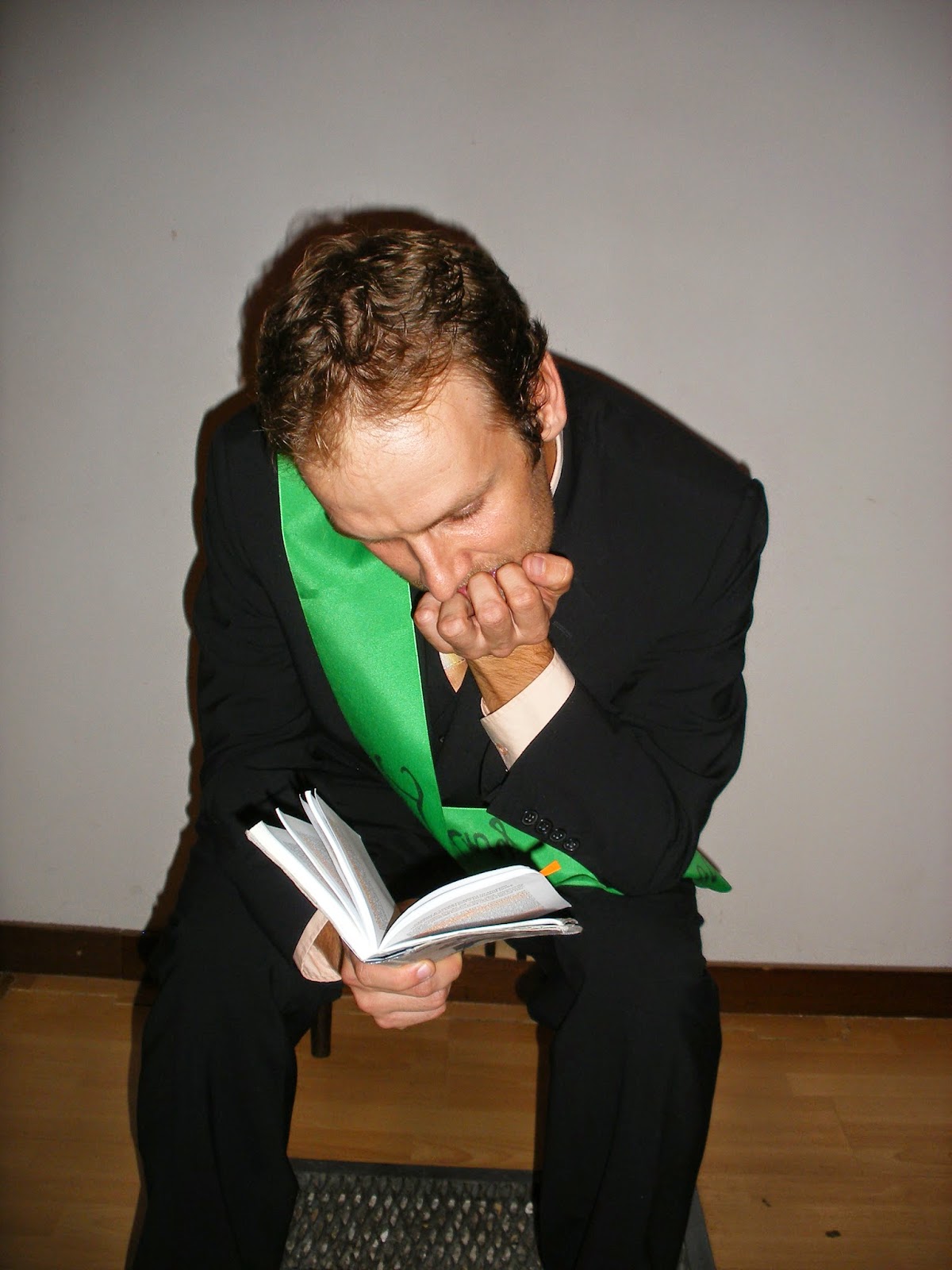
He loved “South Park” and lived for bicycling.  He made us laugh, sometimes when we weren’t supposed to, and he was lazy about translating for us at staff meetings.  He encouraged us to be “casual” at all times, and used “stunning,” with varying levels of irony, to describe things awful to wonderful.  He brought a book along to his own class’ stužková, and took a break late in the evening to sit and read, or at least pretended to. 

I hate that he’s dead.  I hate that the way he died makes his death all the more believable.  I hate that there are people who never got the pleasure of meeting him, and that there are students who will never have the privilege of learning from him.  I hate that, at least in my opinion, the length of his life was not proportional to the gifts he’d been given, and that all the good he had the potential to do and to share will never come to pass.

But even in his too-short time he changed people’s lives.  The day he died my Facebook feed was filled with tributes from his former students, remembering him as the best teacher they’d ever had and thanking him for what he’d taught them.  If it were any of his colleagues I might doubt their sincerity, but he challenged his students and laughed with them and laughed at them and I know they learned from him, probably even more than they realize.

Here is another of my other favorite memories.  One day the class schedule had been messed about for some very Slovak, bureaucratic reason that hadn’t been explained to us well, if at all.  In roughly equal parts frustration and actual curiosity I asked no one in particular, “Why is this happening?”  Braňo looked up across the desk in the staff room and, face entirely straight, answered, “Because of sin.”  I think I laughed then, because I wrote it down on a sticky note; and in the years since, when I’ve felt most put-upon by events and asked that same question, I’ve thought of his response and it’s made me smile.  Though it’s hard to think of that answer now, I’m sure one day in the future I’ll properly appreciate it again.

While looking for the exercise I quoted above I found an outline that Braňo had given us of the speech he had to give at stužková.  I could easily quote the whole thing, but I think this is the best possible way to end a tribute to him: in his own words, with hope.

May you be lead by something more than just cleverness or even wisdom, may you be seized by something much better than morality, may you be broken by the joy coming from the thankfulness to the one, whose arms were and are strong and wide enough to carry us all, who came to give us an actual reason to be joyful, because he not only broke the coldness and indifference of the world around you, but also the coldness in you.

Friday, February 6, 2015

An Observation about Stereotypes

The people of Massachusetts really are into their Irish-Americanness.  You hear "Shipping Up to Boston" by the Dropkick Murphys playing when the Patriots run out onto the field or on Sam Adams commercials and you think, Sure, that song's about Boston, those things are Boston-adjacent, it works.  But there's a place in Holyoke--I believe in front of the high school, whose mascot is a knight--where there's a big shamrock painted in the middle of the road for no apparent reason; and in subbing at the middle school here I've noticed several kids with almost aggressively Irish first and last name combinations, to say nothing of the strawberry blond/redheaded and very freckled twins Bridget and Sean.  Of course there are plenty of people of other ethnicities, but I'm bemused by the breadth of this assertion of heritage.

Monday, January 19, 2015

Inspiration: Sacred Places of a Lifetime

For Christmas my mom got a National Geographic book called Sacred Places of a Lifetime: 500 of the World's Most Peaceful and Powerful Destinations.  The book is divided into ten somewhat vaguely defined sections: Sacred Landscapes, Megaliths & Mysteries, Cradles of Faith, Majestic Ruins, Daily Devotion, Shrines, The Pilgrim's Way, Ceremonies & Festivals, In Remembrance, and Retreats.  Though I've been to some of the sites listed, I found some I hadn't heard of before that I feel I need to visit.  If you take a look at the book, it might behoove you to keep a pen and paper handy to update your own list.

More important are the ones I've not seen yet.  Several of these have been on my radar before, but some were new to me via this book.  With the help of Sacred Destinations, a site I could spend many an hour on, here are short descriptions of the interesting places I found.  These are organized vaguely geographically.

Canterbury Cathedral is the site of Thomas à Becket's martyrdom, and the church to which the pilgrims were traveling in the Canterbury Tales.  One day I want to walk from Southwark Cathedral in London to Canterbury Cathedral.

Rievaulx Abbey
in Yorkshire was destroyed during Henry VIII's Dissolution of the Monasteries.  Theologically speaking, I'm not sure how sacred a place can be if it's been formally deconsecrated, but the ruins look beautiful (as do those of Fountains Abbey, also in Yorkshire, which didn't make the 500). 

Lindisfarne
or Holy Island is in the northeast of England.  Like Iona, it has long been home to a monastery, and the Lindisfarne Gospels were produced there.

Iona
is an island off the west coast of Scotland long held sacred and the site of a monastery since the early Middle Ages.  The Book of Kells may have been produced, in full or in part, on Iona.

The Calanais (anglicized Callanish) stones have stood on the Isle of Lewis, off Scotland, for nearly 5000 years.

Chartres Cathedral is one of the premier cathedrals in France, and that's saying something.  Its stained glass windows are especially impressive.  Apparently.  Ask my mom, she's been there a few times.

Mont-St-Michel is another island monastery, though, as at Lindisfarne, you can walk to it during low tide. 

Heloise and Abelard, Chopin, Delacroix, Isadora Duncan, and Oscar Wilde are among those buried at Père Lachaise

The London to Canterbury pilgrimage can be walked in about a week, but to complete the Camino de Santiago de Compostela takes at least a month.  There are multiple routes to the cathedral in Compostela, one coming all the way from Rome, but the most well-known running from France across northern Spain.  To achieve your certificate, you must walk at least the last 100 kilometers (60 miles)--and declare that there was a spiritual reason for your journey.

The abbey in San Galgano, Italy, is ruined only in that the roof is missing.  Otherwise the 13th-century building is almost completely intact.

The 6th-century Basilica of San Vitale in Ravenna is filled with Byzantine mosaics.

Aachen Cathedral was first begun by Charlemagne, who's now buried there.  As the cathedral of subsequent Holy Roman Emperors, it is richly decorated and great in historic significance.

What the book calls "Wittenberg Church" is more precisely the Castle Church (Schlosskirche) there, as opposed to the City Church (Stadtkirche).  It was to the Schlosskirche's doors that Martin Luther nailed his theses in 1517, and now he and his friends Philip Melanchthon, and Frederick the Wise are buried there.

Not far from Kraków is the monastery of Jasna Góra in Częstochowa, which holds a miraculous Black Madonna.  I grew up hearing stories of my dad driving tour groups to see a replica of the icon at the Our Lady of Częstochowa Shrine in Pennsylvania, so I'd like to see the real one.

There are several stave churches in Norway; the book lists those at Lom and Borgund, while the best known is probably that at Urnes.  These wooden churches date from Christianity's introduction into Norway in the early Middle Ages.

Kizhi, in Karelian Russia, is home to wooden Orthodox buildings situated in the midst of Lake Onega.  You can get to the pogost by helicopter, boat, or hydrofoil.

The Upper Svaneti region in Georgia has several medieval villages, some of which feature peculiar tower-houses.  Presumably there are churches amongst the buildings; to be honest, I can't now remember if the book was specific about any particular site.
  
The Anatolian rock churches of Göreme, Turkey, are notable for their Byzantine frescoes.  The paintings in the so-called Dark Church are especially vivid due to the paucity of natural light that enters the chuch.

It's a church!  It's a mosque!  Varangian vandals carved runes in its stone!  (It's the Hagia Sophia.)

No one is sure what it was for, and the architecture is not typical for the area, so it's no surprise that Indiana Jones found the Holy Grail at the Treasury in Petra.

The cemeteries of New Orleans are famed for both their architecture and their otherworldly atmosphere.  The oldest dates from 1789.  The Internet seems to suggest that due to the neighborhoods in which they're located, not all of the cemeteries are safe for tourists to visit.

Haida Gwaii, off the coast of British Columbia, is the home of the Haida tribe.  Formerly known as the Queen Charlotte Islands, the area features natural beauty and native culture.

Tuesday, December 16, 2014

Not All My Friends Are Dead

With apologies to Avery Monsen and Jory John.

Back in October one of my friends posted on Facebook talking about a cemetery she was about to visit in Hartford.  It was, she said, where Katharine Hepburn is buried.  Not long after that I invited myself down to see her, and we managed to coax another friend from our college track team to make the drive from New York to join us.

The cemetery in question is Cedar Hill.  After having brunch Coach drove us there, and we left the car near the entrance.  The grounds are large, well-kept--though there were large drifts of leaves that were treacherous, as we couldn't tell what the ground did under them--and a bit hilly.  Though it was chilly and windy, it was a nice day for it; lots of leaves had fallen but some were still hanging on, and the Japanese maples throughout the grounds were particularly vivid.

One of the notable residents of Cedar Hill is Samuel Colt of firearms fame.  You can still see the Colt factory from I-91 as you drive through Hartford, so it's no big surprise that he's buried in the city.  His family's monument is made of pink stone, carved in Egyptian motifs and accented with bronze.  It's large, but not as ostentatious as some of the other monuments there.

On the other hand, you could miss the Hepburn family's plot if you weren't looking for it.  A large stone carved with the family name is all but hidden under two bushes; directly in front of it are the parents' plaques, set into the ground, and the four children's in front of that (Katharine's is second from left in the photo).  Each plaque is engraved simply with a name and dates, with no mention of occupation or achievements.  It's both admirable in its simplicity, and a little anticlimactic that such a famous woman has such a plain memorial.

Not far away is the tomb of J.P. Morgan.  The family's monument is big, and I'm sure it cost a hefty sum, but again, it's not as grandiose as I might have expected.  Then again, according to the visitors' guide, the monument is supposed to represent Morgan's "vision" of the Ark of the Covenant; I'm assuming by vision they mean idea, not revelation, but whatever the case, that does add that bit of extravagance and self-importance one might associate with someone like Morgan.

 Of course, there are lots of non-famous people buried there, some of whom have interesting headstones, memorials, or mausoleums. One that really stuck out was the Hanson family's.  I don't know who these particular Hansons are, but they've got two things going for them.  The first is that their monument features a carving based on Scandinavian runestones, and includes a runic inscription (though I will say that I think they ought to have chosen a different lettering style for the family name, as my opinion is that the one used doesn't fit well with the rest of the carving).  The second is that the monument is right in front of a pair of large and glorious threadleaf Japanese maples.  At any other time of year it probably wouldn't have been as striking, so we went at just the right time.

And then we went to an Irish pub and had some nachos with pastrami on and I had a really good cider.  When I grow up I want to be able to hang around in cemeteries and drink good cider all the time.

Friday, December 5, 2014

Cemetery Shaming

You'd think the cemetery that was the eternal home to one of the greatest poets in American history would be better taken care of.

I was heading toward Amherst the week before Thanksgiving and decided to do a quick check to see if there were any cemeteries there that I ought to visit.  To my surprise I saw that Emily Dickinson is buried in Amherst's West Cemetery.  Even if it didn't appear that there were many colonial or Revolutionary graves there, I still had to stop in to see Dickinson.

Despite being on the National Register of Historic Places, West Cemetery is disappointing.  It could be a really great cemetery to visit--it's ever so slightly hilly, with a few nice trees scattered around, and clear paths for driving.  Whoever manages the cemetery can't be blamed for the fact that the ground is uneven and pocked with small holes that make walking a bit treacherous.  But there are many broken, fallen, or precariously leaning stones, which I'm willing to attribute to the soil itself; but I can find little excuse for the trash--not just litter, but bags of trash and what appear to be pieces of clothing--left around the grounds.

There are many Dickinson graves there, but the important one is easy to find (that's it, second from left above).  Emily and her family are fenced off by what would be a nice iron fence, provided by distant relatives, but for two things: one, that the fence is only a few inches from the carved face of the tombstones, and therefore two, that the fence passes right over where the Dickinsons are actually buried.

As you might expect at a famous poet's grave, people have left little tokens for Dickinson.  There are small rocks piled on top of her headstone, along with pens and a necklace or bracelet; that all makes a fair amount of sense.  The framed picture of John Lennon and the gray Converse high-tops make a little less sense to me, but then again, the cemetery is within walking distance of the UMass campus, and you know what English majors are like.

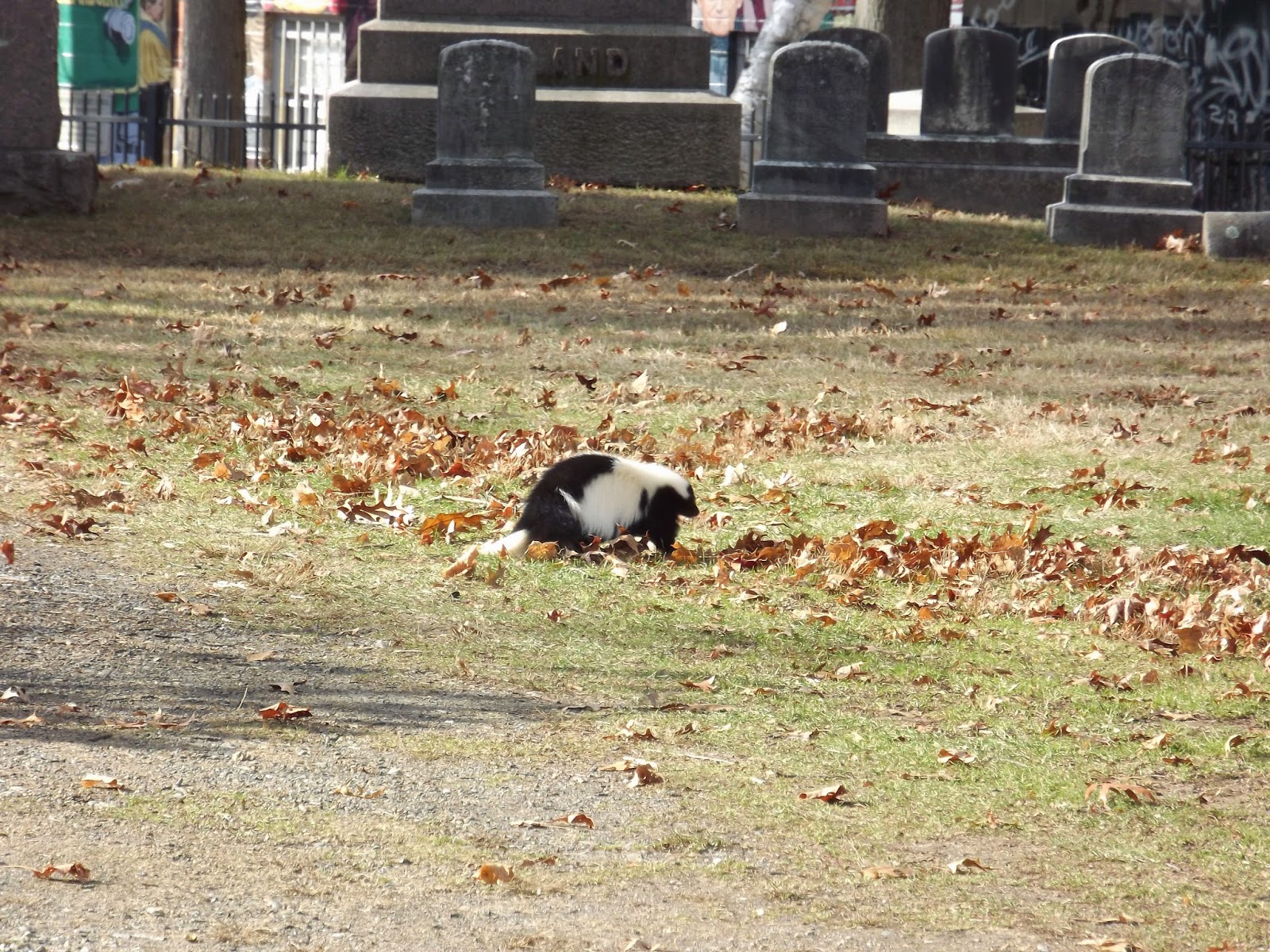
The most exciting part of visiting West Cemetery came as I was getting back in the car and saw a skunk trundling around.  I've seen cats and squirrels and chipmunks in cemeteries before, but this was a first for skunks.  So my verdict is go see Emily Dickinson if you like, but don't expect too much, and watch out for the wildlife.

On a practical note, Google seems to believe that the cemetery is at 586 S. Pleasant St.  It isn't.  That appears to be someone's house.  I used the entrance on Triangle St., but it might also be possible to enter from N. Pleasant.

Sunday, November 23, 2014

Flashback: A Long Drive


You can drive nearly from one coast to the other in five days (and fewer if you can power through more than eight or so hours a day behind the wheel), but I wouldn’t really recommend it.

To see everything of interest between southern California and southern Connecticut would take a very long time.  I daresay we’d still be driving if we’d been able to stop at every place we saw in a guidebook that caught our interest.  But, of course, even with time constraints, we did get to make a few stops, each of us getting to see something that particularly appealed to us, and we all survived and my new old car survived and those are the important things.

At the beginning of August Mom and Dad and I drove across the country to get me and said new old car, christened the Bluebird after Dad saw a bus from that company, to grad school (again, though a different school and a different degree than last time).  There are two basic ways you can get from our Point A to Point B: by taking I-40, which cuts through the Southwest before heading into Missouri and so on, or by taking I-80, which starts out going north through Utah and then heads east.  We chose the latter route, though with a bit of a detour.  While the most direct route involves taking I-70 through Colorado and picking up I-80 in Nebraska, we decided to stay on I-15 all the way through Utah and meet 80 in Wyoming, because we wanted to see Wyoming (and I, for one, wanted to avoid driving through big mountains as much as possible).  The biggest downside to our chosen route was that there was a lot of road work going on on 80; perhaps if we had known this beforehand we would've gone a different way, and it's a bit of a surprise that the AAA office didn't warn us about the issue.
 
Before we left we had a few places that we intended to stop, in Iowa and Indiana and Pennsylvania, but we didn’t make any hotel reservations ahead of time so that we could drive as far as we wanted to on any given day.  It was a logical notion that didn’t necessarily pan out in real life.

(Our ideal plan had been to leave 80 around Toledo, drive through Detroit and across the bridge into Canada, and then come down from the north somewhere.  This plan was foiled by the fact that somebody on our trip let her passport expire.  It’s less than three and a half hours from my current location to the border, though, and just under four to Montreal, so you know that that’s going to happen at some point.)

With Dad and I taking turns, I drove about half of the time.  My shifts ended up being from:
the Arby’s in Baker, CA, to Arshel’s restaurant in Beaver, UT (after leaving Beaver, above)
Evanston, WY, to Wamsutter, WY
Sidney, NE, to the western edge of Lincoln, NE
Adair, IA, to near Brooklyn, IA*
Walcott, IA, to possibly Channahon, IL
Valparaiso, IN, to near Howe, IN
somewhere between Toledo and Akron, OH, to Shenango Valley, PA
State College, PA, to somewhere quite close to the New York-Connecticut border when my nerves finally gave up on me and I had to let Dad drive the 15 or so minutes left to our final destination

I don't have as many pictures as you might expect from the trip because of all the time I spent behind the wheel.

On our very first night we learned that you can’t just roll into Provo on a Wednesday night and expect to find vacant hotel rooms.  This did not, however, mean that we immediately got online and made reservations for the rest of our nights.  Except for the places we knew we were going to stop, we left our accommodations to chance.

I'd venture to say that the worst road we had to deal with was in Indiana.  Hoosiers, I am disappointed in you.  You dare to charge people to drive on that section of interstate?  Where is that toll money going?  It's certainly not going toward the upkeep of your roads.

I think my favorite scenery of the trip was from Utah into Wyoming.  I know my favorite driving was in Wyoming, and not just because you can go 80 miles per hour; southern Wyoming is very pretty, with lots of rolling hills and green grass and not a lot else.  On the western end of our route there’s a lot of open space between the cities.  That openness disappears the further east you go, with ranges giving way to farmland, denser populations, and more trees appearing.  It seemed as though the trees had swallowed all of Pennsylvania, and after the days of horizon it felt suffocating to have them looming overhead. 

One of our serendipitous finds was a Czech restaurant in Omaha called Bohemian Café.  Since it was a Czech place there was no halušky on the menu, nor did they have any Kofola or even Vinea, but the food was good nonetheless.  There was soup and pork and knedľa and poppyseed cake, and you don’t really need much else after you’ve been deprived of a good Central European meal for too long.


I feel confident in saying that the highlight for my dad was stopping in Iowa at Iowa 80, the world’s largest truck stop.  It’s huge.  One room has truck accessories for sale but it also has a full tractor-trailer and two rigs on display.  There’s a food court and like four different gift shops and showers and a chapel and a museum and a dentist's office, and parking for hundreds of trucks and even more cars.  It was pretty amazing.  

If I ever make this drive, or even part of it, again, I'm going to make sure there's plenty of time for stopping places.  Or I'll hire someone to drive for me, like that couple did with the cab driver.  That sounds more like it.


The uncertainty is due to the fact that many of our trade-offs took place at gas stations or rest stops, which all sort of start to look alike after a few hundred miles.

Friday, November 14, 2014

Castle Run

A few weeks ago one of my former students shared a video on Facebook of a bunch of guys freerunning and parkouring around Spiš Castle.  This was done with the castle's permission, because it was a professional video with sponsors and everything.  The group, Born To Trick, has made a series of these videos called "Castle Run"; there are eight of them, each filmed in a different Slovak castle.  This morning the poor soul who has the dubious distinction of being my best Slovak friend sent me a link to this video, done at Orava Castle.  I can't imagine leaping about in that castle, where I felt so dizzy even when I looked at the pictures of it when I got home.  Though I've not seen all of the videos yet, this one might end up being my favorite; besides the parkour it also features folk dancers, and that's what Slovakia is.  It's people who are proud of their country, its culture and its natural beauty, and that celebrate that while embracing modern life.