I've always been interested in names and naming things, and being in another country offers ample opportunity to learn new styles of names. In this post (for which I've done a lot of informal research and which is being posted on an important person's name day) I'll say a little about both given names and surnames, but I'm far from being an expert on Slovak naming conventions.
Preface: Pronunciation
I was getting frustrated over my inability to clearly express how certain letters and special characters ought to be pronounced, but then I found this lovely table. (I can see a few places where the pronunciations don't match up across the table, but overall I think it will help.)
Personally speaking, I cannot pronounce anything with a ch as it ought to sound, so any names with that combination automatically default to the nickname. Furthermore, it takes too much time for me to try to pronounce things correctly, so in class, nearly everyone gets the anglicized pronunciation of their name.
I. Given Names
Here are most of my students, past and present.
Girls: Adela, Adriána, Alena, Alexandra, Alžbeta, Andrea, Anežka, Barbora, Beáta, Bernadeta,* Bianka, Bibiana, Blanka, Daniela, Denisa, Diana, Dominika, Dušana, Eliška, Emília, Eva, Evelýn, Hana, Ivana/Ivona, Iveta, Jana, Jaroslava, Júlia, Karina, Karolína, Katarína, Klaudia, Kristína, Laura, Lenka, Linda, Lívia, Lucia, Ľubica, Ľudmila, Magdalena, Mária, Marianna, Martina, Michaela, Milica, Miroslava, Monika, Natália, Nikola/Nikoleta, Patrícia, Paula, Paulina, Petra/Petrana, Renata, Romana, Ružena, Sabina, Simona, Stanislava, Stela, Soňa, Svetlana, Tatiana, Terézia, Timea, Vanda, Veronika, Viera, Viktoria, Vlasta, Zdenka, Zita, Zuzana, Žofia
Boys: Adam, Andrej/Ondrej, Armand, Benjamin, Branislav, David, Denis, Dušan, Erik, Filip, František, Gregor, Jakub, Ján, Juraj, Karol, Kristián, Lukaš, Ľubomír, Marcel, Marek, Marián, Marko, Maroš, Martin, Matej, Matuš, Maxim,* Michal, Mick,* Nazarij,* Patrik, Pavel, Peter, Richard, Róbert, Roman, Stanislav, Šimon, Štefan, Tomáš, Viliam, Vladimír
Multiples aside (4A this year has three Simonas), this also shows that we have a lot more female students than male. In addition, this year there are two sets of siblings with paired names: Ján and Jana, and Kristína and Kristián.
Ia. Name Days
At some point, I know not when nor by whom, a Slovak name day calendar was created. It seems the majority of Slovaks have names that are on the official calendar, although some names of foreign provenance are used, like those starred above (Max and Nazarij's parents are Ukrainian, and Mick is Dutch). Your name day has no correspondence with the day you were born--that is to say, if you're born on January 20th, your name need not be Dalibor, but if your name is Dalibor, then January 20th is your name day. On your name day you usually get a little treat, some chocolate or cake or something. Name days aren't as important as birthdays, but they're still remembered.
Name days sometimes correspond with saints' days in the Catholic calendar, but not always. For example, Valentin, Andrej/Ondrej, and Štefan all celebrate their name days on the saints' days (that's February 14th, November 30th, and December 26th, respectively). But Juraj's name day is April 24th, while St George's Day is celebrated the day before.
Ib. Two Names or Three?
Most Slovaks today only have two names, their given name and their surname. Only two of my students have a middle name. One was allowed to legally add her second name when her baby sister was born, and she is very proud of it. Some major figures in Slovak (/Czechslovak) history have had three names, though. These include Milan Rastislav Štefánik, Štefan Marko Daxner, Pavol Országh Hviezdoslav, and Tomáš Garrigue Masaryk (Masaryk, the first president of Czechoslovakia, took his wife's maiden name as his middle name when they married). I have talked with one of my students about this, and he was able to offer the following insight: In some villages, there are many families with the same last name, and therefore they may adopt family nicknames in addition to their legal surnames. My student said that his family's nickname is Gajdoš, and that if he introduced himself in his village with his legal name, that wouldn't help anyone to place him; but that if he introduced himself with his first name plus Gajdoš, that would be more specific. In part because there are not a huge variety of first and last names here, people have used their family nicknames or other nicknames or pseudonyms (like Hviezdoslav, above, which means something like "celebrating the stars") to help set themselves and their names apart.
II. Nicknames
Almost every name has what I think of as a "secret Slovak nickname." The pattern seems to be: when in doubt, chop off the end of the name and add -o for a boy and -a for a girl (Ján→Jano, Miroslava→Mira). The -ko/-ka ending is diminutive, so calling a Jan "Janko" is like saying "little Johnny."
A few kids have anglicized nicknames, like Nyky for Veronika. I started calling Bernadeta "Bernie" based on sheer laziness (I also persist in spelling it the American way and will not be swayed otherwise; I don't think she or any of her classmates realized that Bernie is mostly a guy's name until sometime last year). Some students introduced themselves with anglicized nicknames at the beginning of the year, so one Michal was Mike (and often Mikey), and one Katarína is Katy.
III. Surnames
Males and females have different last names. A daughter has the feminine form of her father's last name until she marries and gets the feminine form of her husband's last name. The feminine ending is usually -ová. So if one of my coworkers, Pán Hudec, ever gets married, his wife will be Pani Hudecová. If the masculine form ends in - ý (like Kamenský), the feminine changes to -á (Kamenská).
My first year I had two girls in the same fifth year class whose last names are Medveďová. I assumed that two students who are the same age and in the same class must be twins, but they were not. They just had the same last name.
Not all Slovaks have surnames of Slovak origin. Remember, modern Slovakia used to be part of the Austro-Hungarian Empire, and there were significant populations of German immigrants in the area as well, besides the obvious Czech, Polish, and Hungarian communities. I was surprised last year at the number of students with surnames of German origin; while I've been here there have been a Schmidt, a Šnider, and a pair of siblings who are Kirsch and Kirschová.
IV. Titles
Pán translates to "Mr." or "sir," pani to "Mrs." or "ma'am," and the less frequently-used slečna to "Miss." Here at school we often hear students calling their Slovak teachers Pani učiteľka, more or less "Mrs. teacher." The headmistress is very often addressed as Pani riaditeľka. It's similar to the German form of address so well-known from the movies, "Herr Doktor" or what have you. I would assume that a doctor would indeed be addressed as Pán doktor/Pani doktorka, especially since pastors are called Pán farár/Pani fararka.
V. Conclusion
Last year I read something about Katarina von Bora Luther, and I immediately thought of her as "Katka Luther." This is a sign that I have been in Slovakia too long.
Appendix: Nicknames
For extra credit, match the nickname to the given name from the list above.
Girls: Ady, Aďa, Baška, Betka, Dada, Danka, Dena, Dia, Domča, Duška, Eli, Hanka, Ivka, Janka, Jarka, Kaja, Katka, Kaťa, Kika, Kiki, Lucka, Ľubka, Magda, Maja, Majka, Maťa, Milka, Mima, Mirka, Miška, Monča, Nati, Nika, Paťa, Pauli, Peťa, Romča, Sabi, Saška, Sima, Sisa, Stanka, Sveťa, Terka, Viki, Zuzka, Žofka
Boys: Benjo, Braňo, Fero, Jano, Juro, Kubo, Ľubo, Maňo, Maťo, Mišo, Paľo, Peťo, Puky, Rišo, Robo, Stano, Števo, Vilo, Vlado
Tuesday, November 30, 2010

Monday, November 29, 2010
"SNEŽI!"
"It's snowing!" This is what the kids always yell whenever it starts snowing during school, as it did last Wednesday. They act as though they've never seen snow before in their little Slovak lives. And shortly thereafter I always end up saying, "Snow stays outside the classroom."


Wednesday, November 24, 2010
Thanksgiving
 I am thankful that it's finally snowing in Tisovec.
I am thankful for my health and safety.
I am thankful for my students (like my beloved third years), who are funny and smart and kind and frustrating and always surprising.
I am thankful for Hobbits—the kind you eat, not the kind you walk into Mordor with.
I am thankful for the Middle Ages.
I am thankful that we just celebrated 21 years of the fall of Communism in the former Czechoslovakia.
I am thankful for Johann Sebastian Bach.
I am thankful that I have eaten halušky at 10:30 PM and kapustnica at midnight.
I am thankful to be teaching history again, and I am thankful for my old Barron’s AP European History study guide.
I am thankful for bryndza cakes, and those little meringues with the chocolate cream.
I am thankful that I don’t have to use the ř.
I am thankful for my past and present friends/colleagues/traveling companions/co-conspirators.
I am thankful for my family. I am really very spoiled by them.
And I am super duper thankful for the lovely, effective new dryer in the basement.
One day my life may actually get hard, but it hasn’t yet, and I’m thankful for that.
i thank You God for most this amazing
day:for the leaping greenly spirits of trees
and a blue true dream of sky;and for everything
which is natural which is infinite which is yes
(i who have died am alive again today,
and this is the sun's birthday;this is the birth
day of life and love and wings:and of the gay
great happening illimitably earth)
how should tasting touching hearing seeing
breathing any-lifted from the no
of all nothing-human merely being
doubt unimaginable You?
(now the ears of my ears awake and
now the eyes of my eyes are opened)
--e.e. cummings
Saturday, November 6, 2010
Lucky
Lucky to have been where I have been
If you followed the link two posts ago and watched the video (I tried to post it here, but the embed option was denied me), you would have noticed Colbie Caillat wandering around on a beach somewhere and Jason Mraz looking classy in some Old World city. The first time I saw the video, a few weeks ago, I thought, 'That place looks familiar.' Then I realized that it was Prague, and that I was going back to Prague for fall break.
This time, instead of the dreaded overnight bus, we took the overnight train. Although I was just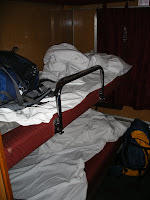 a little tiny bit too tall for the bunk, the overall sleeper-cabin experience was much more comfortable than the bus had been. We (Tika, Robin, and Anička, who teaches in Košice) arrived just after 7 a.m. on Friday morning, and dropped our things off at the Old Prague Hostel. This hostel definitely had the previous one beat for proximity to the Old Town. Once we'd left our big bags behind, we walked into the center, and I got to talk about Jan Hus and the Reformation and whatever else I could remember/make up about Old Town Square. And then we went to Bohemia Bagel and ate some bagels and drank some fresh-squeezed OJ and coffee, and that right there made the whole trip pretty much worth it.
So we walked across Charles Bridge, and went to the castle, and saw the cathedral, and walked around Mala Strana, and ate lunch, and climbed the astronomical clock tower, and then actually checked in at the hostel. Rob and Anička wanted to nap (Rob having a cold the whole time we were there and no one having slept fantastically well on the train, despite it being far superior to the bus), so I went looking for a camera shop I'd found online to buy a new battery, and Tika came with. The shop, Foto Škoda, is right off Wenceslas Square, and I highly recommend it if you need any kind of apparatus while you're in Prague.
On Saturday morning we took our day trip, this time to a town south of Prague called Český Krumlov. We endured the world's hottest bus for about three hours, but it was well worth it. The Vltava River, which makes about an 85-degree turn through Prague, horseshoes through Český Krumlov. I really like bridges, and the idea of living near a river, so I was quite taken with the town. It retains its medieval streets, most of which lead up to the chateau, whose round, painted tower is a landmark. The chateau's former moat has been home to bears since around the 17th century, but the bears seemed to be hiding when we looked for them. One of the highlights of our visit was the restaurant we ate at for lunch. Both Rick Steves and Lonely Planet mentioned U dwau Maryi as a good place to eat, and I was all for going, because it's a medieval-type place, but I didn't want to foist my weirdness on anyone else. When we found it, we all agreed that it looked good, so in we went. We sat at the back, right out by the river, with blankets and hot wine to warm us, and I had millet casserole with ham and cabbage, mostly because when I read the words "millet casserole" I was instantly fascinated. It was good, although, as you might imagine, rather hard to describe. The closest thing I can think of would be some kind of casserole made with grits, and yet it wasn't like that at all.
On Sunday we planned to visit the Jewish quarter in the morning. Upon arriving at the Pinkas Synagogue, we saw that there was, of course, a line to get in, and then, upon considering the prices, decided it wasn't really necessary to visit the various sites of the Jewish Museum (which I'd already been to, anyway). I did want to go visit the Old-New Synagogue, though, since it's the oldest synagogue in Prague and I hadn't been there before. The synagogue was built in the second half of the 13th century, and according to legend, the Golem of Prague is stored in its attic.
 You really expect me to believe that that's real? I mean, really?
If you followed the link two posts ago and watched the video (I tried to post it here, but the embed option was denied me), you would have noticed Colbie Caillat wandering around on a beach somewhere and Jason Mraz looking classy in some Old World city. The first time I saw the video, a few weeks ago, I thought, 'That place looks familiar.' Then I realized that it was Prague, and that I was going back to Prague for fall break.
This time, instead of the dreaded overnight bus, we took the overnight train. Although I was just
 a little tiny bit too tall for the bunk, the overall sleeper-cabin experience was much more comfortable than the bus had been. We (Tika, Robin, and Anička, who teaches in Košice) arrived just after 7 a.m. on Friday morning, and dropped our things off at the Old Prague Hostel. This hostel definitely had the previous one beat for proximity to the Old Town. Once we'd left our big bags behind, we walked into the center, and I got to talk about Jan Hus and the Reformation and whatever else I could remember/make up about Old Town Square. And then we went to Bohemia Bagel and ate some bagels and drank some fresh-squeezed OJ and coffee, and that right there made the whole trip pretty much worth it.
So we walked across Charles Bridge, and went to the castle, and saw the cathedral, and walked around Mala Strana, and ate lunch, and climbed the astronomical clock tower, and then actually checked in at the hostel. Rob and Anička wanted to nap (Rob having a cold the whole time we were there and no one having slept fantastically well on the train, despite it being far superior to the bus), so I went looking for a camera shop I'd found online to buy a new battery, and Tika came with. The shop, Foto Škoda, is right off Wenceslas Square, and I highly recommend it if you need any kind of apparatus while you're in Prague.
On Saturday morning we took our day trip, this time to a town south of Prague called Český Krumlov. We endured the world's hottest bus for about three hours, but it was well worth it. The Vltava River, which makes about an 85-degree
 turn through Prague, horseshoes through Český Krumlov. I really like bridges, and the idea of living near a river, so I was quite taken with the town. It retains its medieval streets, most of which lead up to the chateau, whose round, painted tower is a landmark. The chateau's former moat has been home to bears since around the 17th century, but the bears seemed to be hiding when we looked for them. One of the highlights of our visit was the restaurant we ate at for lunch. Both Rick Steves and Lonely Planet mentioned U dwau Maryi as a good place to eat, and I was all for going, because it's a medieval-type place, but I didn't want to foist my weirdness on anyone else. When we found it, we all agreed that it looked good, so in we went. We sat at the back, right out by the river, with blankets and hot wine to warm us, and I had millet casserole with ham and cabbage, mostly because when I read the words "millet casserole" I was instantly fascinated. It was good, although, as you might imagine, rather hard to describe. The closest thing I can think of would be some kind of casserole made with grits, and yet it wasn't like that at all.
 On Sunday we planned to visit the Jewish quarter in the morning. Upon arriving at the Pinkas Synagogue, we saw that there was, of course, a line to get in, and then, upon considering the prices, decided it wasn't really necessary to visit the various sites of the Jewish Museum (which I'd already been to, anyway). I did want to go visit the Old-New Synagogue, though, since it's the oldest synagogue in Prague and I hadn't been there before. The synagogue was built in the second half of the 13th century, and according to legend, the Golem of Prague is stored in its attic.
Besides the religious sites, the other really cool thing about Josefov is the Art Nouveau architecture. There are so many beautiful buildings in the area, and in other parts of the city as well. 

 In the afternoon, I went to the Convent of St Agnes of Bohemia (Klášter Sv Anežky České), which is home to the National Gallery in Prague's Bohemian and Central European medieval art collection. It took me a minute to find the convent, because the signs pointing it out seemed to lead to dead ends; but the entrance is sort of in a corner. The art collection was much larger than I'd expected it to be, and was almost exclusively religious art. There were lots of Madonnas and crucifixes and saints, and the tags in English were very well-written, but made me laugh, because they just use such silly expressions to talk about art sometimes. You could also walk around the oldest parts of the convent, dating from the 13th century, with markers where St Agnes and Wenceslas I and his wife Cunigunde are buried. As trite as it sounds, I had a feeling of peace walking around looking at the art and architecture.
That night being Halloween, we had to go out, although most of the actual parties had been the night before. We managed to end up at Prague's Australian bar, Fat Boy's, which was fantastic because A) it was a non-smoking establishment, B) they had Magners, and C) there was an NFL game (Patriots and Vikings) on the telly. What more can you want out of your Halloween than that?
Monday morning it behooved me to cruise around the mall, and then we watched the astronomical clock ding at noon and had some real hamburgers for lunch. After that I took off for a wander. I ended up on a hilltop park to the northeast of the castle, where there were real Praguers enjoying their day off, walking and playing and running with their dogs. From that vantage point, this is what I saw:  And lo, as I looked over the Vltava and the city, I said to myself, 'Hey, isn't there a big cemetery over there in Žižkov? And isn't Alfons Mucha buried there?' And myself said, 'I think you're right. We should go find it.' And though a third part of myself said, 'It's already three and you're supposed to meet the others at five; you'll never make it in time,' the rest of me was ready to go from the word "cemetery." So we all speedwalked down the hill, across the river, past the bus station, and up another hill into Žižkov, and finally reached
  the cemetery. In the picture above, it's to the left of and past the big TV tower.
The cemetery, Olšany Cemetery, was gorgeous. It turns out that Mucha isn't buried there, and I only got to see a fraction of it, but it was supercool. By the time I got there it was late afternoon, and there were fallen leaves and ivy everywhere, and some of the older mausoleums were broken down and boarded up...it was everything I've ever wanted in a cemetery. I just wish I'd gone earlier so I could have looked around more. It's possible that it was the highlight of my trip. There I felt accomplished and in awe and a little tiny bit creeped out (there were LOTS of angel statues, and it reminded me of "Blink," my favorite episode of Doctor Who) and like I couldn't have picked a better day than All Saints' Day to go. Because it was dusky when I was there, a lot of my pictures are a little out of focus, but I think it adds to the ambience, if photographs can have ambience. 
On Tuesday before we left we stocked up on bagels and I had a lemon-lime-ginger presse that was both exorbitantly expensive and wonderfully delicious. Then we got on our trains and subsequent buses and made it back into our dear Slovakia and home to Tisovec.
In conclusion, I have a message for the people of Prague: I hate to break this to you, but I'm pretty sure your city is fake.
You really expect me to believe that that's real? I mean, really?Tuesday, October 19, 2010
WATCH THIS VIDEO
This amazing video was projected on the Astronomical Clock tower in Prague for its 600th anniversary. I don't know how they did it, but it's pretty fantastic.
The 600 Years from the macula on Vimeo.
Hiking in the High Tatras
 Last weekend we went up to the High Tatras to go hiking. This, as I’m sure you realize, was not my idea. I went because I’d not spent much time in that area before, and I wanted to see the beautiful nature* for which the area is famous. At first we’d arranged to meet some of the teachers from Poland, but they ran into transportation difficulties—apparently all of the trains coming into Slovakia were sold out—so it ended up just being the four of us. We’d also first planned to go on Friday afternoon, do the main hike on Saturday, and come back on Sunday, but instead left on Saturday morning so that people could get more stuff done before the trip.
We took buses to Poprad, and from there took a train to Popradské pleso. When we got to the train station in Poprad, the signs for our train listed the platform as “TEŽ” rather than a number. TEŽ stands for Tatranské Elektrické Železnice, the electric railroad that runs to the resorts and towns in the Tatras. Like many trains that go to areas frequented by tourists, this train had announcements not only in Slovak but also in German and English.
We got off at Popradské pleso and walked up a road for about an hour to get to the actual lake (a pleso is a high mountain lake) and our hotel. There are lots of chaty to stay in on hiking routes; these are cabins which often have dorm-type accommodations. On the shores of Popradské pleso, though, is an actual hotel. It was probably nicer than the one I live in, but it wasn’t greatly luxurious. We each paid about 16€ for our night’s stay in a six-bed room with bathrooms down the hall. (I didn’t see showers anywhere. Maybe if you’re a hardcore hiker you just don’t shower for as long as you’re on your trek.)

Once we’d checked in and eaten lunch, we started off on our hik
 e. We were heading for Velké Hincovo pleso, the highest lake in Slovakia. It was a pretty hike; we crossed rivers running over rocks, and saw snow high in the mountains above us. It was also hard. For some reason I didn’t expect there to be so many rocks on the trail. In places it was like climbing stairs. After a while we were stopping every few minutes for a break, and soon I decided I couldn’t go any further. (On one of those breaks we saw one of our second years coming down with his parents. He seemed rather surprised to see us, and his father kept telling him to tell us to get a move on and not waste time if we wanted to reach the lake.) My legs were tired, and my knees were starting to ache, and it wasn’t going to be a lot easier going down than going up; so though it galled me, I admitted defeat. I was pretty frustrated for a while, since I was trying to prove that I could do it, and I hated having to give up. But being able to walk in the future was pretty important, and it’s not like I was going to miss seeing something I actually cared deeply about. If there had been an awesome castle at the end of the hike, I would have kept going. So Robin, who’d already seen the lake, didn’t care about seeing it again, and had already joked that she was a quitter, went back down the trail with me. We walked around the pleso and relaxed for a while before the other two got back.
 The next morning H went up another trail and the rest of us walked the trail around the lake to the symbolic cemetery. The cemetery has plaques and memorials to people who have died in the Tatras. Most of the people were climbers and hikers, although there are two memorials for people who died in plane crashes in the mountains, too, including a group of soldiers during the Slovak National Uprising. The mountains around us kept appearing and disappearing in the fog.
Bef
 ore we could get back on public transportation, we had to get down to Štrbské pleso. Originally we had planned to come up this trail on Friday evening, and it turned out to be a good thing we didn’t, since it would have been a steep, rocky, dark climb then. On Sunday morning it was beautiful, because we walked through the fog. We couldn’t always see the valley to our left. I think this trail was my favorite, and not because it was the one we were leaving by. We could actually see the fog moving around us, and quickly, too.
In towns and villages in Slovakia, people don’t always acknowledge or greet you. They may even look at you with suspicion if you say hello. But on the hiking trails there was more camaraderie, and a definite informality. People greeted us, sometimes with the formal “Dobrý deň,” but often with a simple “Ahojte” (hi, plural). Perhaps it was just because it’s hard to ignore someone on the same trail you’re using. Whatever the reason, it was nice to be greeted, and I liked observing all the different kinds of people who passed us.
So now I can strike “Hiking in the Tatras” off my list of things I never actually intended to do in life. This coming weekend is fall break, and I’ll be returning to a place I’ve already visited, with a new twist. Here’s a video clue. Get excited; I am.
* “The beautiful nature” is something we hear about all the time. People don’t spend time outdoors, they go to the nature. It’s got to the point where it’s very hard for me to even suggest any alternative phrase to “the nature.”
Tuesday, October 12, 2010
Orava
 The problem with having been here for two years is that by now all of the places I’d like to go are the ones that are the least easy to get to. These are the ones that it takes a bus and three trains to get to, and four buses to get home from, and that mean leaving earlier on a Saturday than one usually gets up on a weekday. I am committed to seeing as many things as I can, though, especially my castles and World Heritage Sites.
If you’re a classic cinema fan, you might recognize Orava Castle from the old black-and-white vampire film Nosferatu. (I can’t even imagine how inexpensive it was to film in Slovakia in the 1920s.) Orava is one of the country’s most famous castles, and it was only the travel time that kept me from visiting it before. But on Saturday Tika and I went up north, taking a bus from Tisovec to Banská Bystrica, then trains from Bystrica to Vrútky, then Kraľovany, and finally Oravský Podzámok. On the way home we took buses from Oravský Podzámok to Dolný Kubín, then to Ružomberok, Bystrica, and home.
From the train station in Oravský Podzámok, you walk to the left, which takes you across the Orava River. Once you’ve crossed the river, the entrance to the castle grounds is on the right side. When we first saw the castle from the train, we expected it to be up higher, because there are higher hills in the area; but it’s a tricksy castle. It doesn’t look like much of a climb, but once you’re inside, you move upward pretty steadily. From the top of the citadel it’s a fair drop pretty much straight down.

 Our tour group entered the castle (through the door with the dragon handle!) at 10:50. We passed through the first two gates, then a tunnel into the lower castle area. Like Fiľakovo, Orava has three distinct levels: the lower, middle, and upper castles. When we were entering the first room, one of the armouries, I needed to clarify with the guide where I could take pictures, so I went up and did the whole 'I don't speak much Slovak but...' thing. She spoke some English, though, so not only did I get my answer about photographs, but she also gave us some information about things she'd already said, and told us that there were explanatory texts in some of the rooms.
Like other castles, Orava had been used as a defensive position for quite a while (on the high ground), and the castle has been rebuilt and expanded several times in its history. Many of the governors of the castle were from the Austro-Hungarian nobility. Some of the furnished rooms in the castle are fairly modern--that is, from the 18th century and possibly later.
 In a fairly predictable fashion, my favorite room was the "Knights' Hall," which was decorated with paintings of hunters and this Davy Crockett-type dude about to kill him a bar.
Lonely Planet says the tour is "long" without being more specific. Our  tour, excluding the chapel, which was an additional two euros, ran about an hour and forty minutes. It didn't feel long, though, and it covered a lot of the castle. Besides the furnished rooms, there was also an exhibit on the geography and natural life in the Orava region, with a stuffed two-faced goat kid and more normal taxidermied subjects.
I felt a bit disoriented on the tour, because we were passing through rooms and hallways, sometimes emerging into courtyards and onto balconies, and always moving up toward the highest point. I would not recommend the tour for people with serious vertigo or inner-ear imbalances; when we climbed the last set of stairs to the citadel, I was feeling a little dizzy. The citadel is the highest part, the easiest to defend, and on the back side the drop goes right down the rock face into the river. True to the Central European spirit of "If you're dumb enough to hurt/kill yourself, don't blame us," there was a window wide open in the citadel with nary a protective barrier between a visitor and highly-probable death.

Subscribe to:
Posts (Atom)